THE LIGHTO EDIT
A little art
changes everything.
Thoughtful works by artists near and far, chosen for the spaces we call home.
EXPLORE THE COLLECTIONMeet the artists and find the piece that feels like yours.
LIGHTO TO MEET YOUFIND YOUR POINT OF VIEW
A place to begin.
Landscapes, abstract forms, and everyday beauty.
THE COLLECTION
Art to live with
Browse the works from LIGHTO's authorized artists.
No artworks match these filters. Try another color, subject, or orientation.
THE PEOPLE BEHIND THE ART
Meet the artists
From established names to new perspectives, discover the makers in the LIGHTO collection.
Sizes & prices
| Size | With framing | Framing + acrylic |
|---|---|---|
| 96×67 cm | USD 210 | USD 250 |
Product details
Medium: Poster
Artwork dimensions: Approximately 67 × 96 cm
Source: Original museum poster
Paper: Coated paper
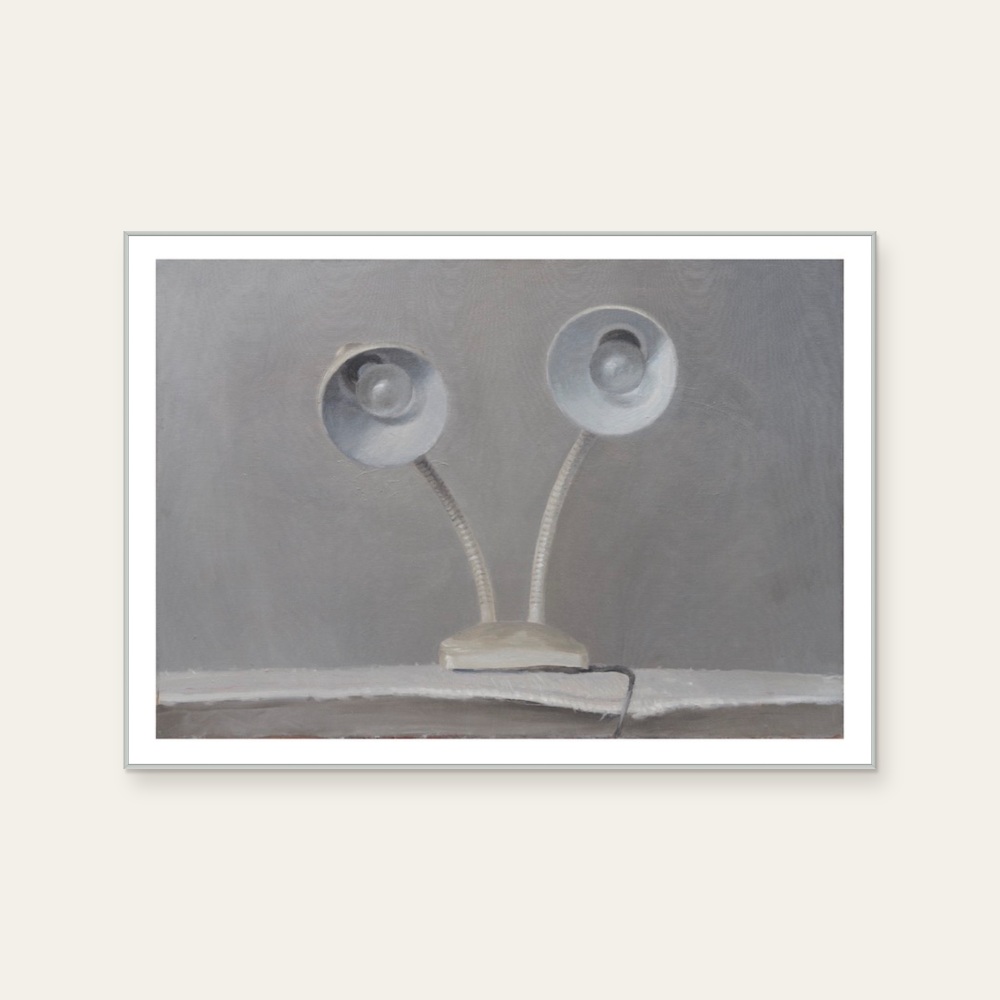
Although this painting appears to depict an ordinary old-fashioned double-headed desk lamp, it occupies a distinctive place in art history for several reasons:
1. The power of the ordinary
In the 1960s, many artists favored grand subjects, but Celmins took a different approach. She made the most unassuming everyday objects in her studio, including this lamp, a fan and a heater, the protagonists of her paintings. She sought to show that sustained, close observation could give even the most ordinary object a sacred, quiet power.
2. A refined aesthetic of gray
This painting reveals Celmins's fascination with gray. Rather than using bright colors, she employs subtle tonal shifts to capture the movement of light across the lamp's metal shades and flexible necks. This monochromatic treatment gives the work a sense of distance reminiscent of a dream or an old photograph.
3. An exercise in looking
This painting asks for sustained attention. Celmins's approach has been described as Deep Looking. She devotes considerable time to rendering every detail so that viewers, too, will pause and relearn how to observe an object's surface texture, weight and presence in space.
4. Restrained emotion and stillness
Although the lamp appears cool and impersonal, many critics see an underlying sense of solitude in her work. The compression of strong emotion into an exceptionally calm, realistic technique is one of its most compelling qualities.
Paper & medium
Poster / Glossy Paper
About the artist
Vija Celmins (born 1938) is a Latvian-American artist based in New York. She is known for her extremely detailed, realistic, and time-consuming depictions of natural phenomena such as the surface of the sea, the stars, the desert, and the surface of the moon.
1. Artistic style: reinterpreting reality
Vijay Selmin's work is often compared to “photorealism”, but she is more inclined to describe it as a “redescription” of reality. Rather than simply copying photographs, she transforms three-dimensional natural landscapes into pure structures and textures on a two-dimensional plane through an extremely focused, repetitive, and slow creative process.
2. Iconic theme: boundless nature
Since the late 1960s, she has focused on depicting natural phenomena that have “no horizon, no proportional reference point,” most notably the following series:
Oceans: Capture extremely subtle light and shadow changes in waves and undulations.
Night Skies: Depicts the depth, silence, and eternity of distant galaxies.
Webs: Linked creations like the one you provided. She was fascinated by the fragile and delicate properties of cobwebs, which are both natural products and abstract geometric lines, and explored the depth and plane tension of space.
Deserts and rocks: an almost paranoid depiction of the texture of the surface.
3. Creative techniques: working slowly
Selmin's output is not high, as everything takes a very long time to complete. She excels in the use of multiple media, and her mastery of each is at the top of her game:
Black and white aesthetics: Most of her work is presented in black, white, and grayscale, which allows the viewer to focus on the texture, level, and pure visual experience of the object without the interference of color.
Printmaking and sketching: She is highly accomplished in charcoal painting, pencil drawing, and various printmaking techniques such as Mezotint. She believes that different media give different “weights” to images.
4. Artistic status and viewing experience
Selmin is considered an “artist of artists,” and her work does not pursue grand narratives or intense emotional catharsis, but rather carries a meditative calm.
Zoom perspective: When viewing her work, the viewer often needs to constantly adjust the distance - from a distance, it looks like a real photo, and close-up, you will find countless small and powerful strokes and scratches.
Collection Records: Her work has been acquired by major museums around the world, including the Museum of Modern Art (MoMA) in New York, the Metropolitan Museum of Art (The Met), and the Tate Museum in London.
Conclusion
The art of Viya Selmin is an art of “observation.” She transforms vast universes, oceans, or tiny webs of cobwebs into a flat texture that can be gazed at and touched by her hands. If you appreciate the exquisite detail, the simple hue, and the serene atmosphere, her work is definitely worth exploring.