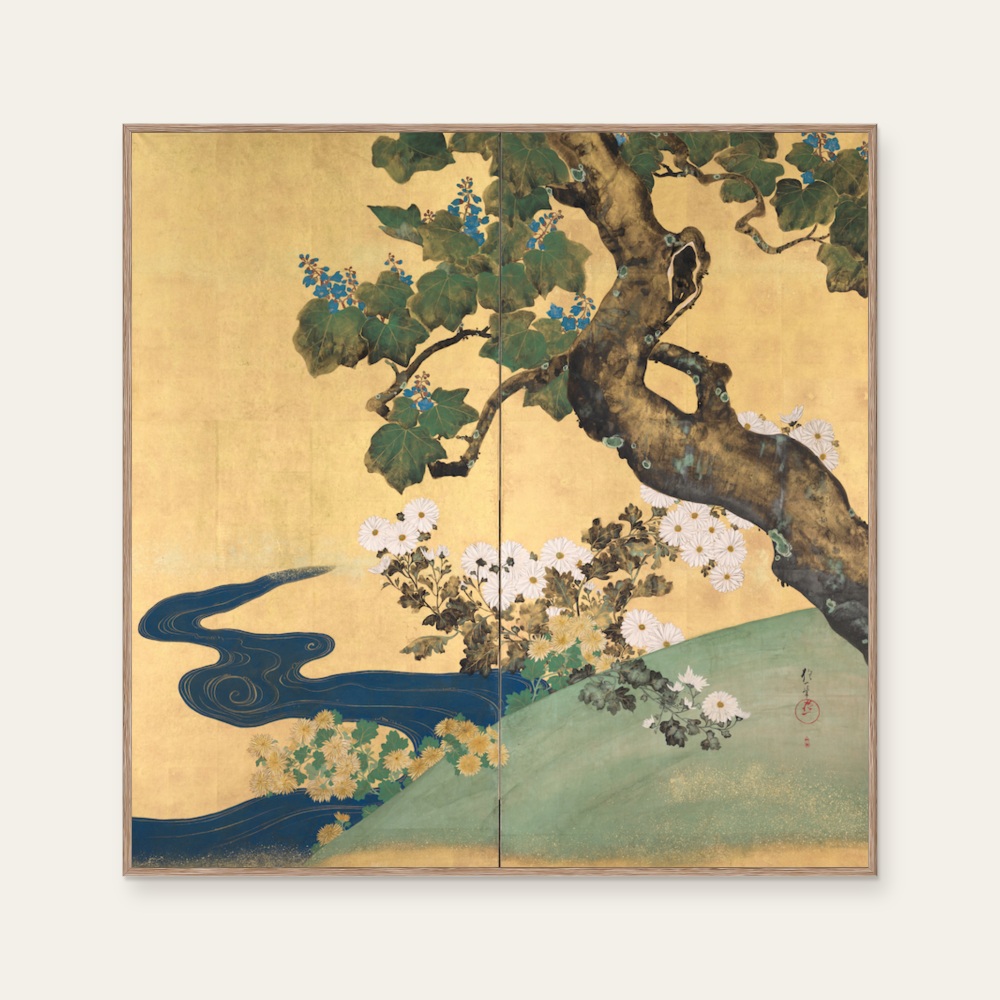
Rinpai | Hakuichi Sakai - Cassia and Chrysanthemum Flowing Water Screen
Rinpa School ↗From USD 50
- Subject
- Nature & Landscapes、Japanese Art
- Orientation
- Square
THE LIGHTO EDIT
Thoughtful works by artists near and far, chosen for the spaces we call home.
EXPLORE THE COLLECTIONMeet the artists and find the piece that feels like yours.
LIGHTO TO MEET YOUFIND YOUR POINT OF VIEW
Landscapes, abstract forms, and everyday beauty.
THE COLLECTION
Browse the works from LIGHTO's authorized artists.
No artworks match these filters. Try another color, subject, or orientation.
THE PEOPLE BEHIND THE ART
From established names to new perspectives, discover the makers in the LIGHTO collection.
From USD 50
| Size | Artwork only | With framing | Framing + acrylic |
|---|---|---|---|
| 40×40 cm | USD 50 | USD 110 | USD 123 |
| 60×60 cm | USD 90 | USD 176 | USD 206 |
| 50×50 cm | USD 83 | USD 163 | USD 186 |
At the end of the 18th century and the beginning of the 19th century, the Edo region (now Tokyo) began to popularize new Rinpoche-style works, and the most notable artist of this period was Sakai Hōitsu. Holding a childhood contact with the elegant literary and art world, leaning towards the art of Ogata Korin, and even compiled the first Korin painting collection "Korin Baitu", which made a great contribution to the subsequent development of the Lin school.
While inheriting Korin's elegant style, Sakai Hakuichi's works actively incorporate realistic depictions related to nature and seasonal changes. The "Summer and Autumn Sketch Screen" shows the flowers and flowers in the summer and autumn seasons and the cold and winding currents. Here, Bao Yi not only realistically depicts the characteristics of vegetation and water flow, but also delicately depicts the sense of nature generated by seasonal changes. These are not manifestations of Past Lin School paintings, but also innovations.
Together with Hajime Sakai, he revived the Zongda Kwanglin school of painters and his disciples, one of whom, Suzuki Kiitsu, is famous for his novel and unique style of painting. "Summer and Autumn Stream Diagram Screen" shows the vitality of nature: the golden plane is a coarse trunk, full of leaves suggesting vitality, scattered autumn leaves floating with the wind, and the water rushing through the chill... Suzuki's one of the works adds a little more natural interest to the richness of Linden School art, and at the same time proves that the Linden School painting style of this period has been quite different from the early days.
Giclée print / Metallic photo paper
The Rinpa school, also known as the "Korin school", is a modern school of plastic arts that emerged in the late Momoyama period in Japan. The first generation of Ben-Ami Koetsu (Ben-Ami Koetsu) and Tawaraya Soda laid down its style. The second generation of Ogata Korin and the Qianshan brothers created a large number of works to promote it. The third generation of Sakai Hugoichi not only continued its style, but also announced the compilation of predecessors' works to the world, allowing the "Lin school" to be recognized as a systematic genre in society. Relative to other Edo era schools such as the Kano School, the Maruyama School, and the Shijo School, the Rinpoche School learned painting skills directly from painters through imitation. The inheritance of the Rinpoche School does not matter the time, place, or status, and is a characteristic that other schools have not seen. Lam's influence on European impressionism, modern Japanese painting, and design has played a pivotal role in the history of Japanese art.
The four most representative craft painters in the Lin school, arranged according to the chronological order of their appearance, are Tawaraya Sonta, Ogata Korin, Sakai Hakuichi, and Kamisaka Yukiya. The four craft painters did not know each other or even met each other. Because the times they lived in were exactly one hundred years apart. In the history of Linpai, they represented a hundred years, or a century, respectively.