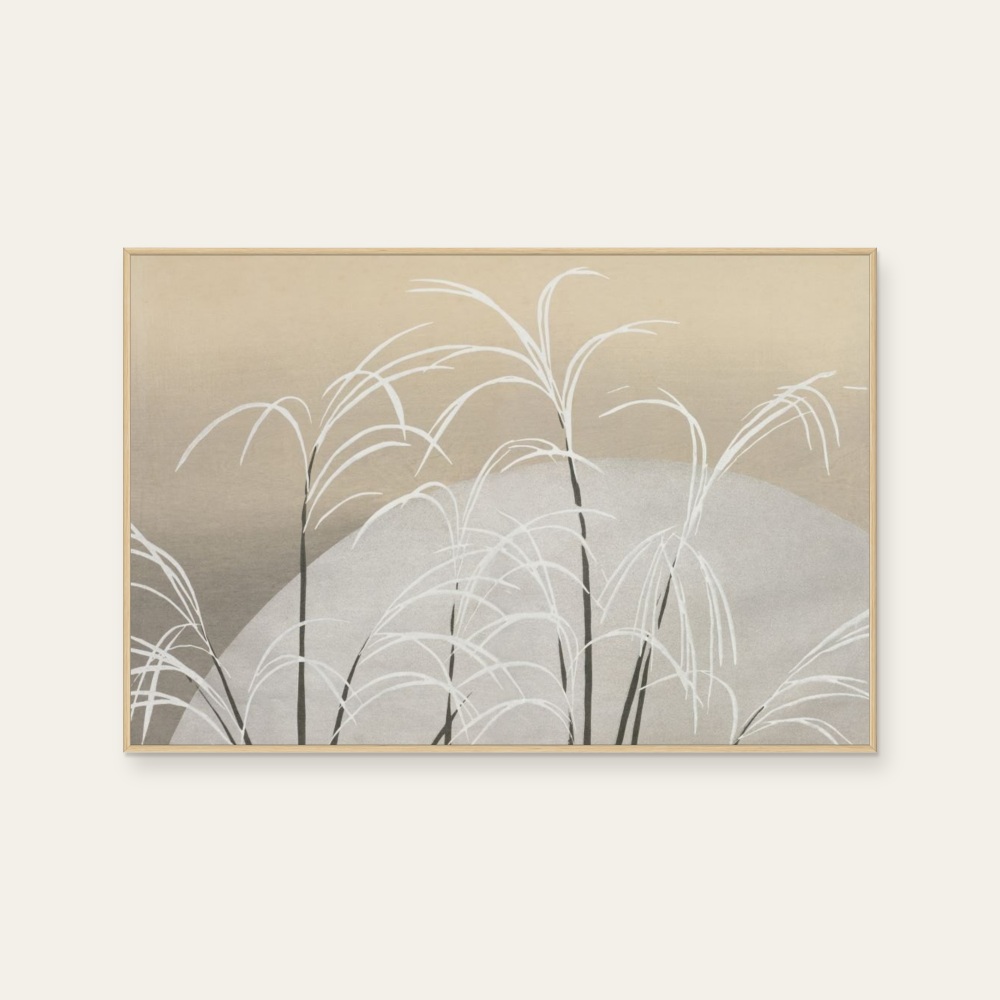
Rinpa | Kamisaka Sekka - Mt. Fuji
Rinpa School ↗From USD 43
- Color
- Grey、Cream & Brown
- Subject
- Nature & Landscapes、Japanese Art
- Orientation
- Landscape
THE LIGHTO EDIT
Thoughtful works by artists near and far, chosen for the spaces we call home.
EXPLORE THE COLLECTIONMeet the artists and find the piece that feels like yours.
LIGHTO TO MEET YOUFIND YOUR POINT OF VIEW
Landscapes, abstract forms, and everyday beauty.
THE COLLECTION
Browse the works from LIGHTO's authorized artists.
No artworks match these filters. Try another color, subject, or orientation.
THE PEOPLE BEHIND THE ART
From established names to new perspectives, discover the makers in the LIGHTO collection.
From USD 43
| Size | Artwork only | With framing | Framing + acrylic |
|---|---|---|---|
| 45×30 cm | USD 43 | USD 96 | USD 110 |
| 60×40 cm | USD 76 | USD 156 | USD 173 |
| 89×60 cm | USD 123 | USD 223 | USD 270 |
Kamisaka Sekka is considered the father of modern Japanese design. Born in Kyoto in 1866, he began studying painting at the age of 16. His visit to the Paris International Exposition in 1901 played a key role in his artistic career, which led to his in-depth study of modern European industrial design.
Sekka became a master of Japanese historical tradition, combining this traditional Japanese aesthetic with his own innovations to create stunning designs that are both modern and timeless. Characteristics of Linpai date back to the 17th century and include the use of brightly colored large planes to create flat pictorial spaces, abstract compositions, and the use of mica and gold and silver foil. Sekka's design incorporates traditional Rinpoche techniques and themes such as Japanese stories and natural scenes, as well as groundbreaking, more abstract compositions and bright aniline dyes.
"Hundred Worlds of Grass" is a woodblock print book published by Yukika Kamisaka (all three volumes), English name: World of a things
Giclée print / fine art etching paper
The Rinpa school, also known as the "Korin school", is a modern school of plastic arts that emerged in the late Momoyama period in Japan. The first generation of Ben-Ami Koetsu (Ben-Ami Koetsu) and Tawaraya Soda laid down its style. The second generation of Ogata Korin and the Qianshan brothers created a large number of works to promote it. The third generation of Sakai Hugoichi not only continued its style, but also announced the compilation of predecessors' works to the world, allowing the "Lin school" to be recognized as a systematic genre in society. Relative to other Edo era schools such as the Kano School, the Maruyama School, and the Shijo School, the Rinpoche School learned painting skills directly from painters through imitation. The inheritance of the Rinpoche School does not matter the time, place, or status, and is a characteristic that other schools have not seen. Lam's influence on European impressionism, modern Japanese painting, and design has played a pivotal role in the history of Japanese art.
The four most representative craft painters in the Lin school, arranged according to the chronological order of their appearance, are Tawaraya Sonta, Ogata Korin, Sakai Hakuichi, and Kamisaka Yukiya. The four craft painters did not know each other or even met each other. Because the times they lived in were exactly one hundred years apart. In the history of Linpai, they represented a hundred years, or a century, respectively.