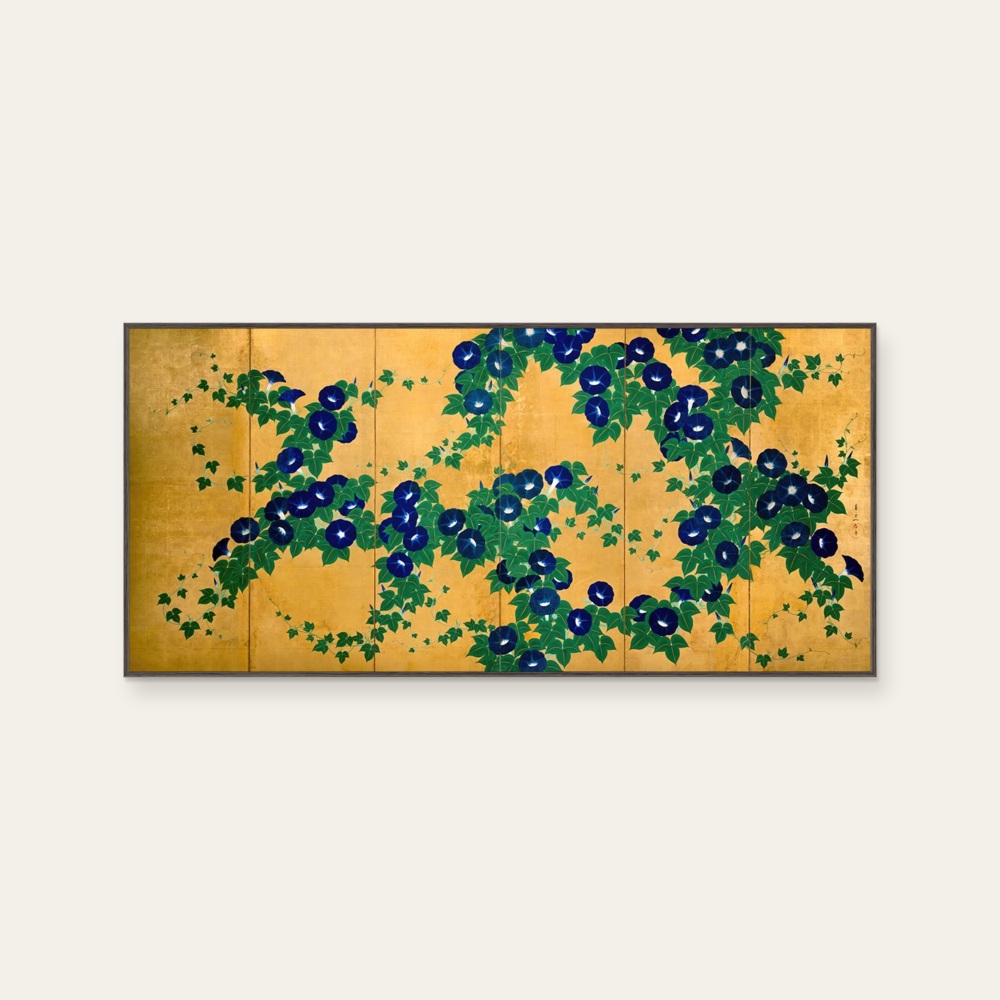
Rinpa | Suzuki Kiitsu- Morning Glory(L)
Rinpa School ↗From USD 56
- Color
- Red & Orange、Green
- Subject
- Nature & Landscapes、Japanese Art
- Orientation
- Landscape
THE LIGHTO EDIT
Thoughtful works by artists near and far, chosen for the spaces we call home.
EXPLORE THE COLLECTIONMeet the artists and find the piece that feels like yours.
LIGHTO TO MEET YOUFIND YOUR POINT OF VIEW
Landscapes, abstract forms, and everyday beauty.
THE COLLECTION
Browse the works from LIGHTO's authorized artists.
No artworks match these filters. Try another color, subject, or orientation.
THE PEOPLE BEHIND THE ART
From established names to new perspectives, discover the makers in the LIGHTO collection.
From USD 56
| Size | Artwork only | With framing | Framing + acrylic |
|---|---|---|---|
| 60×30 cm | USD 56 | USD 123 | USD 136 |
| 80×40 cm | USD 90 | USD 176 | USD 210 |
| 100×50 cm | USD 116 | USD 216 | USD 266 |
| 120×60 cm | USD 160 | USD 296 | USD 363 |
From the late eighteenth to the early nineteenth century, a new Rinpa style became popular in Edo, now Tokyo. Its most prominent artist was Sakai Hōitsu. Introduced to the refined worlds of literature and art from childhood, Hōitsu became deeply devoted to the work of Ogata Kōrin. He even compiled the first collection of Kōrin's paintings, One Hundred Paintings by Kōrin, making a major contribution to the continued development of Rinpa.
While inheriting Kōrin's elegant style, Sakai Hōitsu actively incorporated realistic depictions of nature and seasonal change. His screen Summer and Autumn Grasses presents flowers and grasses from both seasons alongside a cool, winding flow of water. In addition to depicting the vegetation and water realistically, he sensitively conveys the feeling of nature as the seasons change—an innovative approach not seen in earlier Rinpa painting.
Hōitsu's pupils also helped revive the Sōtatsu–Kōrin tradition. Among them, Suzuki Kiitsu became known for his fresh and distinctive style. His screen Summer and Autumn Streams reveals nature's vitality: rough-textured tree trunks against a gold ground, abundant foliage suggesting vigorous growth, scattered autumn leaves drifting in the wind, and a rushing stream carrying a hint of cold. Kiitsu added a more natural playfulness to Rinpa's splendour, while demonstrating how far the style of this period had developed from its earlier forms.
What is Rinpa?
Rinpa, also known as the Kōrin school, is a Japanese school of visual art that emerged in the late Momoyama period and remained active into modern times. Hon'ami Kōetsu and Tawaraya Sōtatsu established its early style. In the second generation, the brothers Ogata Kōrin and Ogata Kenzan developed it through a substantial body of work. In the third generation, Sakai Hōitsu both continued the tradition and compiled and published the work of his predecessors, helping Rinpa become recognised as a coherent school. Unlike Edo-period schools such as Kanō and Maruyama–Shijō, whose artists learned directly from masters through copying, Rinpa's transmission crossed differences in time, place and social status. Rinpa has had a considerable influence on European Impressionism, modern Japanese painting and design, and holds an important place in Japanese art history.
Four especially representative painter-craftsmen associated with Rinpa, in chronological order, are Tawaraya Sōtatsu, Ogata Kōrin, Sakai Hōitsu and Kamisaka Sekka. They did not know one another and never met: their lives were separated by roughly a hundred years. Each represents a century in the history of Rinpa's development.
Giclée print / Metallic photo paper
The Rinpa school, also known as the "Korin school", is a modern school of plastic arts that emerged in the late Momoyama period in Japan. The first generation of Ben-Ami Koetsu (Ben-Ami Koetsu) and Tawaraya Soda laid down its style. The second generation of Ogata Korin and the Qianshan brothers created a large number of works to promote it. The third generation of Sakai Hugoichi not only continued its style, but also announced the compilation of predecessors' works to the world, allowing the "Lin school" to be recognized as a systematic genre in society. Relative to other Edo era schools such as the Kano School, the Maruyama School, and the Shijo School, the Rinpoche School learned painting skills directly from painters through imitation. The inheritance of the Rinpoche School does not matter the time, place, or status, and is a characteristic that other schools have not seen. Lam's influence on European impressionism, modern Japanese painting, and design has played a pivotal role in the history of Japanese art.
The four most representative craft painters in the Lin school, arranged according to the chronological order of their appearance, are Tawaraya Sonta, Ogata Korin, Sakai Hakuichi, and Kamisaka Yukiya. The four craft painters did not know each other or even met each other. Because the times they lived in were exactly one hundred years apart. In the history of Linpai, they represented a hundred years, or a century, respectively.