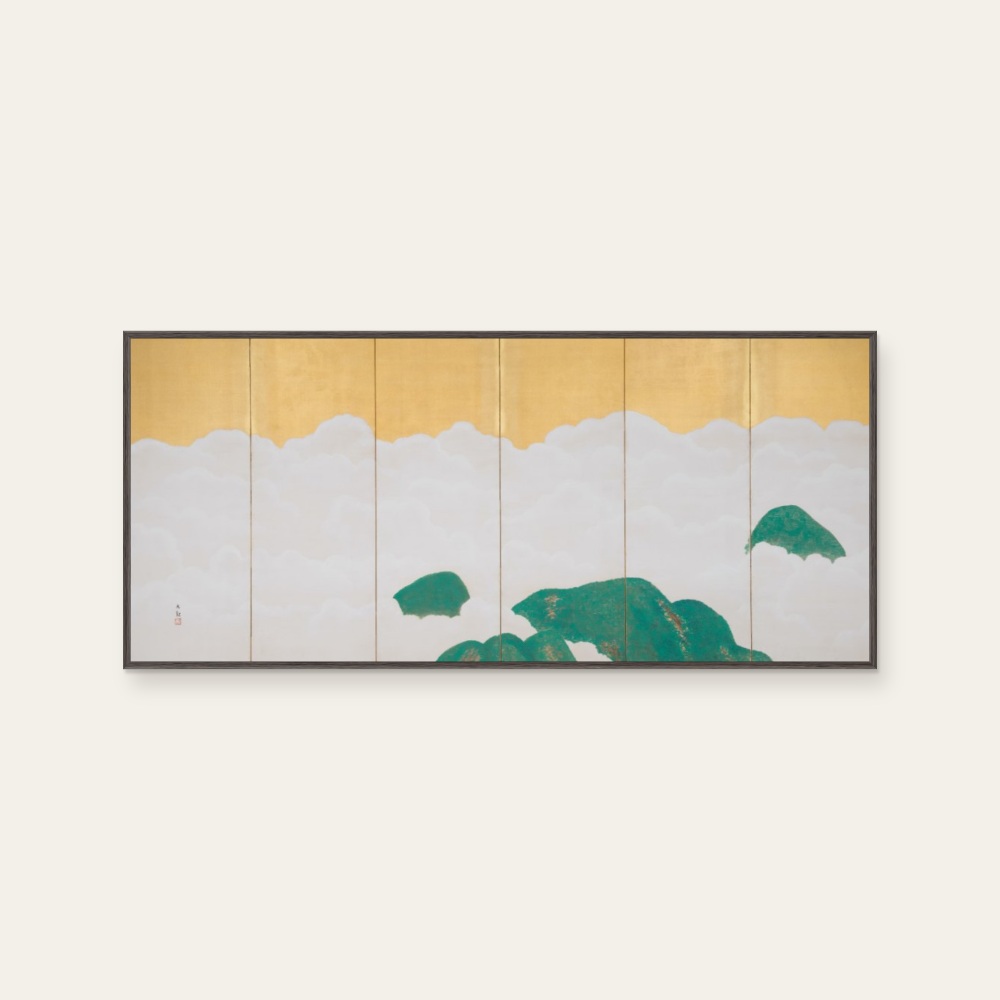
Rinpa | Gunjo Fuji (L)
Rinpa School ↗From USD 63
- Color
- Black & White、Green
- Subject
- Nature & Landscapes、Japanese Art
- Orientation
- Landscape
THE LIGHTO EDIT
Thoughtful works by artists near and far, chosen for the spaces we call home.
EXPLORE THE COLLECTIONMeet the artists and find the piece that feels like yours.
LIGHTO TO MEET YOUFIND YOUR POINT OF VIEW
Landscapes, abstract forms, and everyday beauty.
THE COLLECTION
Browse the works from LIGHTO's authorized artists.
No artworks match these filters. Try another color, subject, or orientation.
THE PEOPLE BEHIND THE ART
From established names to new perspectives, discover the makers in the LIGHTO collection.
From USD 63
| Size | Artwork only | With framing | Framing + acrylic |
|---|---|---|---|
| 67×30 cm | USD 63 | USD 130 | USD 150 |
| 90×40.3 cm | USD 96 | USD 190 | USD 230 |
| 120×53.73 cm | USD 146 | USD 268 | USD 330 |
Yokoyama Taikan (1868-1958) was a taito and spiritual leader in the modern Japanese art world. Spanning the Meiji, Taisho and Showa eras, he devoted his life to the modernization and innovation of traditional Japanese painting, and co-founded the "Japan Art Academy" with the thinker Tenshin Okakura. He was not only one of the first recipients of the Order of Japanese Culture, but also respected as Japan's "national painter".
🎨 Core Artistic Achievement: Bold Disconnect "Ambiguity"
In late 19th-century Japan, traditional schools of painting, such as the Kano School, were extremely focused on sharp, sharp silhouettes. However, Yokoyama Daikan and companion Harukusa Hishikawa believe that the real scenery is full of air, light, and moisture, which cannot be expressed with hard wires.
They boldly “take off the lines” and simply use dense color dyeing and the dense ink to stack out the shape of the object. This painting method was criticized and ridiculed by traditional conservatives at that time, and was called "Mōrōtai" (meaning a semi-finished product like a fog). However, Daikan Yokoyama did not compromise, and this technique eventually succeeded in breaking down the barriers between traditional Japanese painting and Western impressionism and light and shadow methods, becoming the most important turning point in the history of modern Japanese art.
🏔️ Lifelong Favorite Theme: "Mt. Fuji in the Big View"
Yokoyama Daikan painted more than 1,500 works with the theme of "Mt. Fuji" in his lifetime, and even has the reputation of "Fuji of Daikan" in the art world.
For him, Mt. Fuji is not only a mountain, but also a symbol of Japanese ethos and “eternity”. His Mt. Fuji is ever-changing:
• “Qunqing Fuji”: Abandon the stereotype of traditional snowflakes and show the grandeur and spirituality of the mountain in a deep and mysterious blue (Qunqing).
• “Spiritual Peaks”: “Buckwheat Powder” made with ink and seashells, depicting the sacred gesture of the summit of Mt. Fuji looming between the clouds.
🍶 Curious life anecdote: "Wine Immortal Grand View"
In addition to his extraordinary achievements in art, Daikan Yokoyama is also a legendary "wine immortal" in life.
When he was young, he was rumored to drink up to 2 liters (about 3.6 liters) of Japanese liquor a day. What's even more amazing is that he barely eats rice, big fish and meat on a daily basis. The only source of heat and inspiration is liquor, and only accompanied by a small amount of sea urchins, dried fish, fruits and other liquor. His wife once quipped that he "lived like a yellow eagle, eating only food and not food", but he still lived to the age of 89, which was enough to see his energy.
Giclée print / fine art etching paper
The Rinpa school, also known as the "Korin school", is a modern school of plastic arts that emerged in the late Momoyama period in Japan. The first generation of Ben-Ami Koetsu (Ben-Ami Koetsu) and Tawaraya Soda laid down its style. The second generation of Ogata Korin and the Qianshan brothers created a large number of works to promote it. The third generation of Sakai Hugoichi not only continued its style, but also announced the compilation of predecessors' works to the world, allowing the "Lin school" to be recognized as a systematic genre in society. Relative to other Edo era schools such as the Kano School, the Maruyama School, and the Shijo School, the Rinpoche School learned painting skills directly from painters through imitation. The inheritance of the Rinpoche School does not matter the time, place, or status, and is a characteristic that other schools have not seen. Lam's influence on European impressionism, modern Japanese painting, and design has played a pivotal role in the history of Japanese art.
The four most representative craft painters in the Lin school, arranged according to the chronological order of their appearance, are Tawaraya Sonta, Ogata Korin, Sakai Hakuichi, and Kamisaka Yukiya. The four craft painters did not know each other or even met each other. Because the times they lived in were exactly one hundred years apart. In the history of Linpai, they represented a hundred years, or a century, respectively.