THE LIGHTO EDIT
A little art
changes everything.
Thoughtful works by artists near and far, chosen for the spaces we call home.
EXPLORE THE COLLECTIONMeet the artists and find the piece that feels like yours.
LIGHTO TO MEET YOUFIND YOUR POINT OF VIEW
A place to begin.
Landscapes, abstract forms, and everyday beauty.
THE COLLECTION
Art to live with
Browse the works from LIGHTO's authorized artists.
No artworks match these filters. Try another color, subject, or orientation.
THE PEOPLE BEHIND THE ART
Meet the artists
From established names to new perspectives, discover the makers in the LIGHTO collection.
Sizes & prices
| Size | With framing | Framing + acrylic |
|---|---|---|
| 100×75 cm | USD 276 | USD 303 |
Product details
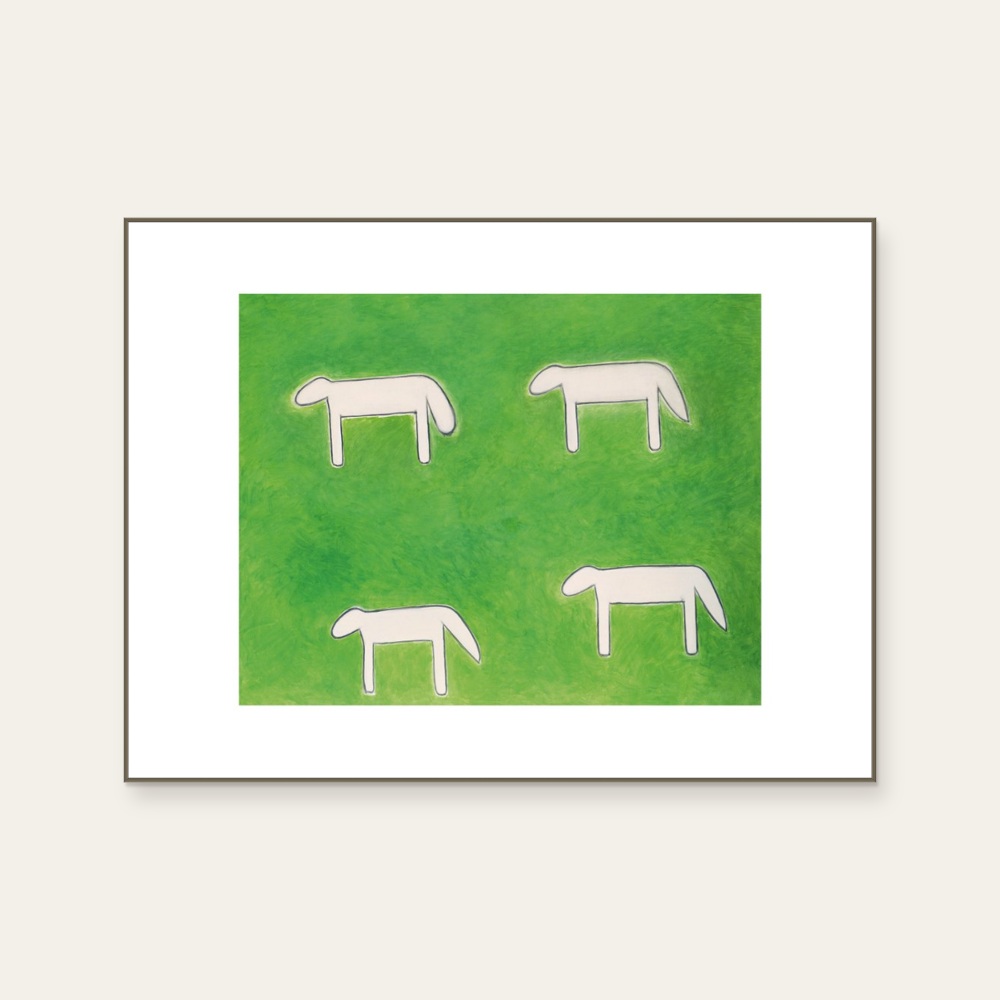
Title: Four Sheep
Poster size: 75 x 100 cm
Gallery original poster
Paper & medium
Poster / Matte Paper
About the artist
Peter Kinley
Peter Kinley (1926-1988) was a painter of near-abstract landscapes and figures.
Moving to the UK in the late 1930s, he held a retrospective exhibition at the Oxford Museum of Modern Art in 1982, and a solo exhibition and touring performance at Kettle's Yard Gallery in Cambridge in 1986. Kinley's work is in public collections, including the Tate.
Born in Vienna, he came to England in 1938 with a Jewish father and was forced to leave the country in 1938. He was sent to St. Anne's School in Latham, where he was raised by a Catholic family; his parents interned in France. Kingley served in the army from 1944-8, then studied at the Düsseldorf Academy from 1948-9 and at the Sint Maarten School of Art from 1949-53. He was exhibited in the exhibition “Six Contemporary Youth” at Gimpel Fils in 1951 and 1953, and was influenced by the exhibition de Staël in London in 1953. Kinley's first solo exhibition was at Gimpel Fils in London and Paul in New York in January 1961, Rosenberg & Co.
He studied at Düsseldorf College and later at St. Martin's College of Art, where he taught, and in the early 1960s his knowledge of Islamic art and architecture led to an interest in other Eastern cultures, especially Indian culture. He began to collect Indian paintings and handicrafts, and India's system of colors and compositions was consistent with his own exploration of a language in which objects (people, houses, planes) could be expressed with all the clarity of an image without losing subtlety. His work was published in Mary Chamot, Dennis Farr and Martin Butlin, “Modern British Painting, Drawing and Sculpture”, London 1964. He left London to teach at Bath College in 1970, and his work began to reflect more on his country life. He considered his work to be figurative, not realistic or naturalistic in the 19th-century sense, but based on observations of the subject. Kingley died in September 1988.