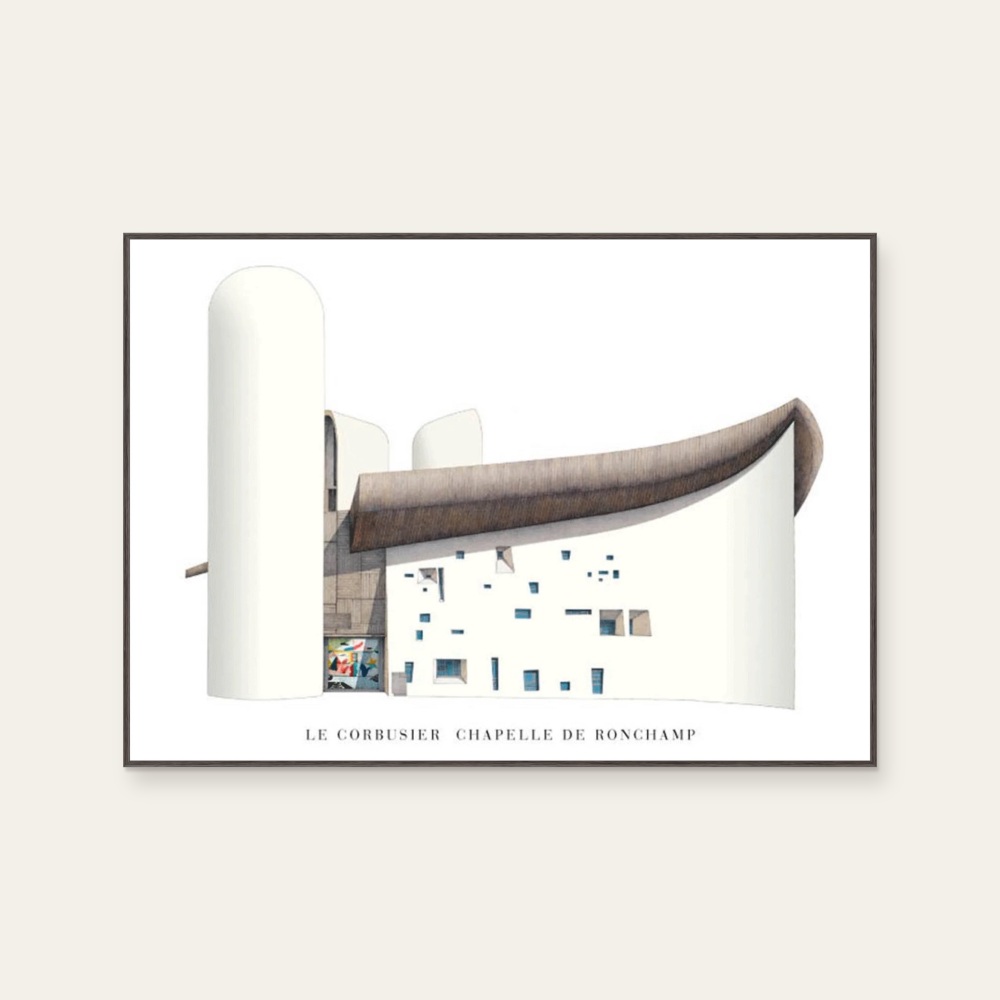
Chapelle de Ronchamp (Chapelle Notre-Dame du Haut)
Le Corbusier ↗From USD 190
- Color
- Grey、Cream & Brown
- Subject
- Architecture & Objects
- Orientation
- Landscape
THE LIGHTO EDIT
Thoughtful works by artists near and far, chosen for the spaces we call home.
EXPLORE THE COLLECTIONMeet the artists and find the piece that feels like yours.
LIGHTO TO MEET YOUFIND YOUR POINT OF VIEW
Landscapes, abstract forms, and everyday beauty.
THE COLLECTION
Browse the works from LIGHTO's authorized artists.
No artworks match these filters. Try another color, subject, or orientation.
THE PEOPLE BEHIND THE ART
From established names to new perspectives, discover the makers in the LIGHTO collection.
From USD 190
| Size | With framing | Framing + acrylic |
|---|---|---|
| 70×50 cm | USD 190 | USD 223 |
Introduction to the work and building: Notre-Dame du Haut chapel
Chapelle Notre-Dame-du-Haut stands on the hill of Bourlémont in Ronchamp, France. Le Corbusier paid particular attention to the landscape and sightlines, making the building seem to grow out of the hill. The official World Heritage description notes its asymmetrical plan and the crab-shell-like roof resting above curved walls. It has neither the side aisles nor the cruciform plan commonly found in traditional churches, yet it still faces east.
Its most compelling features are its thick walls, curved roof, light and sense of stillness. The exterior resembles a white sculpture, while the roof appears as a heavy but floating dark shell. Windows of different sizes admit light in highly irregular, almost mysterious ways. Fondation Le Corbusier also notes the use of materials including exposed concrete, painted render, wood, cast iron and bronze, with colored glass and light creating a distinctive atmosphere.
Poster / Glossy Paper
Artist and architect introduction: Le Corbusier
Le Corbusier was born Charles-Édouard Jeanneret-Gris in La Chaux-de-Fonds, Switzerland, in 1887, and began using the name Le Corbusier after 1920. Alongside architecture, he produced paintings, sculptures, tapestries and furniture, and wrote extensively on architecture and urban theory. The official World Heritage website notes that he became internationally known as an architect and urban planner despite having no formal degree in either discipline.
He was one of the most important figures in twentieth-century modern architecture. His early work is often associated with rationality, geometry, white houses and functionalism, as exemplified by Villa Savoye. At Ronchamp, however, his architectural language became freer, more massive and more sculptural. This is what makes the chapel distinctive: it brings spirituality, emotion and spatial poetry to modern architecture.