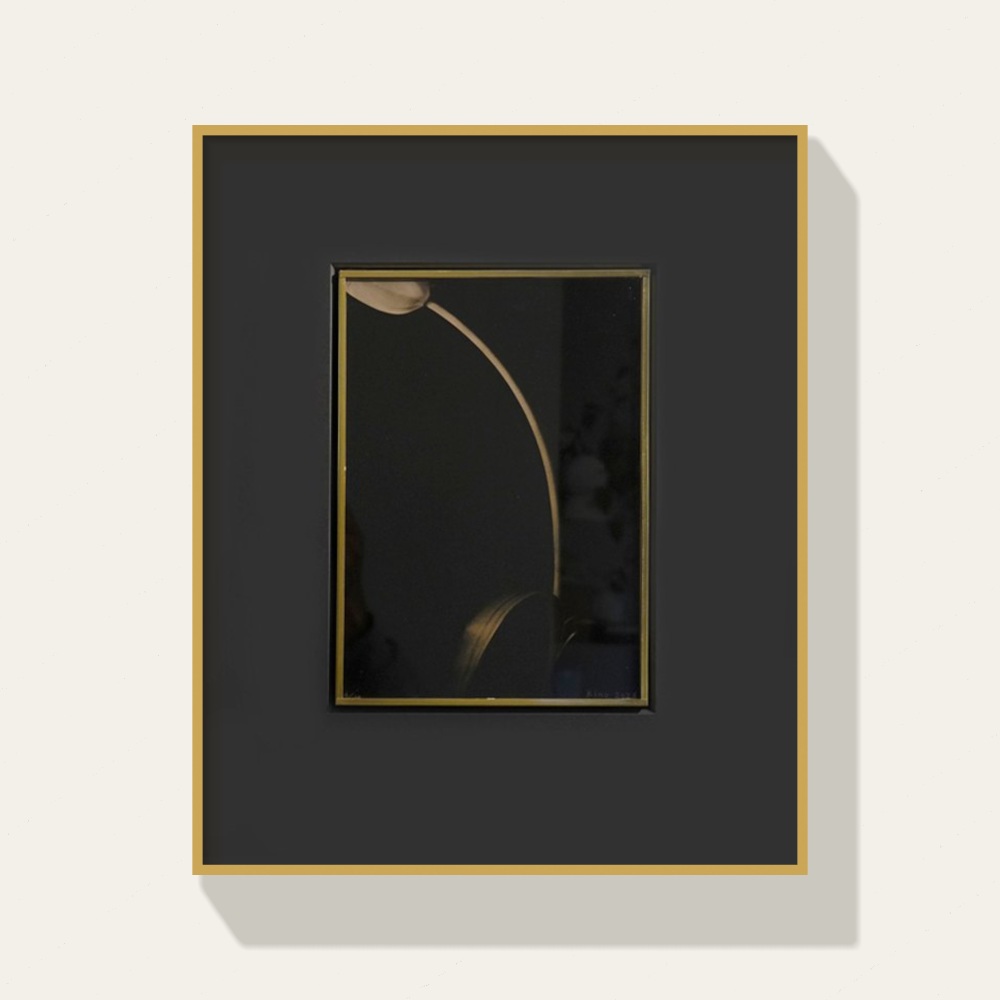
Technique: wet-plate photography.
This work is limited to an edition of ten prints.
.
Artwork details:
Technique: glass wet-plate collodion (Ambrotype)
Size: 181 × 254 mm
Matboard size: 356 × 432mm
The glass is secured in a handmade copper frame, with low-reflection black velvet underneath.
Please note:
Every wet-plate photographic work by Kino Koike is unique. Even when the same image is used, each piece will look different. The process varies with the chemical formula, the weather, temperature and humidity on the day, the way the liquids are applied, how the developer is poured, body temperature and hand movements. Even with the same technique, works in different editions will differ. Dust may also become part of the image. We hope you will appreciate its uniqueness.
.
Artwork title: Tulip curve
Currently available edition: 8 / 10
Prices (NT$) vary by edition number:
Edition 8, 32800.-
Edition 9, 44000.-
Edition 10, 66000.-
.
Concept:
We may be able to see light and shadow, yet we may not be able to capture that intangible sense of “breath.”
Yet that shiver-inducing feeling sometimes reveals itself vividly in certain two-dimensional images.
To capture and express this mysterious “breath,” I point my camera at the scenes before me and continue to record them.
I chose wet-plate photography as the medium for these records. This technique creates unique images that cannot be replicated.
For this work, I carry out every step by hand, from preparing the chemicals and making the exposure to constructing the display frame.
The maturity of the chemicals, the way they are applied, the flow of the developer and even my body temperature affect each work, producing unique textures and variations that prevent the same image from being recreated.
These images, as vivid as living things, seem to merge the “breath” between me and my subjects.
The images in this collection were printed from scans of wet-plate glass with a black cloth as the background. In the solo exhibition, however, I displayed the actual wet-plate glass works as ambrotypes.
Changes in the exhibition lighting or natural light alter the tones and density of the images, bringing their appearance to life.
To see the images more clearly, viewers must adjust their posture and viewing angle. This intention and act of looking, and the thoughts they evoke, give life to the still images within the glass.
If you have the opportunity, I hope you will see the actual works in person and experience their distinctive appeal.
Wet-plate photography is a photographic printing technique invented in 1851 by the Englishman Frederick Scott Archer.
The process involves coating a glass plate with a thin film of collodion mixed with iodides or bromides, then immersing it in a silver nitrate solution to make it light-sensitive. The plate is photographed (exposed) while still wet. It must then be developed and fixed immediately to remove excess silver and produce the image.
Because wet plates have very low sensitivity, exposure usually takes several seconds to several minutes.
The silver image on the glass appears as a negative when viewed by transmitted light. When black cloth is placed behind it, the image appears as a positive. This way of viewing the image is known as an ambrotype.
Wet-plate photography reached Japan in the late Edo period. Photographs of Sakamoto Ryoma and Hijikata Toshizo were made using this technique.
For Light and Breath, the subjects are photographed with a modern film or digital camera to create negatives. These negatives are then used in the darkroom to expose images onto wet-plate glass. This slightly modified technique differs from traditional wet-plate photography, in which the wet plate is exposed directly in the camera, and brings together traditional and modern methods.