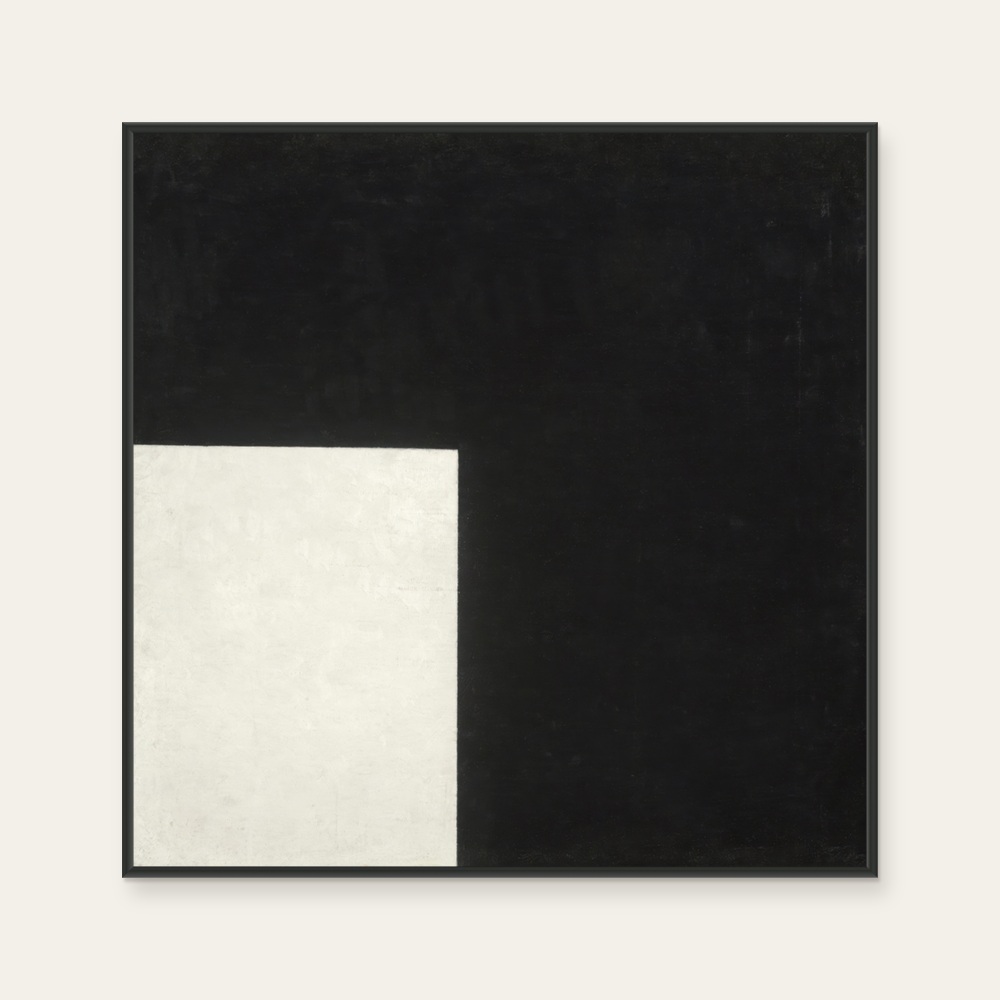
Black and White. Suprematist Composition, 1915
Kazimir Malevich ↗From USD 36
- Color
- Black & White
- Subject
- Abstract & Line Art
- Orientation
- Square
THE LIGHTO EDIT
Thoughtful works by artists near and far, chosen for the spaces we call home.
EXPLORE THE COLLECTIONMeet the artists and find the piece that feels like yours.
LIGHTO TO MEET YOUFIND YOUR POINT OF VIEW
Landscapes, abstract forms, and everyday beauty.
THE COLLECTION
Browse the works from LIGHTO's authorized artists.
No artworks match these filters. Try another color, subject, or orientation.
THE PEOPLE BEHIND THE ART
From established names to new perspectives, discover the makers in the LIGHTO collection.
From USD 36
| Size | Artwork only | With framing | Framing + acrylic |
|---|---|---|---|
| 30×30 cm | USD 36 | USD 83 | USD 93 |
| 40×40 cm | USD 43 | USD 96 | USD 110 |
| 45×45 cm | USD 63 | USD 130 | USD 150 |
| 60×60 cm | USD 90 | USD 176 | USD 203 |
Printing paper: giclée print on etching fine art paper.
* Photographic paper only: ships in 3–5 business days.
* The mounting and framing process is time-consuming and labor-intensive. Please allow 2–3 weeks for your order and thank you for your patience.
Black and White. Suprematist Composition, 1915 / Kazimir Malevich
Artwork dimensions: Medium 40x40 cm / Large 60x60 cm
* Please message us to discuss other sizes.
【Artwork Introduction】Black and White: Suprematist Composition, 1915 — The Zero Point of Painting
Created in 1915, Black and White. Suprematist Composition was a central experiment for Kazimir Malevich during the period when he was defining Suprematism. In that revolutionary year, he broke completely with traditional figurative art, reducing his visual language to the utmost essentials of black and white.
Philosophical meaning: The black rectangle represents “pure feeling,” while the white background symbolizes “the infinite void.” The visual gravity generated between them on a two-dimensional plane makes the geometric form appear to float in a weightless universe.
Craftsmanship: This piece uses high-quality giclée printing to faithfully reproduce the deep tonal layers of black and the purity of white in the original. The texture of the canvas or paper delicately captures Malevich’s rigorous attention to geometric proportions, making it an ideal collectible for lovers of minimalism and modern design spaces.
【Artist Introduction】Kazimir Malevich (1879–1935)
Malevich was a leading figure of the Russian avant-garde and the founder of Suprematism. He argued that art should free itself from dependence on the real world and pursue “the supremacy of pure feeling.” Boldly abandoning depictions of landscapes and figures, he reduced painting to basic geometric forms such as squares and circles, earning him the title “father of modern abstract art.”
His radical ideas, such as Black Square (1915), completely changed the course of 20th-century art, directly inspiring the later Bauhaus movement, Minimalism, and contemporary geometric design. This work in the collection of Sweden’s Moderna Museet is a representative testament to his move toward bringing painting into “zero-degree space” and holds exceptional scholarly value and historical importance in art history.
Giclée print / fine art etching paper
Malevich was a leading figure of the Russian avant-garde and the founder of Suprematism. He is widely regarded as one of the most radical pioneers of 20th-century abstract art. He completely dismantled the traditions of perspective and narrative that had dominated art since the Renaissance, arguing that art should not serve religion or the state, nor should it record history, but should exist independently.
His best-known theory asserts “the supremacy of pure feeling or perception in art.” By reducing art to the most basic geometric shapes—such as squares, circles, and crosses—he dramatically changed the course of modern art. His signature work Black Square is considered a turning point in art history, while his ideas profoundly influenced later Minimalism, the Bauhaus movement, and modern architecture and design, laying a fundamental foundation for contemporary aesthetics.