

THE LIGHTO EDIT
A little art
changes everything.
Thoughtful works by artists near and far, chosen for the spaces we call home.
EXPLORE THE COLLECTIONMeet the artists and find the piece that feels like yours.
LIGHTO TO MEET YOUFIND YOUR POINT OF VIEW
A place to begin.
Landscapes, abstract forms, and everyday beauty.
THE COLLECTION
Art to live with
Browse the works from LIGHTO's authorized artists.
No artworks match these filters. Try another color, subject, or orientation.
THE PEOPLE BEHIND THE ART
Meet the artists
From established names to new perspectives, discover the makers in the LIGHTO collection.
Sizes & prices
| Size | Artwork only | With framing | Framing + acrylic |
|---|---|---|---|
| 40×40 cm | USD 43 | USD 96 | USD 110 |
| 60×60 cm | USD 90 | USD 176 | USD 203 |
Product details
Printing paper: giclée print on etching fine art paper.
* Photographic paper only: ships in 3–5 business days.
* The mounting and framing process is time-consuming and labor-intensive. Please allow 2–3 weeks for your order and thank you for your patience.
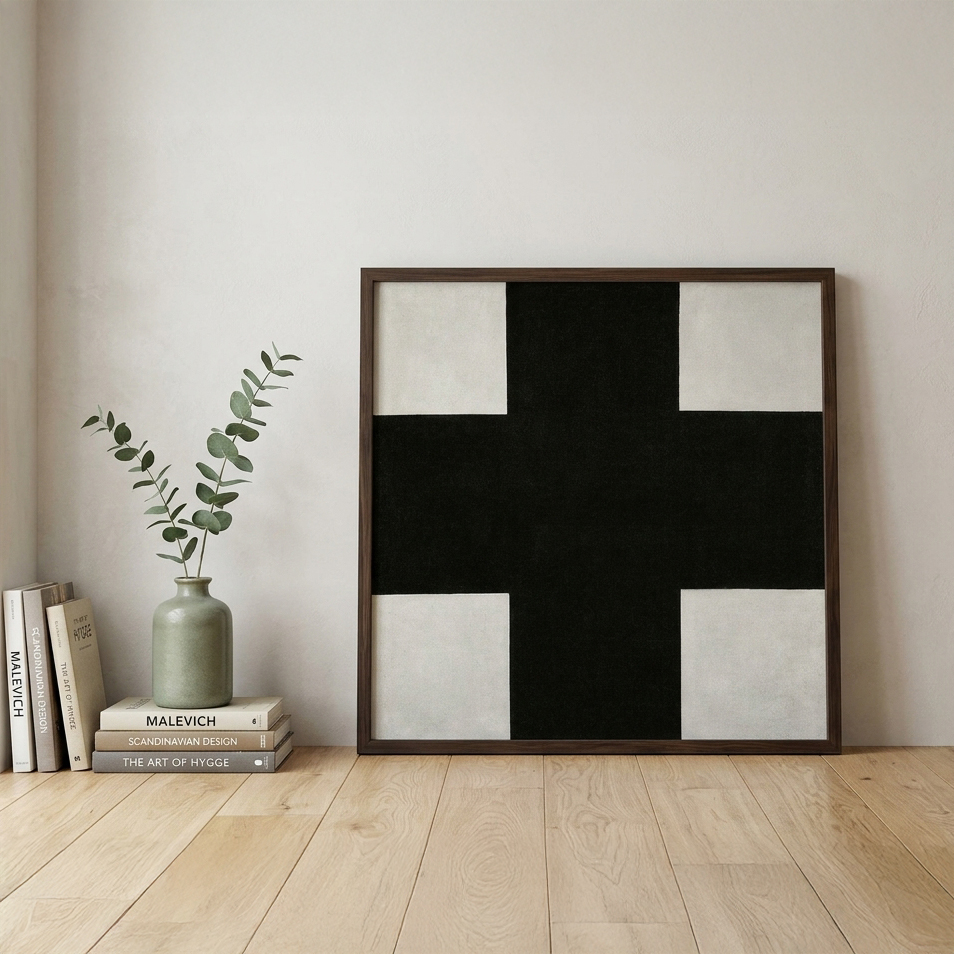
Black Cross, 1923 / Kazimir Malevich
Artwork dimensions: Medium 40x40 cm / Large 60x60 cm
* Please message us to discuss other sizes.
This work is Black Cross, created by Kazimir Malevich in 1923.
Together with Black Square and Black Circle, this work forms the three central geometric icons of Suprematism. Such works do not depict religious symbols; they are radical explorations of form and space.
Here is a detailed introduction to this work:
【Artwork Introduction】Black Cross, 1923 — The Pure Tension of Form
One of three major motifs: If the square is the starting point of Suprematism and the circle expresses movement, the cross represents the intersection of horizontal and vertical energies. It results from cutting apart and recombining the square.
Nonreligious absolute abstraction: Although the shape resembles a religious symbol, Malevich emphasized that it is a “non-objective” geometric form. The four arms of the cross extend to the edges of the picture, breaking with the centered composition of traditional painting and generating an outward-expanding energy.
Visual tension: The enormous black cross contrasts sharply with the white void of the background. This extreme simplification is intended to evoke “pure emotion” in the viewer. In this giclée work, you can observe the almost absolute spatial tension between the black areas and the white field.
【Artist Introduction】Kazimir Malevich (1879–1935)
Malevich was a leading figure of the Russian avant-garde and the founder of Suprematism. He argued that art should free itself from dependence on the real world and pursue “the supremacy of pure feeling.” Boldly abandoning depictions of landscapes and figures, he reduced painting to basic geometric forms such as squares and circles, earning him the title “father of modern abstract art.”
His radical ideas, such as Black Square (1915), completely changed the course of 20th-century art, directly inspiring the later Bauhaus movement, Minimalism, and contemporary geometric design. This work in the collection of Sweden’s Moderna Museet is a representative testament to his move toward bringing painting into “zero-degree space” and holds exceptional scholarly value and historical importance in art history.
Paper & medium
Fine art print on etching paper.
About the artist
Malevich was a leading figure of the Russian avant-garde and the founder of Suprematism. He is widely regarded as one of the most radical pioneers of 20th-century abstract art. He completely dismantled the traditions of perspective and narrative that had dominated art since the Renaissance, arguing that art should not serve religion or the state, nor should it record history, but should exist independently.
His best-known theory asserts “the supremacy of pure feeling or perception in art.” By reducing art to the most basic geometric shapes—such as squares, circles, and crosses—he dramatically changed the course of modern art. His signature work Black Square is considered a turning point in art history, while his ideas profoundly influenced later Minimalism, the Bauhaus movement, and modern architecture and design, laying a fundamental foundation for contemporary aesthetics.
【Recommendations for Purchasing This Work from Lighto】
This work is especially well suited to modern, minimalist, or industrial-style interiors:
Visual focal point: The large circular form has a strong visual presence, making it ideal as the focal point of an entryway or living room.
Lightbox effect: Because Lighto’s products often incorporate lightbox technology, when the backlight behind “Black Circle” is illuminated, the “black-and-white contrast” at its edges becomes sharper, while the white “sense of emptiness” is transformed into light and shadow, deepening the profound beauty of “floating in the universe.”
This is more than a decorative object; it is a classic conversation piece about the “aesthetics of subtraction.”