

THE LIGHTO EDIT
A little art
changes everything.
Thoughtful works by artists near and far, chosen for the spaces we call home.
EXPLORE THE COLLECTIONMeet the artists and find the piece that feels like yours.
LIGHTO TO MEET YOUFIND YOUR POINT OF VIEW
A place to begin.
Landscapes, abstract forms, and everyday beauty.
THE COLLECTION
Art to live with
Browse the works from LIGHTO's authorized artists.
No artworks match these filters. Try another color, subject, or orientation.
THE PEOPLE BEHIND THE ART
Meet the artists
From established names to new perspectives, discover the makers in the LIGHTO collection.
Sizes & prices
| Size | Artwork only | With framing | Framing + acrylic |
|---|---|---|---|
| 69.8×55.8 cm | — | USD 230 | USD 263 |
Product details
Artist: Jasper Johns
Johns is regarded as one of America’s greatest contemporary artists. His best-known work is Flag (1954–1955), inspired by a dream he had of the American flag.
Johns’s work is often classified as Neo-Dada rather than Pop Art, although his materials frequently include images and objects from popular culture. Nevertheless, many introductions to Pop Art include his work because of his practice of giving new meaning to a familiar image or object.
Johns’s early works were inspired by simple objects: his paintings directly depicted such things as the American flag, maps, targets, letters, and numbers. His work is best known for its refined treatment of the painted surface. In some works, he used encaustic, a very old technique for making paint whose principal characteristic is the use of liquid wax, as well as other media including stucco and plaster. Johns’s artistic ideas gave his work a range of avant-garde meanings, much like the work of the Dada artist Duchamp, who occupied an important place in his artistic thinking. Johns also produced prints on a considerable scale, with artistic concepts similar to those in his paintings.
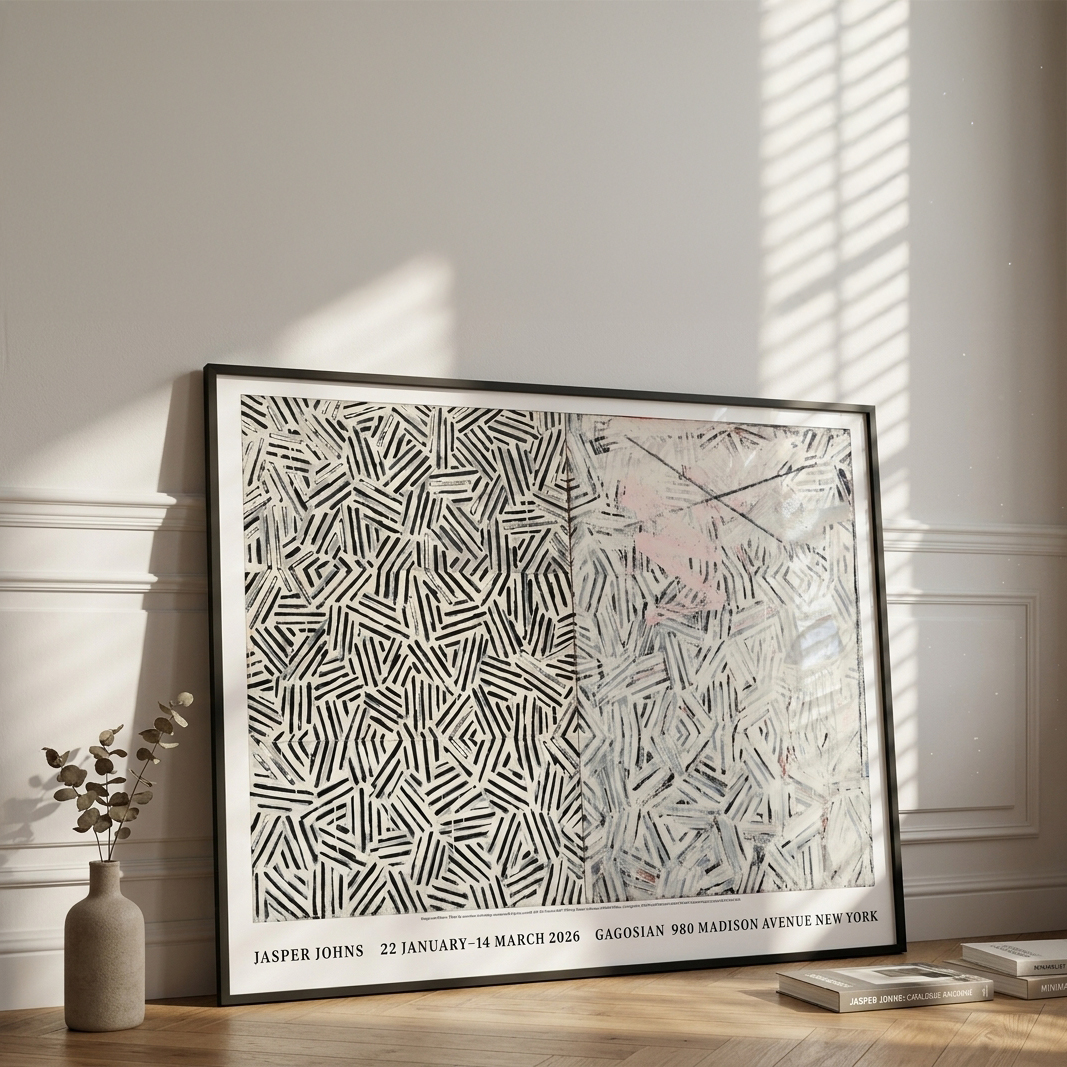
Artwork title: Between the Clock and the Bed
Poster size: 55.8 × 69.8 cm
Original poster from an American art gallery
This poster, featuring Corpse and Mirror (1974), was produced in 2026 to coincide with the exhibition Jasper Johns: Between the Clock and the Bed at Gagosian, 980 Madison Avenue, New York.
On loan from David Geffen's private collection, this painting is one of the important early works in artist Jasper Johns's “crosshatch” series. The series dominated the direction of his work for a decade and continued to influence his subsequent artistic practice.
This work, made on two panels, combines oil painting, encaustic, and collage. Its title refers to the Surrealist creative method Cadavre Exquis (“Exquisite Corpse”), a collaborative process in which several people take turns adding images or words to a folded sheet of paper.
In the image, Johns first arranges parallel lines into an interlocking structure of three sections on the left, then reinterprets the composition as a mirror image on the right.
Jasper Johns began his celebrated crosshatch series in the 1970s, arranging many short parallel lines at different angles into repeated, complex geometric structures. Unlike the emotional and gestural emphasis of earlier Abstract Expressionism, Johns deliberately chose patterns with almost no symbolic or narrative meaning, making the structure of the image itself his subject. This important shift moved painting away from emotional expression toward visual systems and pictorial language, profoundly influencing later conceptual art and contemporary painting. Johns recalled that the pattern originated in the upholstery of a car: he realized that an apparently meaningless visual arrangement could itself become a subject. Corpse and Mirror is an important early example. A geometric structure of parallel lines is established on the left and reinterpreted as a mirror image on the right, also recalling the Surrealist method of the exquisite corpse. Their art-historical importance and limited availability have long attracted leading collectors. This work, for example, was owned and loaned by David Geffen, helping establish Johns's crosshatch series among the most representative achievements of postwar American art.
Paper & medium
Original poster; size and framing options are listed above.
About the artist
Johns is regarded as one of America’s greatest contemporary artists. His best-known work is Flag (1954–1955), inspired by a dream he had of the American flag.
Johns’s work is often classified as Neo-Dada rather than Pop Art, although his materials frequently include images and objects from popular culture. Nevertheless, many introductions to Pop Art include his work because of his practice of giving new meaning to a familiar image or object.
Johns’s early works were inspired by simple objects: his paintings directly depicted such things as the American flag, maps, targets, letters, and numbers. His work is best known for its refined treatment of the painted surface. In some works, he used encaustic, a very old technique for making paint whose principal characteristic is the use of liquid wax, as well as other media including stucco and plaster. Johns’s artistic ideas gave his work a range of avant-garde meanings, much like the work of the Dada artist Duchamp, who occupied an important place in his artistic thinking. Johns also produced prints on a considerable scale, with artistic concepts similar to those in his paintings.