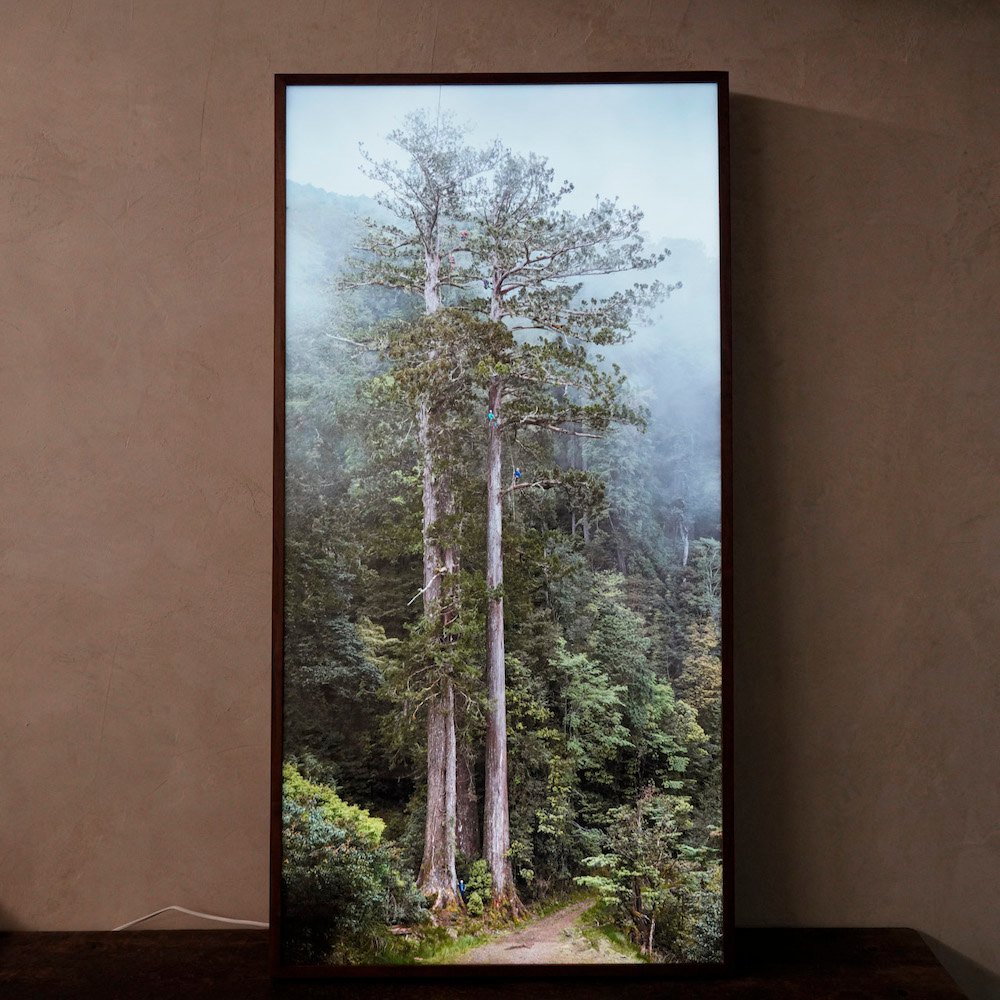
The tree to the moon Taiwania (Lightbox)
From USD 96
Nature & Landscapes · Photography
THE LIGHTO EDIT
Thoughtful works by artists near and far, chosen for the spaces we call home.
EXPLORE THE COLLECTIONMeet the artists and find the piece that feels like yours.
LIGHTO TO MEET YOUFIND YOUR POINT OF VIEW
Landscapes, abstract forms, and everyday beauty.
THE COLLECTION
Browse the works from LIGHTO's authorized artists.
No artworks match these filters. Try another color, subject, or orientation.
THE PEOPLE BEHIND THE ART
From established names to new perspectives, discover the makers in the LIGHTO collection.
From USD 96
Nature & Landscapes · Photography
| Size | Specification | Artwork only | With framing | Framing + acrylic |
|---|---|---|---|---|
| 15×30 cm | Walnut Lightobox | USD 96 | — | — |
| 20×40 cm | Walnut Lightobox | USD 156 | — | — |
| 30×60 cm | Walnut Lightobox | USD 360 | — | — |
About The Tree That Crashed Into the Moon
"Taiwanese cedar has existed on the earth for more than 100 million years, so it has the name of a living fossil, the genus name" Taiwania ", and it is the only plant in the world that uses" Taiwan "as a" genus name ". In the Qilan Mountains, the number of trees in Taiwanese cedar is small, showing a sporadic distribution. Taiwanese cedar is one of the tallest trees in East Asia, and the Rukai people call it the" tree that hit the moon ", and only very few people can see it in its entirety."
Taiwanese cedar is the botanical world. It is the only plant named after Taiwan. It has deep global popularity and importance. In 1904, Japanese scholars collected Taiwanese cedar specimens for the first time in the Nantou Mountain Area at an altitude of 2000 meters. It is mainly distributed in the cloud belt mountains at an altitude of 1,800 to 2,500 meters. It is a glacial heritage plant and a world-class living fossil. Because Taiwanese fir often mixes with red cypress, some groups are cut down at the same time during the large logging period.
The Taiwan Cedar Lifetime Photography Project team is comprised of Dr. Jennifer Sanger, an epiphytic research scholar, and Steven Pearce, a professional photographer from Tasmania, Australia. The filming team delivered a speech at the forest testing institute of the Agricultural Committee on the 12th, as the end of the filming trip in Taiwan. This is their third project in the world. The 70-meter-high photograph of Taiwanese cedar will be assembled into a photo showing the face of Taiwanese cedar, which will be completed in about a month.
The clutter of taking full-length photos of trees can be traced back to 2009 when National Geographic magazine photographed the world's tallest tree species,── Redwood, in the United States; "Tree-Project" is the successor, and similar projects are still few. Xu Jiajun, a forestry research institute researcher who contributed to this project, said that when people take pictures of tall trees, they have to shoot from bottom to top, and the proportion changes accordingly. The full-length photos are taken at each height along the tree body, and each photo is taken on a one-to-one scale without distortion or distortion.
"Ten kilometers from the Ivy○ Line Forest Road in Qilan Mountainous Area, Yilan County, Taiwan, there are three giant Taiwanese cedars" Three Sisters "born adjacent to each other. The Australian team came to Taiwan to collaborate with the Taiwanese tree lovers to take a photo of themselves. The shooting results were shocking, and the Australian photographer directly said that" Taiwanese really should be proud of owning this forest ".” — Correct View News Network
Find Taiwanese Cedar: http://e-info.org.tw/node/105526
Tree of the Moon Shooting Story: http://e-info.org.tw/node/204865
Black walnut light box
USB powered
5V 5-Section Dimming
The Tree Projects is an Australian environmental education and giant wood photography team dedicated to documenting and protecting giant trees and forest ecosystems around the world through the powerful Tree Portrait technology.
In Taiwan, The Tree Projects enjoy tremendous popularity because they are an important driving force for bringing Taiwan's "Shenmu" to an international perspective with a complete face.
The unique "giant wood photo" technology When people shoot magic trees in the forest, they can only shoot from the bottom to the top, causing the trees to be severely deformed and the proportion is distorted in the photo. The Tree Projects employs extremely time-consuming and dangerous technologies to address this issue:
Climbing tracks: They erect climbing ropes equal to the height of the trees next to the big trees as “tracks.” Lifting: The photographer lifts and lowers vertically along the rope, horizontally translating the parts of the giant wood at intervals.
Seamless stitching: Finally, thousands of local photos were stitched in a 1: 1 true ratio into a high-resolution "body photo" with no distortion and high image quality, so that the world can see the real magnificent face of the giant wood.
The Tree Projects has been invited to Taiwan many times, working with a team of "tree seekers" composed of forestry laboratories and successful universities to record Taiwan's precious Taiwania cryptomerioides (known as the king of conifers): 2014 "Taiwan Sister Sister Sister Sister Sister Sister Sister Sister Sister Sister Sister Sister Sister Sister Sister Sister Sister Sister Sister Tree Sister Sister Sister Sister Sister Sister Sister Sister Sister Sister Tree Sister Sister Sister Sister Sister Sister Sister Sister Sister Sister Sister Sister Sister Sister Sister Sister Sister Sister Sister Sister Sister Sister Sister Sister Sister Sister Sister Sister Sister Sister Sister Sister Sister Sister Sister Sister Sister Cilan
2023 "Momoyama Shenmu": Come to Taiwan again to record Momoyama Shenmu with a height of 79.7 meters.
"Da 'an Creek Leaning Sword": They also took a full-length photo of the "Da 'an Creek Leaning Sword", which is currently the highest tree record holder in Taiwan and East Asia, with a height of 84.1 meters, showing the extreme biodiversity and vitality of Taiwan at medium and high altitudes. The work of The Tree Projects is not only a record of scientific exploration, but is also widely used in environmental education and ecological exhibitions, bringing the emotion of alpine giant trees to people in the city.