THE LIGHTO EDIT
A little art
changes everything.
Thoughtful works by artists near and far, chosen for the spaces we call home.
EXPLORE THE COLLECTIONMeet the artists and find the piece that feels like yours.
LIGHTO TO MEET YOUFIND YOUR POINT OF VIEW
A place to begin.
Landscapes, abstract forms, and everyday beauty.
THE COLLECTION
Art to live with
Browse the works from LIGHTO's authorized artists.
No artworks match these filters. Try another color, subject, or orientation.
THE PEOPLE BEHIND THE ART
Meet the artists
From established names to new perspectives, discover the makers in the LIGHTO collection.
THE PEOPLE BEHIND THE ART
Richard Lin
4 WORKS
Richard Lin, Taiwan, 1933–2011, was a descendant of the Lin family of Wufeng and a graduate of Chien Kuo High School. In 1949, he went to London, England, to study architecture and fine art. He taught at a renowned art college in Britain and served as a tutor at the Royal College of Art. Beginning in 1958, he held solo exhibitions at several contemporary galleries in London. In 1961, he received an encouragement award from the British Modern Art Society. In 1966, he won first prize at an open painting exhibition held at the Ulster Museum. While pursuing minimalist painting in Britain during the 1960s and 1970s, he made an important personal contribution by giving the “empty space” of Chinese literati painting a sense of modernity. His works are widely collected by museums in Europe and America.
Known for his minimalist paintings and installations, Lin Shou-yu pushed the precision and purity of Minimalism to their utmost, imbuing his work with rational inquiry and philosophical meaning. In his best-known “White Series,” he skillfully employed whites of varying shades, visual weights, transparency and opacity, proportions, and density on blank canvases. At times, he interrupted the pure white world with a few long, fine, straight lines of color, as though condensing emotion into a cold, sharp mark across the vault of the universe. In the 1970s, while Lin Shou-yu was living in Britain, the painter Miró visited his studio. Standing before Lin’s “White Series,” he praised it: “In the world of white, no one can compare with you.”
1933–2011. Born into the Gongbaodi branch of the Lin family of Wufeng. From 1952 to 1958, he studied architecture and art in Britain, attending Millfield and the Regent Street Polytechnic in London, now the University of Westminster.
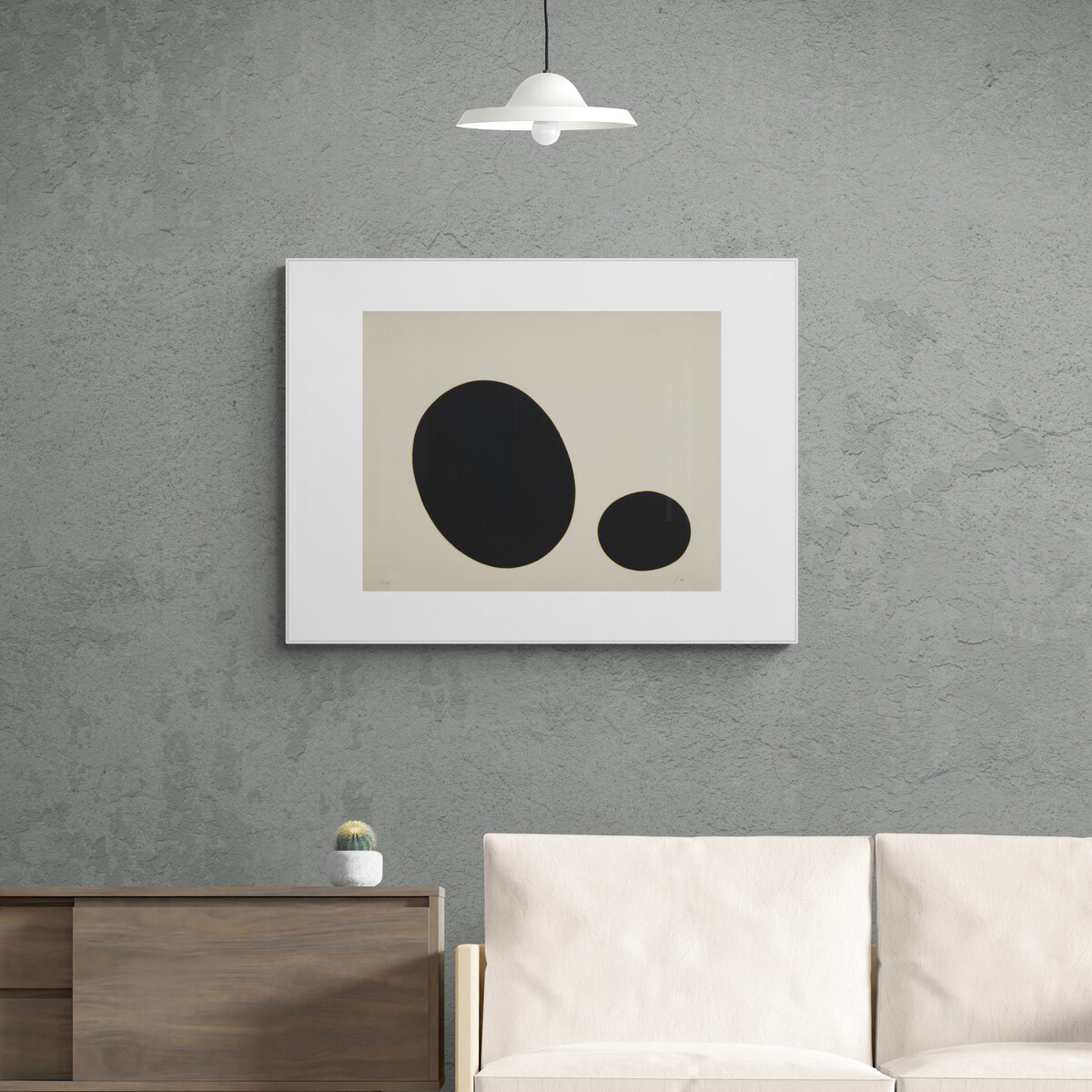
Richard Lin excels at composing an entire picture with the simplest elements, colors, and lines. Even when only a few elements appear in the image, subtle differences exist between them. His best-known works are those of his “White Period,” in which he used different shades of white and whites at different heights, incorporating the Eastern philosophy of Laozi and Zhuangzi.
Featured here are two works licensed for sale by Britain’s Tate: Flirtation and Relationships II. Using only ellipses and lines, they seek to convey the subtle interactions and emotions between people. They are highly abstract yet deeply expressive works.
In 1964, he became the first Chinese artist to exhibit at documenta in Kassel, showing alongside Kandinsky and Francis Bacon.
In 1966, Miró visited Richard Lin's studio and praised his White Series: 'In the world of white, you are without equal.'
In 1984, he announced his retirement from painting and turned to sculpture and installation.
2010: Richard Lin: Fifty Years of Creation, a major solo exhibition at the Kaohsiung Museum of Fine Arts.