

THE LIGHTO EDIT
A little art
changes everything.
Thoughtful works by artists near and far, chosen for the spaces we call home.
EXPLORE THE COLLECTIONMeet the artists and find the piece that feels like yours.
LIGHTO TO MEET YOUFIND YOUR POINT OF VIEW
A place to begin.
Landscapes, abstract forms, and everyday beauty.
THE COLLECTION
Art to live with
Browse the works from LIGHTO's authorized artists.
No artworks match these filters. Try another color, subject, or orientation.
THE PEOPLE BEHIND THE ART
Meet the artists
From established names to new perspectives, discover the makers in the LIGHTO collection.
Sizes & prices
| Size | Artwork only | With framing | Framing + acrylic |
|---|---|---|---|
| 30×40 cm | — | USD 276 | USD 296 |
Product details
Zao Wou-Ki once said, “I am not afraid of growing old, nor am I afraid of death, as long as I can still pick up a paintbrush.” His life was one of continually breaking boundaries—crossing national borders and dissolving the divisions between representation and abstraction, ink and oil paint.
Zao Wou-Ki (1920–2013) was one of the most highly regarded French painters of Chinese heritage of the 20th century and a leading figure in **Lyrical Abstraction**. His artistic career perfectly fused the evocative qualities of traditional Chinese aesthetics with the power of Western modern abstract art.
Zao Wou-Ki’s work is known for its **“Western medium, Eastern soul.”** He used the weight of oil paint and the expanse of canvas to express a flow of “qi” akin to that in Chinese ink painting.
Sense of space and expressive spirit: His paintings often lack a fixed viewpoint, conveying a grand sense of the cosmos emerging from chaos and moving to its own rhythms.
Fusion of East and West: He transformed the lines of Chinese calligraphy and the archaic simplicity of inscriptions on metal and stone into dynamic abstract symbols, combining them with Western approaches to light, shadow, and color.
⏳ Three Major Stages of Artistic Development: Zao Wou-Ki’s creative career can be divided into several significant turning points:
1. Early figurative and Klee-influenced period. After moving to Paris in 1948, he drew inspiration from Paul Klee and began reconstructing space with spare, delicate lines, creating a strongly poetic and narrative quality.
2. Oracle-bone period (1954–1959). This marked a crucial move toward abstraction. He deconstructed ancient Chinese oracle-bone and bronze inscriptions, transforming them into mysterious black lines against increasingly deep, layered backgrounds.
3. The storm period and mature years (1960s–1970s). This is his best-known phase. Bold brushstrokes and fierce collisions of color fill the canvas, evoking storms, waves and mountains in motion. Works from this period are often titled by their creation dates, for example 29.09.64.
4. Late period: ethereality and a return to simplicity (after the 1980s). With age, his colors became more transparent and luminous and his compositions more open, conveying a detached serenity closely aligned with the ethereal spirit of traditional Chinese landscape painting.
🏆 Historical Standing and Influence — Member of the French Academy: He is one of the very few artists of Chinese descent to receive this honor.
Market peak: Zao Wou-Ki’s works are consistent successes at international auctions and have repeatedly set new sales records for Asian contemporary art, as with the celebrated triptych June–October 1985.
A bridge between traditions: He successfully demonstrated the value of Eastern aesthetics in modern art within the postwar European art world, influencing countless younger artists.
Poster size: 30x40 cm
Finished dimensions with acid-free mat board: 40 x 51 cm
(Please message us to discuss other presentation options.)
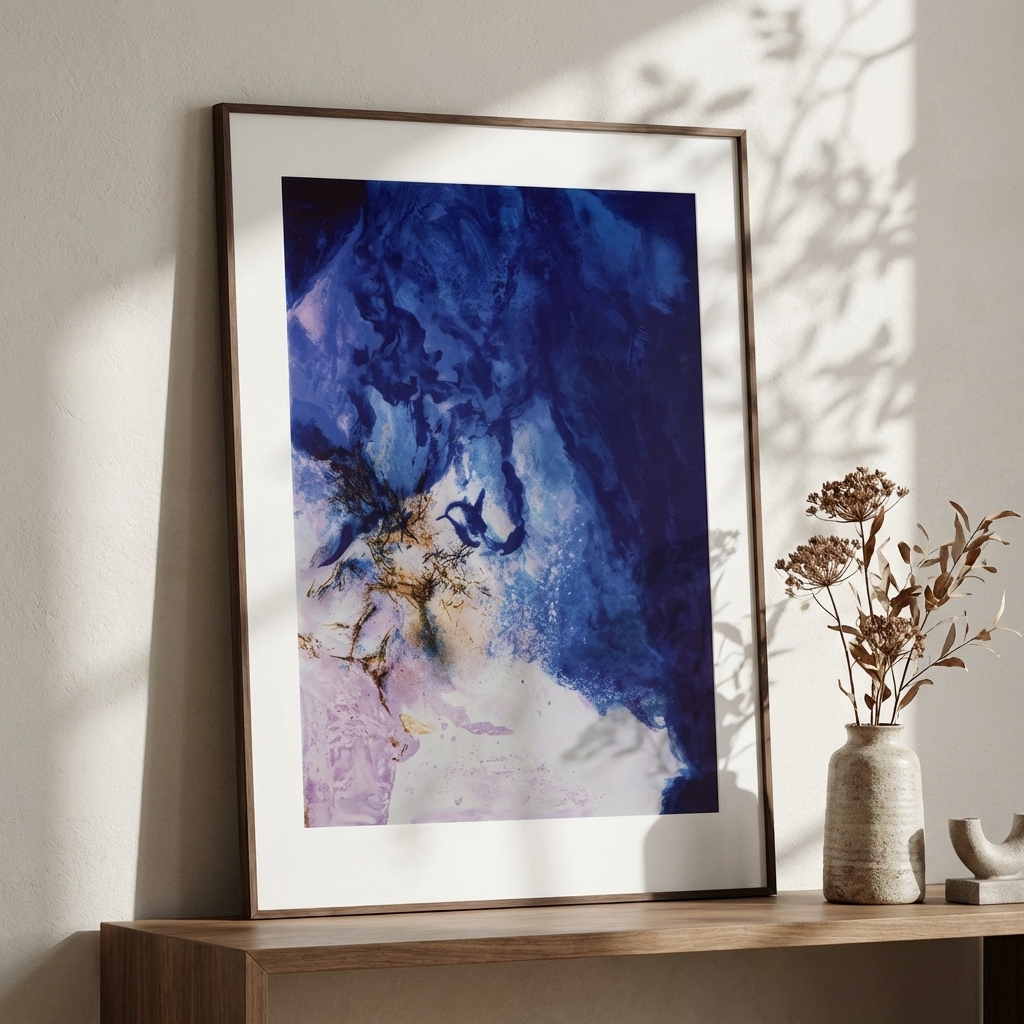
Original print from a Hong Kong museum
Actual photograph of the poster:
Example of artwork with mat board:
Paper & medium
Original print from a Hong Kong museum.