

THE LIGHTO EDIT
A little art
changes everything.
Thoughtful works by artists near and far, chosen for the spaces we call home.
EXPLORE THE COLLECTIONMeet the artists and find the piece that feels like yours.
LIGHTO TO MEET YOUFIND YOUR POINT OF VIEW
A place to begin.
Landscapes, abstract forms, and everyday beauty.
THE COLLECTION
Art to live with
Browse the works from LIGHTO's authorized artists.
No artworks match these filters. Try another color, subject, or orientation.
THE PEOPLE BEHIND THE ART
Meet the artists
From established names to new perspectives, discover the makers in the LIGHTO collection.
Sizes & prices
| Size | Artwork only | With framing | Framing + acrylic |
|---|---|---|---|
| 50×70 cm | — | USD 210 | USD 240 |
Product details
Artist: Willem de Kooning
Willem de Kooning (1904–1997) was born in Rotterdam, the Netherlands, and later moved to the United States. He was one of the most important Abstract Expressionist artists of the 20th century and a central figure in the New York School. Both Tate and Britannica classify him as a Dutch-American Abstract Expressionist painter; Britannica also identifies him as an important exponent of Action Painting.
A well-known aspect of his work is that he does not completely separate the “abstract” from the “figurative.” He painted figures early in his career and later moved into abstraction, but traces of bodies, landscapes, women, cities, and light often remain in his images. In other words, rather than simply painting geometric shapes, he breaks the real world apart and reassembles it in an intense, emotional way.
De Kooning’s brushwork often has a palpable physicality, and his paintings seem to be constantly changing. This is part of their appeal: they do not hang quietly on the wall but seem still to be breathing, struggling, and moving.
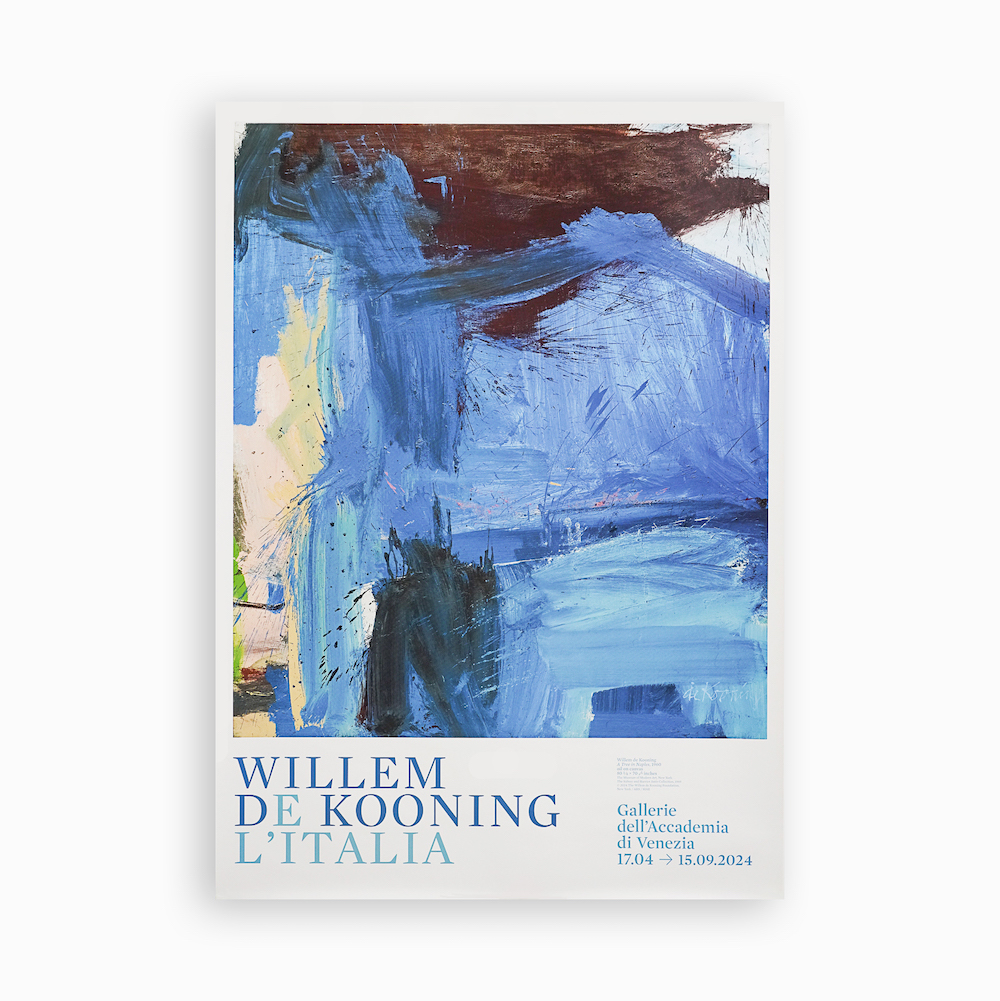
Artwork title: A Tree in Naples, 1960. Poster dimensions: 50 × 70cm
Year: 1960. Medium: oil on canvas. Dimensions: 203.7 × 178.1 cm. Currently in the collection of MoMA.
Although this work is titled “A Tree,” it is not a landscape depiction in the conventional sense. Instead, it compresses the air, sea, city light, tree shadows, and bodily sensations of Naples into vigorous brushstrokes. The broad swathes of blue resemble the sea and sky, but also a wall washed with sunlight in memory; the dark reddish brown above evokes the earth, rooftops, or the heat of southern Italy.
Its appeal lies in the fact that you do not necessarily have to “understand what it depicts.” Instead, you can feel the painter’s brush striking, dragging across, and scraping the canvas. That sense of speed makes the picture seem as though a gust of wind has just swept through it.
Paper & medium
Year: 1960. Medium: oil on canvas. Dimensions: 203.7 × 178.1 cm. In the collection of MoMA.
About the artist
Willem de Kooning (1904–1997) was born in Rotterdam, the Netherlands, and later moved to the United States. He was one of the most important Abstract Expressionist artists of the 20th century and a central figure in the New York School. Both Tate and Britannica classify him as a Dutch-American Abstract Expressionist painter; Britannica also identifies him as an important exponent of Action Painting.
A well-known aspect of his work is that he does not completely separate the “abstract” from the “figurative.” He painted figures early in his career and later moved into abstraction, but traces of bodies, landscapes, women, cities, and light often remain in his images. In other words, rather than simply painting geometric shapes, he breaks the real world apart and reassembles it in an intense, emotional way.
De Kooning’s brushwork often has a palpable physicality, and his paintings seem to be constantly changing. This is part of their appeal: they do not hang quietly on the wall but seem still to be breathing, struggling, and moving.