

THE LIGHTO EDIT
A little art
changes everything.
Thoughtful works by artists near and far, chosen for the spaces we call home.
EXPLORE THE COLLECTIONMeet the artists and find the piece that feels like yours.
LIGHTO TO MEET YOUFIND YOUR POINT OF VIEW
A place to begin.
Landscapes, abstract forms, and everyday beauty.
THE COLLECTION
Art to live with
Browse the works from LIGHTO's authorized artists.
No artworks match these filters. Try another color, subject, or orientation.
THE PEOPLE BEHIND THE ART
Meet the artists
From established names to new perspectives, discover the makers in the LIGHTO collection.
Sizes & prices
| Size | Artwork only | With framing | Framing + acrylic |
|---|---|---|---|
| 30×40 cm | USD 43 | USD 96 | USD 113 |
| 50×70 cm | USD 93 | USD 173 | USD 206 |
| 60×81 cm | USD 130 | USD 243 | USD 280 |
Product details
* Photographic paper only (without framing): ships in 3–5 business days.
*If you choose mounting and framing: the process is time-consuming and labor-intensive, so please allow 2–3 weeks for your order and be patient.
Artwork dimensions: Small size: 30 x 40 cm Medium: 50 x 70 cm
Large size: 60 x 81 cm * Please message us about other sizes.
Giclée on etching art paper Hanging method:
Every aluminum frame has a hanging wire on the back. To hang it, you can attach a 3M damage-free hook to the wall (please purchase a version rated for at least 5 kg for safety).
* The original is a woodcut, which gives the marks a rougher texture.
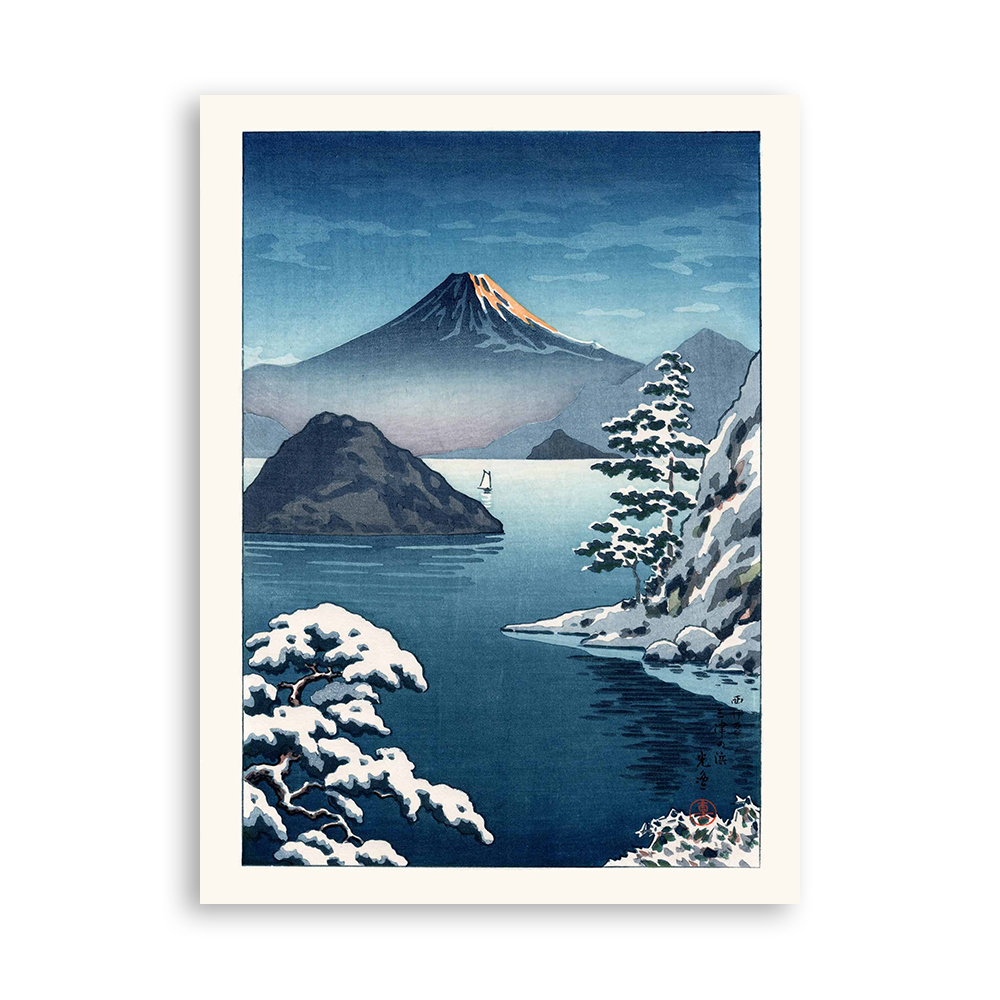
Tsuchiya Koitsu was an important artist of Japan’s Shin-hanga movement, although he was not as widely known or sought after as Kawase Hasui. Like many Shin-hanga artists, Tsuchiya Koitsu focused on landscapes and was particularly adept at depicting changes in light and shadow.
He was born in rural Japan in 1879 (his original given name was “Kōichi”) and later became a pupil of ukiyo-e master Kobayashi Kiyochika (1847–1915), specializing in woodblock carving techniques. As a young man, he lived and worked in his teacher’s home for 19 years.
After 1931, Tsuchiya Kōitsu joined Watanabe Publishers and became one of the principal artists of the shin-hanga movement. His style reflected his training while incorporating qualities associated with masters such as Kawase Hasui and Hiroshi Yoshida. Within the shin-hanga tradition, Kōitsu was especially skilled at using the expressive power of light to create atmosphere and emotional tension, developing a distinctive approach to landscape art.
In his early years, Tsuchiya Koitsu studied woodblock printing under ukiyo-e master Kobayashi Kiyochika and became one of his favored pupils. He later left the art world for a time because of health problems, but was discovered by the prominent print dealer Watanabe Shōzaburō at an exhibition commemorating the anniversary of Kiyochika's death. He then became active in art again and collaborated with publisher Doi Sadaichi, creating a large number of highly representative landscape prints. Koitsu's prints are known for their vivid colors, rich layers, and delicate rendering of light and shadow. He was adept at using perspective to create a sense of space and especially skilled at depicting night scenes, shrines illuminated by lanterns, city bridges, Mount Fuji, and lakes. Works such as Seto Inland Sea, Tomonotsu and Miyajima at Night (Rain at Miyajima) demonstrate his exceptional handling of light, shadow, and rain. His subjects were varied, including cherry blossoms at night by Sarusawa Pond, the autumn moon at Ishiyama-dera Temple, morning views of Mount Fuji, Miyajima in the rain, and Nikko's Shinkyō Bridge, all imbued with a strong sense of atmosphere and emotion. In terms of artistic achievement, he won awards at the Imperial Art Exhibition in both 1916 and 1918. His work was exhibited at the Imperial Art Academy and the Tokyo Art Institute and was highly praised by the art world and collectors, making him a highly influential landscape printmaker in Japan's shin-hanga movement.
Discover Japanese woodblock prints:
Production process and division of responsibilities
1. Artist (eshi) Responsible for drawing the original design.
Provides the overall composition and the design of the figures and landscape.
For example: Katsushika Hokusai, Utagawa Hiroshige, and Kawase Hasui.
2. Publisher (hanmoto)
The heart of the entire team, akin to a “producer + distributor.”
Funded and planned the work, determined its theme, and collaborated with the artist.
Hire carvers and printers, and coordinate the schedule and quality.
Responsible for sales and promotion, and for deciding the size of the edition.
For example: Shozaburo Watanabe of the shin-hanga movement.
3. Block carver (horishi)
Transfer the artist’s original drawing onto a woodblock for carving.
Each color requires a dedicated woodblock.
The technical demands are extremely high: precision down to the millimeter is required, or the overprinted colors will be misaligned.
4. Printer (surishi)
Woodblocks and pigments are used to print the image layer by layer onto washi paper.
Responsible for color gradation, blending, and light-and-shadow effects.
The level of technical skill directly affects the work’s final appearance.