

THE LIGHTO EDIT
A little art
changes everything.
Thoughtful works by artists near and far, chosen for the spaces we call home.
EXPLORE THE COLLECTIONMeet the artists and find the piece that feels like yours.
LIGHTO TO MEET YOUFIND YOUR POINT OF VIEW
A place to begin.
Landscapes, abstract forms, and everyday beauty.
THE COLLECTION
Art to live with
Browse the works from LIGHTO's authorized artists.
No artworks match these filters. Try another color, subject, or orientation.
THE PEOPLE BEHIND THE ART
Meet the artists
From established names to new perspectives, discover the makers in the LIGHTO collection.
Sizes & prices
| Size | Artwork only | With framing | Framing + acrylic |
|---|---|---|---|
| 42×30 cm | USD 43 | USD 96 | USD 113 |
| 72×50 cm | USD 93 | USD 173 | USD 206 |
| 86×60 cm | USD 130 | USD 243 | USD 280 |
Product details
* The original is a woodcut, which gives the marks a rougher texture.
Discover Japanese woodblock prints:
Production process and division of responsibilities
1. Artist (eshi)
Responsible for drawing the original design.
Provides the overall composition and the design of the figures and landscape.
For example: Katsushika Hokusai, Utagawa Hiroshige, and Kawase Hasui.
2. Publisher (hanmoto)
The heart of the entire team, akin to a “producer + distributor.”
Funded and planned the work, determined its theme, and collaborated with the artist.
Hire carvers and printers, and coordinate the schedule and quality.
Responsible for sales and promotion, and for deciding the size of the edition.
For example: Shozaburo Watanabe of the shin-hanga movement.
3. Block carver (horishi)
Transfer the artist’s original drawing onto a woodblock for carving.
Each color requires a dedicated woodblock.
The technical demands are extremely high: precision down to the millimeter is required, or the overprinted colors will be misaligned.
4. Printer (surishi)
Woodblocks and pigments are used to print the image layer by layer onto washi paper.
Responsible for color gradation, blending, and light-and-shadow effects.
The level of technical skill directly affects the work’s final appearance.
Paper & medium
About the artist
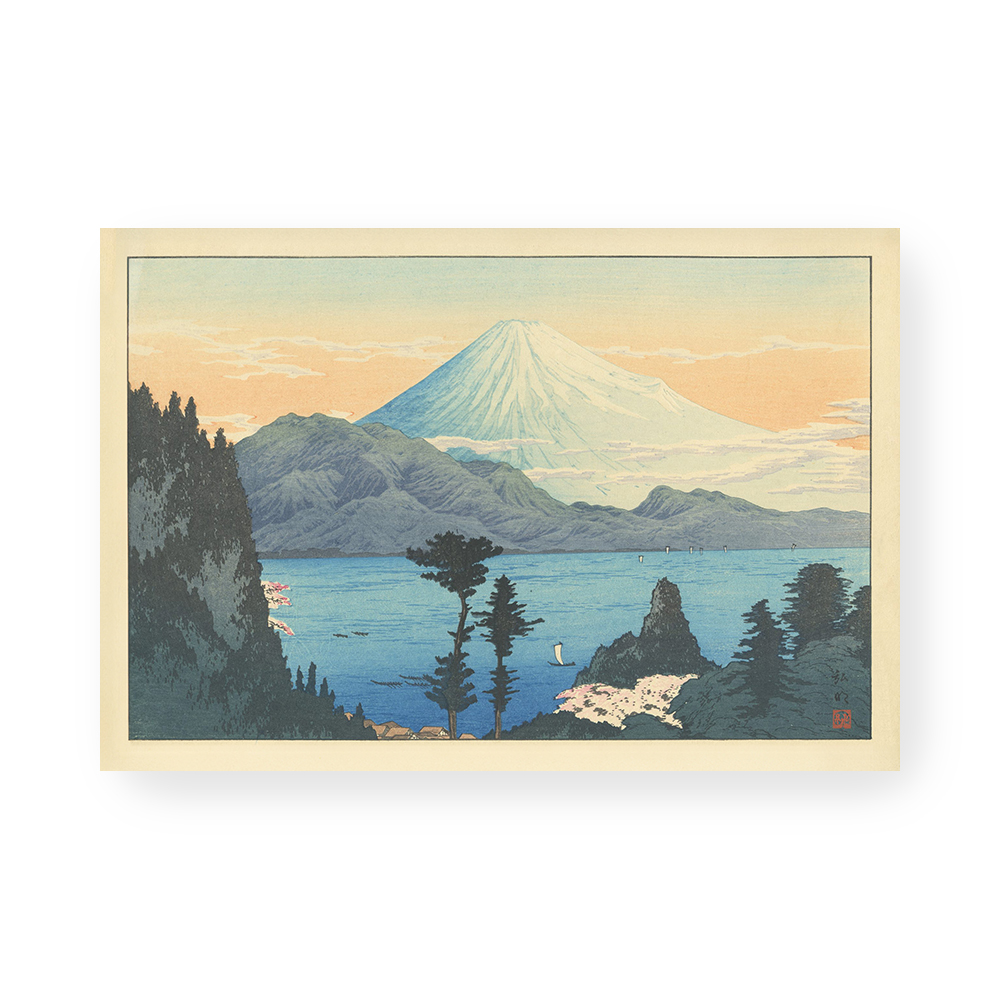
Takahashi Shōtei (January 2, 1871–February 11, 1945) was a renowned Japanese artist known for woodblock prints and paintings depicting landscapes, cityscapes, and rural scenery. Born in Tokyo, he showed a keen interest in art from childhood and began studying painting at an early age. He later became an important member of the Shin-hanga movement and was widely acclaimed for his distinctive style and outstanding artistic achievements.
Shōtei was born in Tokyo in 1871. Adopted into the Takahashi family as a child, he was renamed Takahashi Katsutarō. At nine, he began studying painting with his uncle Matsumoto Fūko; the artist name “Shōtei” is said to have evolved from the family name “Matsumoto.” In his teens, he joined the Imperial Household Agency's design department and received artistic training in traditional Japanese painting at the Kawabata School of Painting. He later joined the workshop of the renowned woodblock printmaker Ishikawa Toyonobu to learn printmaking techniques. Shōtei's early works were strongly influenced by ukiyo-e, featuring clear outlines, bold colors, and delicate details.
In 1907, Watanabe Shōzaburō hired him as his first artist. He adopted the name Shōtei, paying homage to the ukiyo-e master Utagawa Hiroshige and marking an important turning point in his career. His long collaboration with Watanabe produced many works cherished by collectors. One of Shōtei's most notable contributions was his sensitive depiction of night scenes: he skillfully captured the interplay of light and shadow and the atmosphere created by moonlight and lanterns. His tranquil streets, temples and rural nocturnes became particularly popular, establishing his reputation as a master of night-scene prints.
Some of Shōtei's works were signed “Hiroaki”; he also used “Shōtei” and other variations. Prolific throughout his life, he had completed around 500 designs before turning 50. Unfortunately, the fires caused by the 1923 Great Kantō Earthquake destroyed many of his works. He did not stop, however: after the earthquake, he created around 250 more works in the shin-hanga style, continuing to showcase the beauty of Japan's nature and landscapes. In addition to working with Watanabe, he collaborated with publishers including Fūsui Gabō and Tanaka Shōbidō, gaining greater creative control through these partnerships.
Takahashi Shōtei used several names and seals throughout his life. From 1907 to 1922, he primarily signed his works “Shōtei”; after 1922, he also used names including “Kōmei” and “Kōmei.” His works are admired by collectors and art lovers around the world for their innovative use of perspective, meticulous detail, and poetic depictions of Japan’s natural and urban landscapes. Despite hardships including the Great Kantō Earthquake, his artistic achievements live on through these timeless masterpieces.