

THE LIGHTO EDIT
A little art
changes everything.
Thoughtful works by artists near and far, chosen for the spaces we call home.
EXPLORE THE COLLECTIONMeet the artists and find the piece that feels like yours.
LIGHTO TO MEET YOUFIND YOUR POINT OF VIEW
A place to begin.
Landscapes, abstract forms, and everyday beauty.
THE COLLECTION
Art to live with
Browse the works from LIGHTO's authorized artists.
No artworks match these filters. Try another color, subject, or orientation.
THE PEOPLE BEHIND THE ART
Meet the artists
From established names to new perspectives, discover the makers in the LIGHTO collection.
Sizes & prices
| Size | Artwork only | With framing | Framing + acrylic |
|---|---|---|---|
| 30×40 cm | USD 43 | USD 90 | — |
| 40×60 cm | USD 83 | USD 156 | — |
| 60×90 cm | USD 170 | USD 292 | — |
Product details
Product Information:
* Paper selected for the artwork: Enhance matt paper. <Introduction to giclée and photographic paper>
Subtle and non-reflective, it faithfully presents the texture of the artist’s illustrations.
* If you choose a frameless canvas print, it will be produced on acid-free matte canvas.
When purchasing photographic paper alone, direct-hanging hardware can be purchased separately:
【Teak Magnetic Hanging Scroll】 www.lightochan.com/home/Hangingscroll
Alfred Stieglitz, 1864–1946
A renowned American photographic artist. Early in his career, he was an accomplished Pictorialist photographer; he later became an advocate of straight photography and a pioneer of realist photography. As a pioneer of the Photo-Secession movement, he and other artists actively introduced European avant-garde artists, including Matisse and Picasso, to the American art world, significantly influencing the transformation of American ideas about modern art. He is therefore known as the American “father of modern photography.”
Georgia O’Keeffe:
An important painter in the American modernist movement, Georgia O’Keeffe has been admired and revered by many women, who have also reflected on their own identity as women through her. Known for her enormous flower paintings, she also left an unforgettable impression through her delicate and abundant presence.
About the artwork:
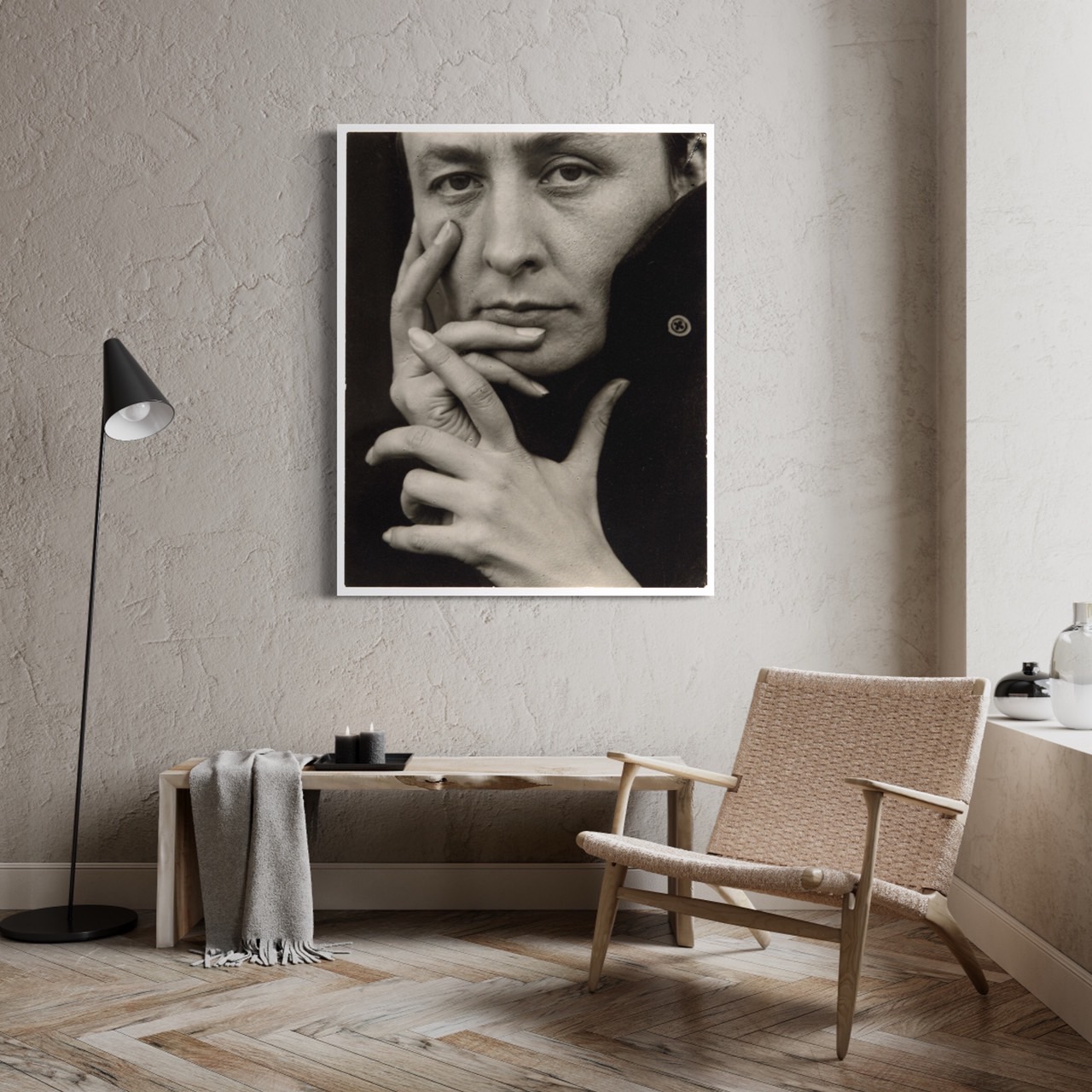
“Stieglitz took his first photographs of me at his gallery ‘291’ in the spring of 1917. Ever since I was a little girl, people had admired my hands. But I had never given them a thought. I was asked to move my hands in many different ways and into different positions, and my head too; I had to turn this way and that. Stieglitz had a keen sense of what he wanted to say with his camera. Looking at some of those photographs of me from more than sixty years ago, I wonder who that person was, as though I had lived many lives in my lifetime. His idea of a portrait was more than a single photograph. His dream was to start with a child at birth and photograph that child in all their activities as they grew into a person and throughout their adult life. As a portrait, it would be a photographic diary.” — Georgia O’Keeffe, 1978
Early in his relationship with Georgia O’Keeffe, Alfred Stieglitz described her in this way to a friend. Stieglitz made expressive studies of O’Keeffe’s almost dancing hands and her torso. She wore a simple black dress with a soft shawl collar, reminiscent of what she had worn when they first met at his gallery. O’Keeffe was already an accomplished painter who expressed herself eloquently with her hands, and Stieglitz recognized their emotional potential.
About 60 years after this photograph was taken, Georgia O’Keeffe recalled, “My hands have always been admired—but I knew nothing about it.” His passionate fascination with O’Keeffe led Alfred Stieglitz to leave his first wife and child, and he developed a profound love affair with her hands through his camera. From the beginning of their relationship, Stieglitz photographed O’Keeffe, eventually amassing a portrait series of more than 325 photographs. In the photograph taken here, only her hands are visible. Their gestures are full of movement, evoking the rhythms of music and dance as well as the abstract biomorphic forms in O’Keeffe’s own drawings and paintings. Wearing a striking hat, an alluring white blouse, and a black jacket, Georgia O’Keeffe cuts a striking figure before one of her paintings, her hands clasping her breasts tightly as though they hold the force of life. Her keen gaze above the camera carries her into a space the viewer cannot share.
From 1917 to the mid-1930s, Alfred Stieglitz photographed O’Keeffe and began a passionate romantic relationship with her in 1918. He called his extended series of photographs of Georgia O’Keeffe A Portrait.
Stieglitz was one of the most important photographers of the early 20th century: “I was born in Hoboken. I am an American. Photography is my passion. The search for truth is my obsession.” Through exhibitions at his New York gallery, he also introduced modern European art to America and supported American modernist painters, including Georgia O’Keeffe, who became his wife. This image is part of a cumulative portrait of Stieglitz comprising hundreds of photographs taken by O’Keeffe between 1917 and 1933. He believed that a single image was not always enough to capture the complexity of a personality, and that any part of the body could be a portrait if it expressed some aspect of a state of mind.
Further reading about Stieglitz:
1. https://chi.donationletterfundraising.com/alfred-stieglitz-american-photographer
2. https://vision.xitek.com/image/201605/02-308581.html
Further reading about Georgia O’Keeffe:
https://www.wowlavie.com/article/ae1802687
About their love story:
Paper & medium
Paper specifications are supplied in the original language below.