

THE LIGHTO EDIT
A little art
changes everything.
Thoughtful works by artists near and far, chosen for the spaces we call home.
EXPLORE THE COLLECTIONMeet the artists and find the piece that feels like yours.
LIGHTO TO MEET YOUFIND YOUR POINT OF VIEW
A place to begin.
Landscapes, abstract forms, and everyday beauty.
THE COLLECTION
Art to live with
Browse the works from LIGHTO's authorized artists.
No artworks match these filters. Try another color, subject, or orientation.
THE PEOPLE BEHIND THE ART
Meet the artists
From established names to new perspectives, discover the makers in the LIGHTO collection.
Sizes & prices
| Size | Artwork only | With framing | Framing + acrylic |
|---|---|---|---|
| 30×45 cm | USD 43 | USD 96 | USD 113 |
| 40×60 cm | USD 76 | USD 156 | USD 173 |
| 60×90 cm | USD 123 | USD 223 | USD 270 |
Product details
* Photographic paper only (without framing): ships in 3–5 business days.
*If you choose mounting and framing: the process is time-consuming and labor-intensive, so please allow 2–3 weeks for your order and be patient.
Artwork dimensions:
Small size: 30 x 45cm
Medium: 40 x 60cm
Large size: 60 x 90cm
* Please message us about other sizes.
Giclée on etching art paper
Hanging method:
Every aluminum frame has a hanging wire on the back. To hang it, you can attach a 3M damage-free hook to the wall (please purchase a version rated for at least 5 kg for safety).
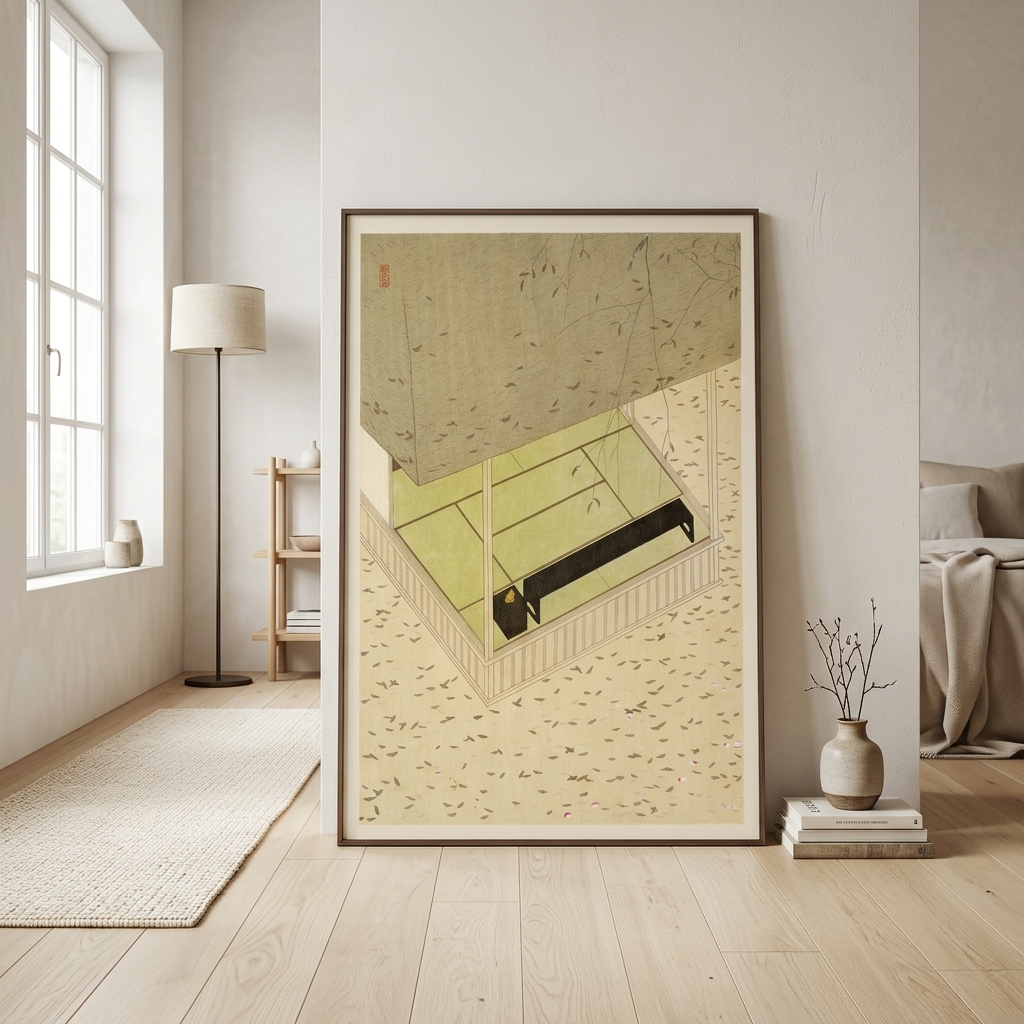
* The antique original is a woodcut. The giclée reproduction seeks to preserve the rough texture of its original marks.
Komura Settai (1887–1940) was one of Japan’s most representative artists from the Taisho period to the early Showa period. He was not only a woodblock printmaker but also a Japanese-style painter, illustrator, book designer, and stage designer. He skillfully combined traditional Edo-period aesthetics with modern graphic design, gaining prominence in the popular culture of his time. Later generations dubbed him “the Suzuki Harunobu of the Showa era.”
A Distinctive “Aesthetic of Subtraction”
Komura Settai’s creative style was deeply influenced by both Japanese tradition and Western modern art, which he refined into a highly distinctive personal visual language:
Lines blending Japanese and Western influences: His prints are grounded in the nuanced spatial compositions of Edo-period ukiyo-e, while also drawing on the signature black-and-white linework of British illustrator Aubrey Beardsley and the geometric sensibility of Art Nouveau.
The art of ample negative space: Hasui was exceptionally skilled at leaving parts of an image unpainted. He often used large areas of empty space, strong diagonal compositions, or just a corner of a building to suggest a story beyond the frame. This pared-back aesthetic invites viewers to imagine the rest for themselves, creating a clean, crisp, romantic atmosphere tinged with melancholy.
Important Cross-Disciplinary Achievements
Although many people today know Settai through his prints, during his lifetime he was an exceptionally active commercial and cross-disciplinary creator:
Book design and illustration: In 1914, with the support of the renowned writer Izumi Kyōka, he designed the cover and binding for Kyōka's novel Nihonbashi, marking his emergence in the design world. In 1933, he drew newspaper illustrations for Kunieda Kanji's serialized novel Osen, bringing his distinctive aesthetic to the height of public visibility.
Commercial design at Shiseido: From 1918 to 1923, he worked in Shiseido’s design department. He helped design perfume bottles, product packaging, and promotional posters, and laid an important foundation for the now-classic “Shiseido typeface,” demonstrating exceptional sensitivity to modern commercial design.
Kabuki stage design: Drawing on his command of space and architectural perspective, he designed sets for approximately 200 kabuki and film productions over his lifetime.
The Legacy and Influence of Printmaking
Komura Settai perfectly demonstrated how traditional woodblock printing techniques could find new life in modern books and commercial graphic design. Notably, many of his high-quality woodblock prints, such as the Osen series, were originally private commissions from writers and were not printed in large quantities; a small number were even compiled and published by others after his death.
His works delicately preserve the atmosphere of a fading Edo era while displaying the refinement of modern design. They continue to exert a profound influence on graphic design and illustration.
Paper & medium
Komura Settai demonstrated how traditional woodblock printing could find new life in modern books and commercial graphic design. Many of his high-quality woodblock prints, including the Osen series, were initially private commissions for writers and were not produced in large quantities. Some were compiled and published after his death.
About the artist
Book design and illustration: In 1914, with the support of the renowned writer Izumi Kyōka, he designed the cover and binding for Kyōka's novel Nihonbashi, marking his emergence in the design world. In 1933, he drew newspaper illustrations for Kunieda Kanji's serialized novel Osen, bringing his distinctive aesthetic to the height of public visibility.
Commercial design at Shiseido: From 1918 to 1923, he worked in Shiseido’s design department. He helped design perfume bottles, product packaging, and promotional posters, and laid an important foundation for the now-classic “Shiseido typeface,” demonstrating exceptional sensitivity to modern commercial design.
Kabuki stage design: Drawing on his command of space and architectural perspective, he designed sets for approximately 200 kabuki and film productions over his lifetime.
Komura Settai perfectly demonstrated how traditional woodblock printing techniques could find new life in modern books and commercial graphic design. Notably, many of his high-quality woodblock prints, such as the Osen series, were originally private commissions from writers and were not printed in large quantities; a small number were even compiled and published by others after his death.
His works delicately preserve the atmosphere of a fading Edo era while displaying the refinement of modern design. They continue to exert a profound influence on graphic design and illustration.