

THE LIGHTO EDIT
A little art
changes everything.
Thoughtful works by artists near and far, chosen for the spaces we call home.
EXPLORE THE COLLECTIONMeet the artists and find the piece that feels like yours.
LIGHTO TO MEET YOUFIND YOUR POINT OF VIEW
A place to begin.
Landscapes, abstract forms, and everyday beauty.
THE COLLECTION
Art to live with
Browse the works from LIGHTO's authorized artists.
No artworks match these filters. Try another color, subject, or orientation.
THE PEOPLE BEHIND THE ART
Meet the artists
From established names to new perspectives, discover the makers in the LIGHTO collection.
Sizes & prices
| Size | Artwork only | With framing | Framing + acrylic |
|---|---|---|---|
| 60×80 cm | — | USD 190 | USD 216 |
Product details
Printing paper
Poster size: 60 x 80 cm ※ Original poster
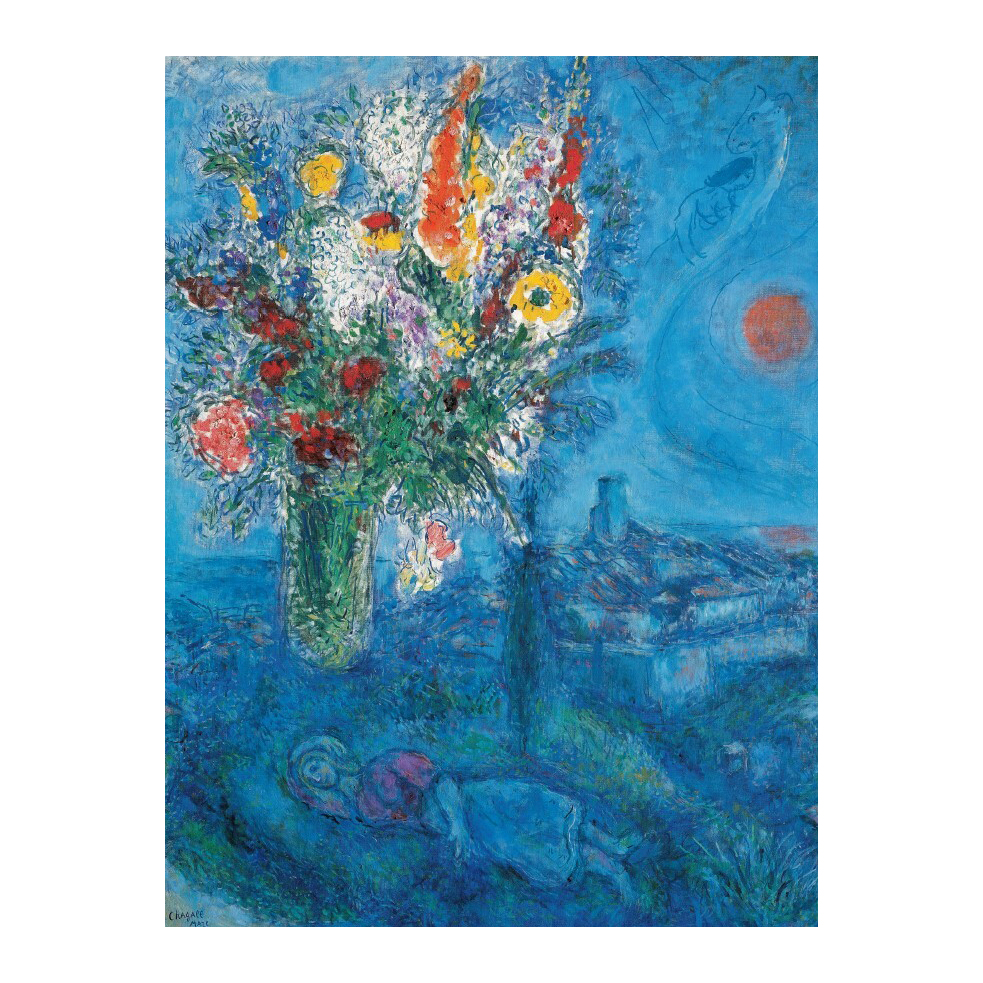
Title: Schlafende mit Blumen
Artwork details / Year: 1972. Medium: oil painting. Original dimensions: 146 × 118 cm.
This painting is undoubtedly a tribute to Chagall's choice of the south of France. Beneath the rays of a blood-red sun, a long-necked animal and a nude woman float in shadow, while the outline of the small medieval town of Saint-Paul-de-Vence appears in the background. In contrast, the subject in the foreground is a young woman sleeping on the grass beside an enormous bouquet of flowers—a motif that also carries symbolic meaning in other works. The entire picture is enveloped in an enchanting blue that frequently appears in his later works. Here, blue not only evokes the southern sunset but also symbolically suggests the otherworldliness of the sleeping figure's soul and spiritual world.
About the artist / Marc Chagall
Marc Chagall (also rendered as Mark Chagall; Russian: Mark Shagal; Yiddish: Mark Shagal; French: Marc Chagall; July 6, 1887–March 28, 1985), born Moishe Zakharovich Shagal (Belarusian: Moisha Zakharavich Shagalaŭ; romanized: Moishe Zakharovich Shagal), was a renowned Russian-French artist of Belarusian Jewish descent. His work ranged across movements including Impressionism, Cubism, and Abstract Expressionism, and took forms including painting, drawing, stained glass, stage sets, and ceramics [1]. His paintings employ dreamlike, symbolic imagery and color; Apollinaire coined the term “Surrealism” to describe his work.
Chagall was born into a Jewish family, and early Jewish thought was a deeply rooted source of inspiration for him. His parents raised 10 children on a meager income, and the family was poor. The dark wooden houses, superstitious villagers, violin players, cows, sheep, chickens, and horses he saw as a child all became sources for his art. He left Russia in 1922 and settled near Paris. During World War II, he moved to the United States and began designing ballet sets and costumes. The animals, objects, and people in these paintings draw on his personal life, dreams, and Russian folklore.
Paper & medium
Original poster; size and framing options are listed above.
About the artist
Marc Chagall (also rendered as Mark Chagall; Russian: Mark Shagal; Yiddish: Mark Shagal; French: Marc Chagall; July 6, 1887–March 28, 1985), born Moishe Zakharovich Shagal (Belarusian: Moisha Zakharavich Shagalaŭ; romanized: Moishe Zakharovich Shagal), was a renowned Russian-French artist of Belarusian Jewish descent. His work ranged across movements including Impressionism, Cubism, and Abstract Expressionism, and took forms including painting, drawing, stained glass, stage sets, and ceramics [1]. His paintings employ dreamlike, symbolic imagery and color; Apollinaire coined the term “Surrealism” to describe his work.
Chagall was born into a Jewish family, and early Jewish thought was a deeply rooted source of inspiration for him. His parents raised 10 children on a meager income, and the family was poor. The dark wooden houses, superstitious villagers, violin players, cows, sheep, chickens, and horses he saw as a child all became sources for his art. He left Russia in 1922 and settled near Paris. During World War II, he moved to the United States and began designing ballet sets and costumes. The animals, objects, and people in these paintings draw on his personal life, dreams, and Russian folklore.