

THE LIGHTO EDIT
A little art
changes everything.
Thoughtful works by artists near and far, chosen for the spaces we call home.
EXPLORE THE COLLECTIONMeet the artists and find the piece that feels like yours.
LIGHTO TO MEET YOUFIND YOUR POINT OF VIEW
A place to begin.
Landscapes, abstract forms, and everyday beauty.
THE COLLECTION
Art to live with
Browse the works from LIGHTO's authorized artists.
No artworks match these filters. Try another color, subject, or orientation.
THE PEOPLE BEHIND THE ART
Meet the artists
From established names to new perspectives, discover the makers in the LIGHTO collection.
Sizes & prices
| Size | Artwork only | With framing | Framing + acrylic |
|---|---|---|---|
| 70×50 cm | — | USD 33334 | USD 33360 |
Product details
Artist: Jeff Wall
Canadian photographer Jeff Wall established his place in the art world in the late 1970s through cinematic photography. As a young man traveling in Madrid, he was inspired by vividly colored, backlit lightbox advertisements. He began staging color transparencies and displaying them in lightboxes, allowing his works to show rich detail. At the same time, photography enabled him to reinterpret the painting and literature he loved and explore different ways of telling stories.
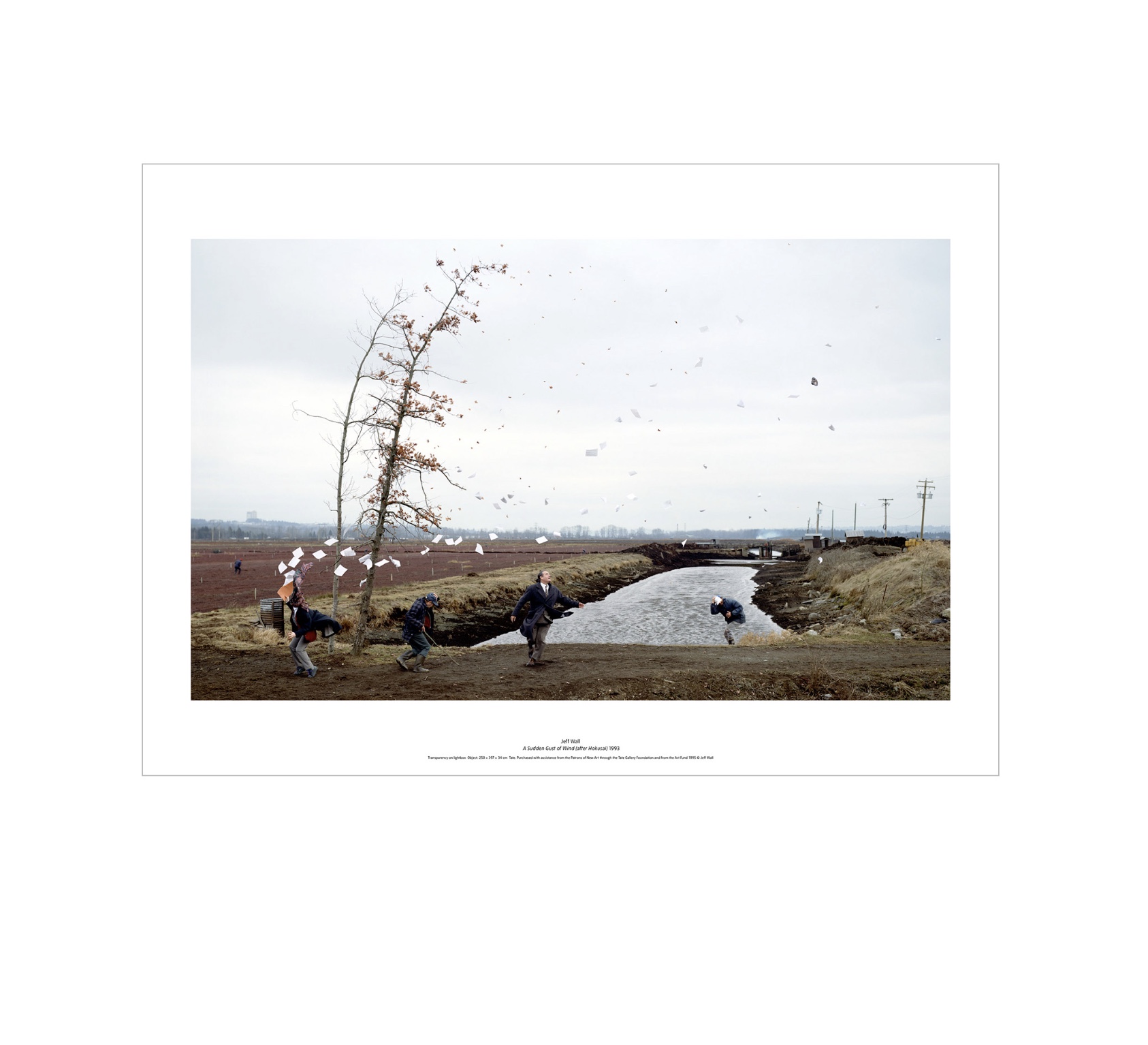
Artwork title: A SUDDEN GUST OF WIND (AFTER HOKUSAI)
Original poster from a British museum
Actual artwork photo x black aluminum frame
A Sudden Gust of Wind (After Hokusai) is a large color photograph displayed in a lightbox. It depicts a flat, open landscape in which four figures in the foreground are frozen in their reactions to a sudden gust of wind. It is based on a woodblock print, Ejiri in Suruga Province (circa 1832), from the famous series Thirty-six Views of Mount Fuji by the Japanese painter and printmaker Katsushika Hokusai (1760–1849). Wall photographed actors in a landscape outside Vancouver, selecting moments with similar weather conditions over five months. He then used a digital darkroom to collage elements of the photographs into his desired composition. The result is an image that looks like a staged performance in the manner of a classical painting. As in Hokusai’s original, two men clutch their hats, while a third looks up at the sky as his bowler hat blows away. On the left, a woman’s body is stopped short by the wind, her head hidden by a scarf blown across it. A stack of papers in her hands scatters in the wind, its trajectory creating a sense of dynamic movement at the center of the image. Two slender trees also stand in the foreground, bending under the force of the wind; falling leaves mingle with the flying papers. In Hokusai’s image, the landscape is a curving path through reeds near a lake, leading toward Mount Fuji in the distance. In Wall’s version, a flat brown field lies beside a canal. A small house, a row of utility poles, concrete posts, and pipes evoke industrial agriculture. A small corrugated-iron structure in the foreground reinforces the landscape’s unromantic character. The path on which the figures stand is a dirt road running from one side to the other along the front of the photograph. The figures do not seem connected to one another, and their placement in the landscape feels incongruous. Two are dressed in fashionable urban clothes, heightening the sense of displacement.
Wall initially trained in painting at the University of British Columbia. After completing his master’s degree, he went to London in 1970 to pursue doctoral research in art history at the Courtauld Institute, which he completed in 1973. He also became interested in film, took part in collaborative film projects, and wrote a feature-film screenplay of his own. In 1977, after a break of nearly seven years, he returned to the studio with an idea for a new, hybrid art form. He explained:
“At the time, I felt very strongly that... painting as an art form was not confronting directly enough the problem of technological products, which had widely taken over its place and function in representing everyday life... I remember being in a state of crisis, not knowing what to do. At just that moment, I saw an illuminated sign somewhere, and it inspired me... It seemed to me the perfect synthetic technique. It was neither photography, nor film, nor painting, nor advertising, but it was closely connected to all of them... It seemed to be a technique capable of expressing this problem, perhaps the only one, because of its fundamentally spectacular nature.”
Large photographic transparencies displayed in light boxes became Wall’s signature medium. In early works such as The Destroyed Room (1978; National Gallery of Canada, Ottawa) and Picture for Women (1979; Musée National d’Art Moderne, Centre Pompidou, Paris), Wall directly referenced paintings by old masters: Eugène Delacroix’s (1798–1863) The Death of Sardanapalus (Louvre, Paris) and Édouard Manet’s (1832–83) A Bar at the Folies-Bergère (Courtauld Institute, London), respectively. Wall’s contemporary reinterpretations introduced elements with subversive political implications, influenced by feminist readings of his theoretical texts. Subsequent works continued to represent the traditional theme of the “theater of painting,” arranging actors as models in constructed scenes using modern technology and settings. They retained their political engagement. Wall soon moved away from overt references to classical painting, however, and began depicting scenes he witnessed in the street. Rather than photographing these “impromptu moments” as news reportage, Wall used them as starting points for his own images. By the late 1980s, his subjects began shifting from events he had seen to scenes from his imagination and dreams. At the same time, allegorical layers replaced the narrative elements of his earlier images. In the early 1990s, Wall began using digital manipulation to assemble photographic elements, heightening the contrast between reality and fiction. Combining elements from various sources is standard practice in the production of classical paintings. For Wall, applying this technique to photographic material resembles the process of filmmaking. As in cinema, the image on a light box depends on a concealed space from which light emanates to make it visible.
Wall believes this inaccessible space creates the effect of “experiencing two places, two worlds, at the same moment,” providing a source of distance, alienation, and power (quoted in Barents, p. 99).
Paper & medium
Original poster; size and framing options are listed above.
About the artist
Canadian photographer Jeff Wall established his place in the art world in the late 1970s through cinematic photography. As a young man traveling in Madrid, he was inspired by vividly colored, backlit lightbox advertisements. He began staging color transparencies and displaying them in lightboxes, allowing his works to show rich detail. At the same time, photography enabled him to reinterpret the painting and literature he loved and explore different ways of telling stories.
JEFF WALL: the truth of representation. A photograph as a literary scene—Jeff Wall.