

THE LIGHTO EDIT
A little art
changes everything.
Thoughtful works by artists near and far, chosen for the spaces we call home.
EXPLORE THE COLLECTIONMeet the artists and find the piece that feels like yours.
LIGHTO TO MEET YOUFIND YOUR POINT OF VIEW
A place to begin.
Landscapes, abstract forms, and everyday beauty.
THE COLLECTION
Art to live with
Browse the works from LIGHTO's authorized artists.
No artworks match these filters. Try another color, subject, or orientation.
THE PEOPLE BEHIND THE ART
Meet the artists
From established names to new perspectives, discover the makers in the LIGHTO collection.
Sizes & prices
| Size | Artwork only | With framing | Framing + acrylic |
|---|---|---|---|
| 50×70 cm | — | USD 156 | USD 176 |
Product details
Artist: Irving Penn
Born in New Jersey in 1917, Irving Penn studied under Alexey Brodovitch. He photographed countless legendary painters, musicians, actors and philosophers. Over a career spanning seventy years, this American master of photography became a legend himself.
Irving Penn initially joined Vogue as a cover illustrator, subsequently becoming a cover photographer while also editing illustrations for its pages. At Vogue, he developed his distinctive style, especially his skill in constructing finely orchestrated two- and three-dimensional settings, profoundly influencing postwar ideas of fashion photography. In 1953, he established his own commercial photography studio and soon became one of the world's most successful and influential advertising photographers.
Before his death in 2009, Irving Penn had been described as a living archive of portrait photography. Working in fashion photography at the age of 92 was rare indeed, and Penn pioneered a new style of studio portraiture. This stemmed entirely from his commitment to traditional photography and its ability to capture the soul with penetrating insight. Penn liked to carry his “studio” with him—in fact, an old painter’s canvas—and wherever he went, he released the shutter against this particular backdrop. As a result, nearly all of Penn’s work has the look of studio photography.
“People often show the camera the side of themselves they wish to show the world... But what lies behind the appearance is more precious, and more wonderful than they themselves believe.” — Irving Penn
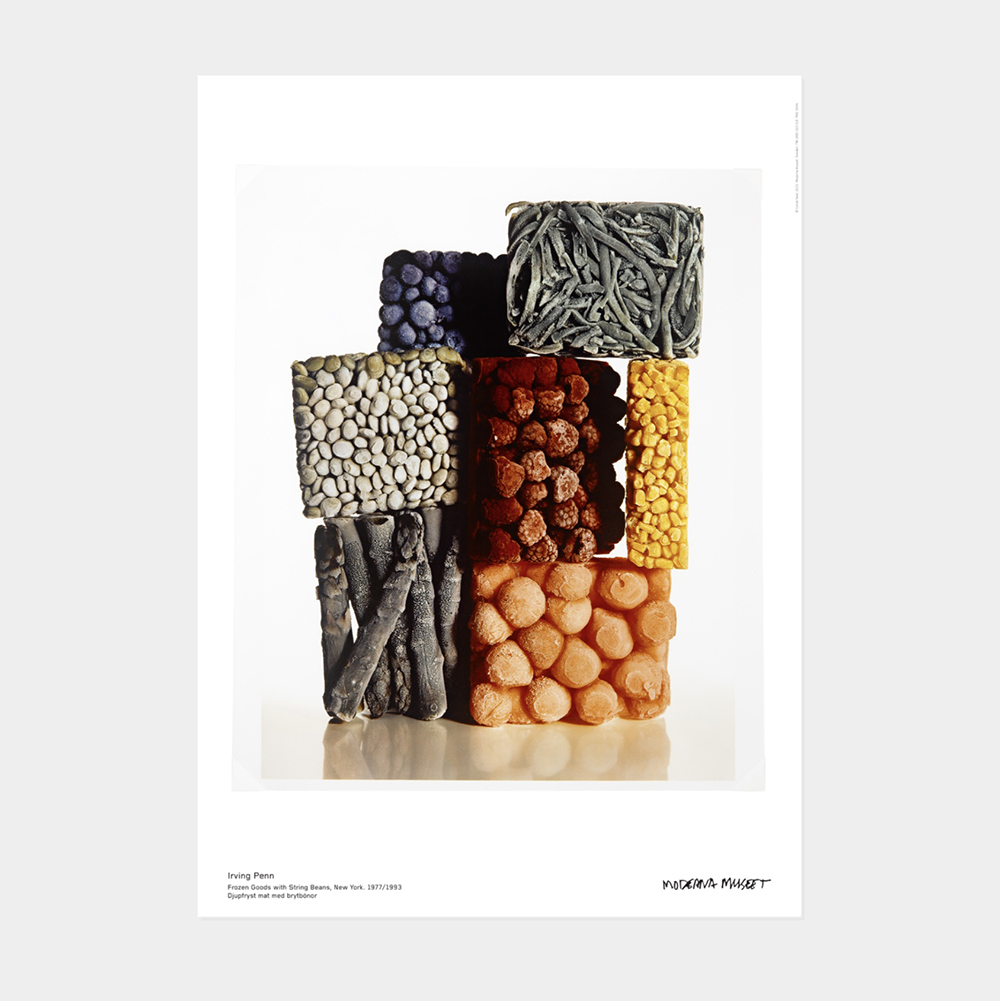
Artwork title: Frozen Foods with String Beans
Original museum poster
Frozen food is one of Irving Penn’s most striking and intriguing subjects.
He is known for his contribution to fashion photography through the countless images he published in Vogue in the 1940s and 1950s. He also mastered still life with an innovative, original approach, transforming food into colorful compositions of icy cubes of fruit and vegetables, revealing an elegance no one had imagined frozen objects could possess.
The fruits and vegetables were arranged with the precision of a Renaissance painting, and the photograph was carefully taken before this velvety layer of frost melted under the heat of the studio lights. This simple yet creative idea produced a powerful, bold image—undoubtedly one of the masterpieces of still-life photography.
Paper & medium
Original poster; size and framing options are listed above.
About the artist
Born in New Jersey in 1917, Irving Penn studied under Alexey Brodovitch. He photographed countless legendary painters, musicians, actors and philosophers. Over a career spanning seventy years, this American master of photography became a legend himself.
Irving Penn initially joined Vogue as a cover illustrator, subsequently becoming a cover photographer while also editing illustrations for its pages. At Vogue, he developed his distinctive style, especially his skill in constructing finely orchestrated two- and three-dimensional settings, profoundly influencing postwar ideas of fashion photography. In 1953, he established his own commercial photography studio and soon became one of the world's most successful and influential advertising photographers.
Before his death in 2009, Irving Penn had been described as a living archive of portrait photography. Working in fashion photography at the age of 92 was rare indeed, and Penn pioneered a new style of studio portraiture. This stemmed entirely from his commitment to traditional photography and its ability to capture the soul with penetrating insight. Penn liked to carry his “studio” with him—in fact, an old painter’s canvas—and wherever he went, he released the shutter against this particular backdrop. As a result, nearly all of Penn’s work has the look of studio photography.
“People often show the camera the side of themselves they wish to show the world... But what lies behind the appearance is more precious, and more wonderful than they themselves believe.” — Irving Penn