

THE LIGHTO EDIT
A little art
changes everything.
Thoughtful works by artists near and far, chosen for the spaces we call home.
EXPLORE THE COLLECTIONMeet the artists and find the piece that feels like yours.
LIGHTO TO MEET YOUFIND YOUR POINT OF VIEW
A place to begin.
Landscapes, abstract forms, and everyday beauty.
THE COLLECTION
Art to live with
Browse the works from LIGHTO's authorized artists.
No artworks match these filters. Try another color, subject, or orientation.
THE PEOPLE BEHIND THE ART
Meet the artists
From established names to new perspectives, discover the makers in the LIGHTO collection.
Sizes & prices
| Size | Artwork only | With framing | Framing + acrylic |
|---|---|---|---|
| 96.5×40.6 cm | — | USD 296 | USD 330 |
Product details
Printing medium: original poster.
* The mounting and framing process is time-consuming and labor-intensive. Please allow 2–3 weeks for your order and thank you for your patience.
* If you would like the text at the bottom trimmed off, please note this when ordering.
Hanging method:
Every aluminum frame has a hanging wire on the back. To hang it, you can attach a 3M damage-free hook to the wall (please purchase a version rated for at least 5 kg for safety).
* The mounting and framing process is time-consuming and labor-intensive. Please allow 3 weeks for your order and thank you for your patience.
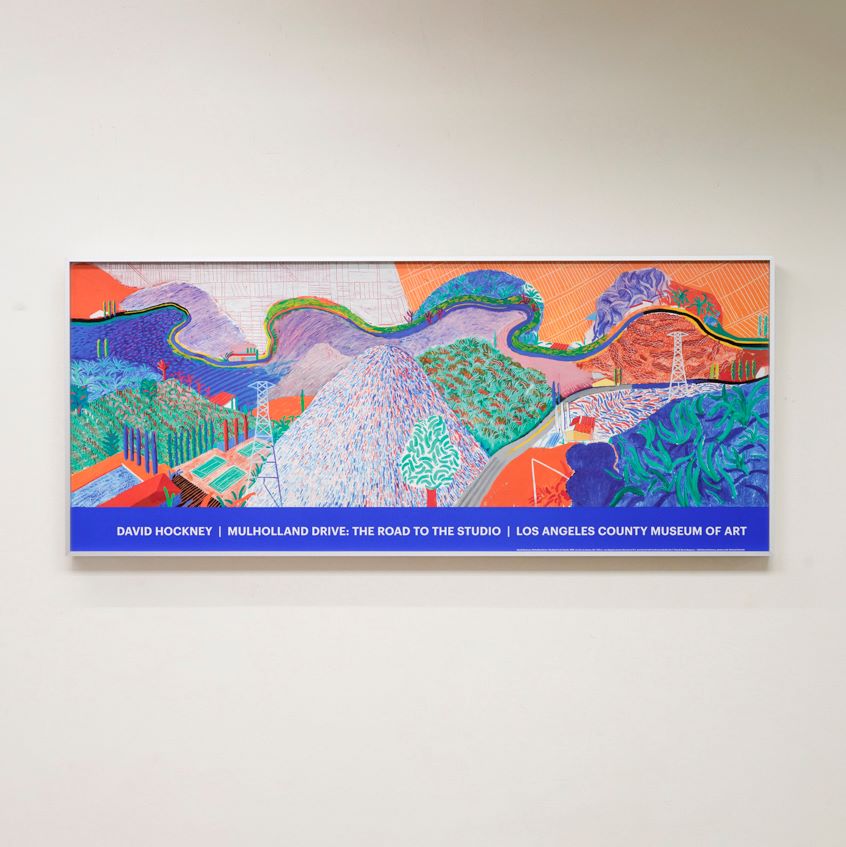
Artwork title: Mulholland Drive
Poster size: 38 x 16 inches ( 96.5x40.6cm )
Original exhibition poster from the United States
Actual artwork photo x silver aluminum frame
Artist: David Hockney
David Hockney was an important artist who rose to prominence in Britain in the 1960s. When he first attracted attention, he was still a student at the Royal College of Art in London. Alongside fellow students and more senior classmates, including Allen Jones and R. B. Kitaj, he participated in the 1961 annual Young Contemporaries exhibition at the Whitechapel Gallery, helping usher in a new British Pop aesthetic.
In 1964, Hockney moved from London to Los Angeles and began painting Southern California life: rolling hills, swimming pools and modernist architecture, often with homoerotic undertones. Landscape also became an important subject in his work, from paintings and collages made with Polaroids and 35 mm color film in the 1980s to mural-scale panoramas and stage sets. In recent years, he has worked on an iPad, continuing to explore the relationships between visual perception, space and technology.
Tate Britain, the Centre Pompidou, and the Metropolitan Museum of Art organized a major retrospective honoring Hockney’s enduring artistic career. Even in his eighties, he continues to create. His work is held by major art institutions around the world, including the British Museum in London, the Metropolitan Museum of Art in New York, and the Hayward Gallery Art Society in London.
David Hockney is loved by many for his ability to engage with the ordinary—the stuff of which most of the world is made. He likes to leave it a little open-ended and draw us in: Hockney offers a subject while inviting us to take part in interpreting the scene.
We return to 1964, when 27-year-old David Hockney moved from Britain to sunny California. Inspired by the environment of the American West Coast, he painted numerous pictures of swimming pools, with or without people, usually in delicate shades of pink, light blue, or light green.
Today, David Hockney lives in Normandy, where he continues to experiment with materials and capture the local atmosphere through his wonderful lines and assured sense of color.
Paper & medium
Original poster; size and framing options are listed above.
About the artist
David Hockney was an important artist who rose to prominence in Britain in the 1960s. When he first attracted attention, he was still a student at the Royal College of Art in London. Alongside fellow students and more senior classmates, including Allen Jones and R. B. Kitaj, he participated in the 1961 annual Young Contemporaries exhibition at the Whitechapel Gallery, helping usher in a new British Pop aesthetic.
In 1964, Hockney moved from London to Los Angeles and began painting Southern California life: rolling hills, swimming pools and modernist architecture, often with homoerotic undertones. Landscape also became an important subject in his work, from paintings and collages made with Polaroids and 35 mm color film in the 1980s to mural-scale panoramas and stage sets. In recent years, he has worked on an iPad, continuing to explore the relationships between visual perception, space and technology.
Tate Britain, the Centre Pompidou, and the Metropolitan Museum of Art organized a major retrospective honoring Hockney’s enduring artistic career. Even in his eighties, he continues to create. His work is held by major art institutions around the world, including the British Museum in London, the Metropolitan Museum of Art in New York, and the Hayward Gallery Art Society in London.
David Hockney is loved by many for his ability to engage with the ordinary—the stuff of which most of the world is made. He likes to leave it a little open-ended and draw us in: Hockney offers a subject while inviting us to take part in interpreting the scene.
We return to 1964, when 27-year-old David Hockney moved from Britain to sunny California. Inspired by the environment of the American West Coast, he painted numerous pictures of swimming pools, with or without people, usually in delicate shades of pink, light blue, or light green.
Today, David Hockney lives in Normandy, where he continues to experiment with materials and capture the local atmosphere through his wonderful lines and assured sense of color.