

THE LIGHTO EDIT
A little art
changes everything.
Thoughtful works by artists near and far, chosen for the spaces we call home.
EXPLORE THE COLLECTIONMeet the artists and find the piece that feels like yours.
LIGHTO TO MEET YOUFIND YOUR POINT OF VIEW
A place to begin.
Landscapes, abstract forms, and everyday beauty.
THE COLLECTION
Art to live with
Browse the works from LIGHTO's authorized artists.
No artworks match these filters. Try another color, subject, or orientation.
THE PEOPLE BEHIND THE ART
Meet the artists
From established names to new perspectives, discover the makers in the LIGHTO collection.
Sizes & prices
| Size | Artwork only | With framing | Framing + acrylic |
|---|---|---|---|
| 68×59.4 cm | — | USD 190 | USD 226 |
Product details
Artist:
Marsden Hartley (1877–1943), born in Lewiston, Maine, was an important American modernist painter, poet and essayist. His work is often seen as a bridge between European modernism and American modern art. The National Gallery of Art records his early studies at the Cleveland School of Art and later training in New York. Louisiana likewise describes his long, nomadic career moving between Europe and the United States.
Hartley's style varied widely, making him fascinating but at times difficult for art historians to categorize. He painted landscapes, still lifes, abstract symbols, mountains and coastlines, drawing on Cubism, German Expressionism and American folk art. The Metropolitan Museum notes that he was an important member of Alfred Stieglitz's circle. His practice began with Maine mountain landscapes, followed by many years traveling between Europe and North America.
Among his best-known works are the abstract pieces he created during his Berlin period, such as Portrait of a German Officer. The Met Museum notes that this work combines Cubism, German Expressionism, and the military imagery of wartime Berlin, while also conveying his personal feelings for a Prussian officer, Karl von Freyburg.
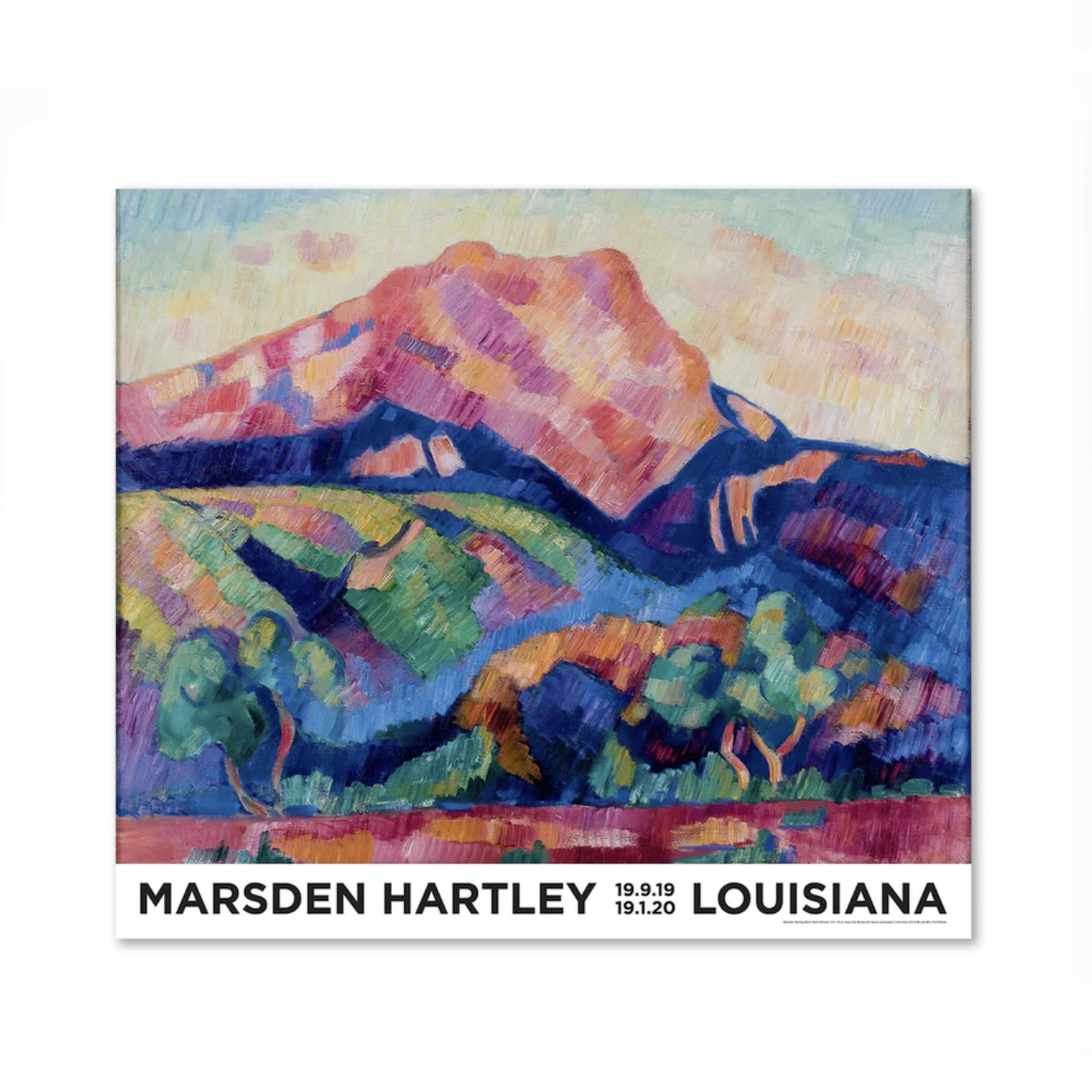
Artwork title: Mont Saint-Victoire
Poster size: W: 68 x H: 59.4 cm
Original poster from an art museum
Mont Saint-Victoire depicts Mont Sainte-Victoire in Provence, southern France. The mountain is famous in art history as a classic subject that Paul Cézanne painted repeatedly. While living in France in 1927, Hartley returned to the theme of mountains, which had interested him since his early years, and created a series of works depicting Mont Sainte-Victoire. Christie’s description also notes that, during his stay in France in 1927, Hartley’s interest in mountain subjects was rekindled, and he created the extraordinary Mont Sainte-Victoire series.
What makes this work most captivating is that it is not simply a landscape painting: Hartley reexamines Cézanne's mountain through a modernist lens.
In the picture, the mountain is rendered as enormous interlocking blocks of pink, purple, blue, and orange. The hills in the foreground are built up with bands of green, blue, purple, and red brushstrokes, making the terrain look as though it has been broken down into rhythmic layers. The work preserves the contours of a landscape but does not seek naturalistic realism; instead, it emphasizes the mountain’s structure, weight, light, and chromatic energy.
Why is this piece important?
This work can be seen as Hartley's response to Cézanne.
When Cézanne painted Mont Sainte-Victoire, he explored how nature could become a stable geometric structure. Hartley went further, making the mountain more vivid, emotional and Expressionist. Less composed than Cézanne's vision, it becomes a luminous, burning and almost spiritual landscape.
One way to understand it is:
Cézanne's Mont Sainte-Victoire investigates the structure of modern painting. Hartley's version transforms the mountain into an emotional, energetic symbol of the spirit.
Paper & medium
Original poster; size and framing options are listed above.
About the artist
Marsden Hartley (1877–1943), born in Lewiston, Maine, was an important American modernist painter, poet and essayist. His work is often seen as a bridge between European modernism and American modern art. The National Gallery of Art records his early studies at the Cleveland School of Art and later training in New York. Louisiana likewise describes his long, nomadic career moving between Europe and the United States.
Hartley's style varied widely, making him fascinating but at times difficult for art historians to categorize. He painted landscapes, still lifes, abstract symbols, mountains and coastlines, drawing on Cubism, German Expressionism and American folk art. The Metropolitan Museum notes that he was an important member of Alfred Stieglitz's circle. His practice began with Maine mountain landscapes, followed by many years traveling between Europe and North America.
Among his best-known works are the abstract pieces he created during his Berlin period, such as Portrait of a German Officer. The Met Museum notes that this work combines Cubism, German Expressionism, and the military imagery of wartime Berlin, while also conveying his personal feelings for a Prussian officer, Karl von Freyburg.