

THE LIGHTO EDIT
A little art
changes everything.
Thoughtful works by artists near and far, chosen for the spaces we call home.
EXPLORE THE COLLECTIONMeet the artists and find the piece that feels like yours.
LIGHTO TO MEET YOUFIND YOUR POINT OF VIEW
A place to begin.
Landscapes, abstract forms, and everyday beauty.
THE COLLECTION
Art to live with
Browse the works from LIGHTO's authorized artists.
No artworks match these filters. Try another color, subject, or orientation.
THE PEOPLE BEHIND THE ART
Meet the artists
From established names to new perspectives, discover the makers in the LIGHTO collection.
Sizes & prices
| Size | Artwork only | With framing | Framing + acrylic |
|---|---|---|---|
| 50×70 cm | — | USD 223 | USD 256 |
Product details
Artist:
Lee Bae
Lee Bae, born in Cheongdo, South Korea, in 1956, is a contemporary Korean artist living and working between Paris and Seoul. He received bachelor's and master's degrees in fine arts from Hongik University and has become an internationally prominent representative of Korean monochrome and material-based art.
His most important material is charcoal. This is fascinating because charcoal is not simply a black pigment; it is “what remains of wood’s life after fire.” Perrotin describes his work aptly: Lee Bae’s art reveals the material and symbolic power of “wood shaped by fire.”
For Lee Bae, charcoal connects Korean cultural memory, the ink of calligraphy, fire, nature, death, and rebirth. The PHI Foundation notes that, in Korean tradition, charcoal also symbolizes purification, moisture control, protection of a space, and the welcoming of new life. His black is therefore not simply black, but a black imbued with cultural memory and spirituality.
Artwork title:
Poster size: W: 50*70cm
Original poster
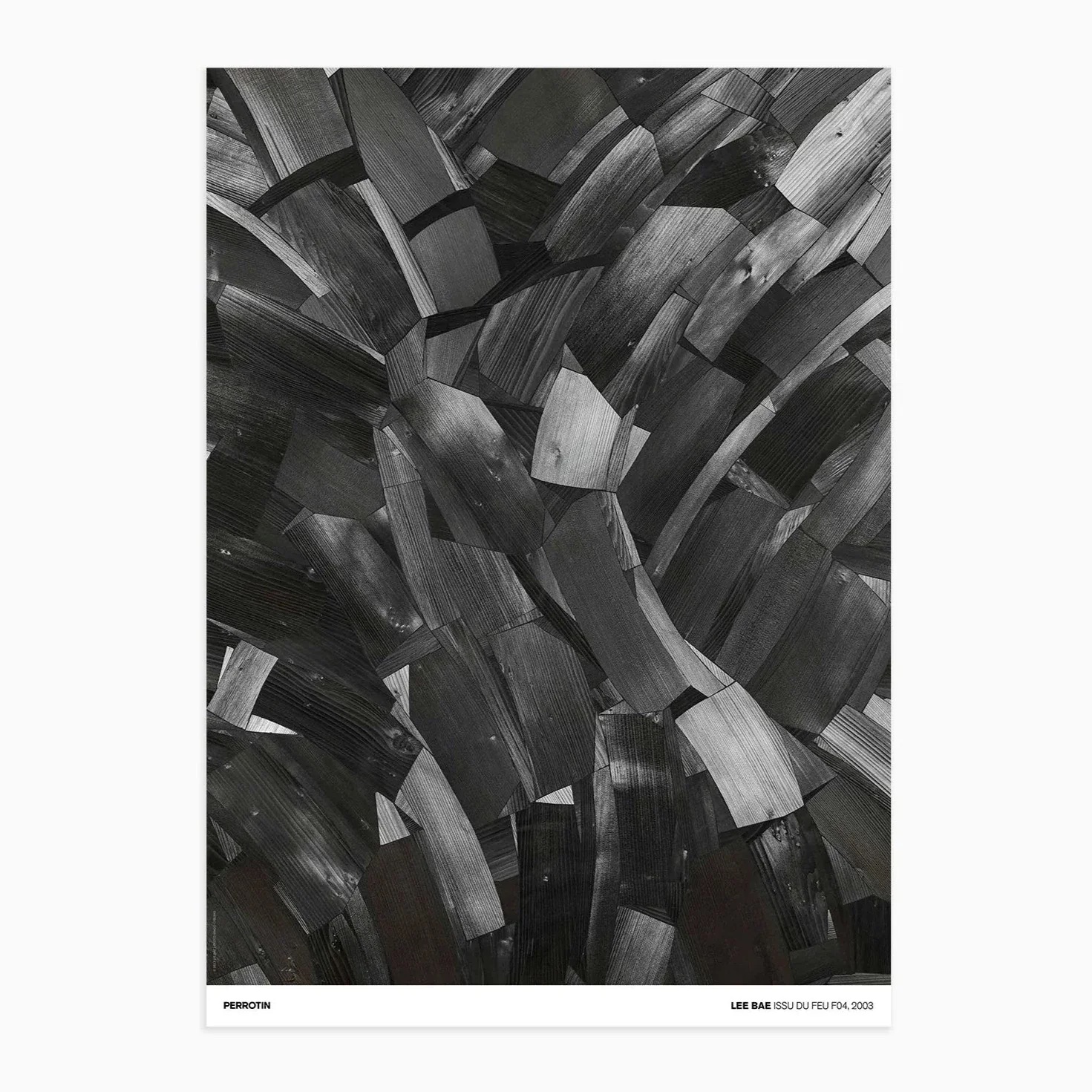
About the artwork: “Issu du Feu F04, 2003”
Issu du Feu can be understood as 'born of fire' or 'from the flames.' It is one of Lee Bae's signature series. Perrotin Tokyo likewise describes it as 'from fire,' presenting Lee Bae as an artist renowned for his continuing exploration of charcoal.
The original series generally uses charcoal as its primary material: the artist cuts, arranges, and polishes pieces of charcoal, then affixes them to canvas or panels to form a mosaic-like black surface. According to Fondation Maeght, Lee Bae shapes and polishes raw charcoal before attaching it to canvas, creating different densities, sheens, and layers of black.
The visual focus of Issu du Feu F04, 2003 is its forms resembling fire-scorched pieces of wood, charcoal, and fragments. It looks almost entirely black, but the longer you look, the more blacks you discover within it: matte black, silvery gray-black, deep ink-black, and black marked by wood grain. Here, black is not the background; it is the protagonist.
About the artwork:
Paper & medium
Original poster; size and framing options are listed above.
About the artist
Lee Bae, born in Cheongdo, South Korea, in 1956, is a contemporary Korean artist living and working between Paris and Seoul. He received bachelor's and master's degrees in fine arts from Hongik University and has become an internationally prominent representative of Korean monochrome and material-based art.
His most important material is charcoal. This is fascinating because charcoal is not simply a black pigment; it is “what remains of wood’s life after fire.” Perrotin describes his work aptly: Lee Bae’s art reveals the material and symbolic power of “wood shaped by fire.”
For Lee Bae, charcoal connects Korean cultural memory, the ink of calligraphy, fire, nature, death, and rebirth. The PHI Foundation notes that, in Korean tradition, charcoal also symbolizes purification, moisture control, protection of a space, and the welcoming of new life. His black is therefore not simply black, but a black imbued with cultural memory and spirituality.