

THE LIGHTO EDIT
A little art
changes everything.
Thoughtful works by artists near and far, chosen for the spaces we call home.
EXPLORE THE COLLECTIONMeet the artists and find the piece that feels like yours.
LIGHTO TO MEET YOUFIND YOUR POINT OF VIEW
A place to begin.
Landscapes, abstract forms, and everyday beauty.
THE COLLECTION
Art to live with
Browse the works from LIGHTO's authorized artists.
No artworks match these filters. Try another color, subject, or orientation.
THE PEOPLE BEHIND THE ART
Meet the artists
From established names to new perspectives, discover the makers in the LIGHTO collection.
Sizes & prices
Product details
Artist:
Lee Bae
Lee Bae, born in Cheongdo, South Korea, in 1956, is a contemporary Korean artist living and working between Paris and Seoul. He received bachelor's and master's degrees in fine arts from Hongik University and has become an internationally prominent representative of Korean monochrome and material-based art.
His most important material is charcoal. This is fascinating because charcoal is not simply a black pigment; it is “what remains of wood’s life after fire.” Perrotin describes his work aptly: Lee Bae’s art reveals the material and symbolic power of “wood shaped by fire.”
For Lee Bae, charcoal connects Korean cultural memory, the ink of calligraphy, fire, nature, death, and rebirth. The PHI Foundation notes that, in Korean tradition, charcoal also symbolizes purification, moisture control, protection of a space, and the welcoming of new life. His black is therefore not simply black, but a black imbued with cultural memory and spirituality.
Artwork title:
Poster size: W: 50*70cm
Original poster
About the artwork:
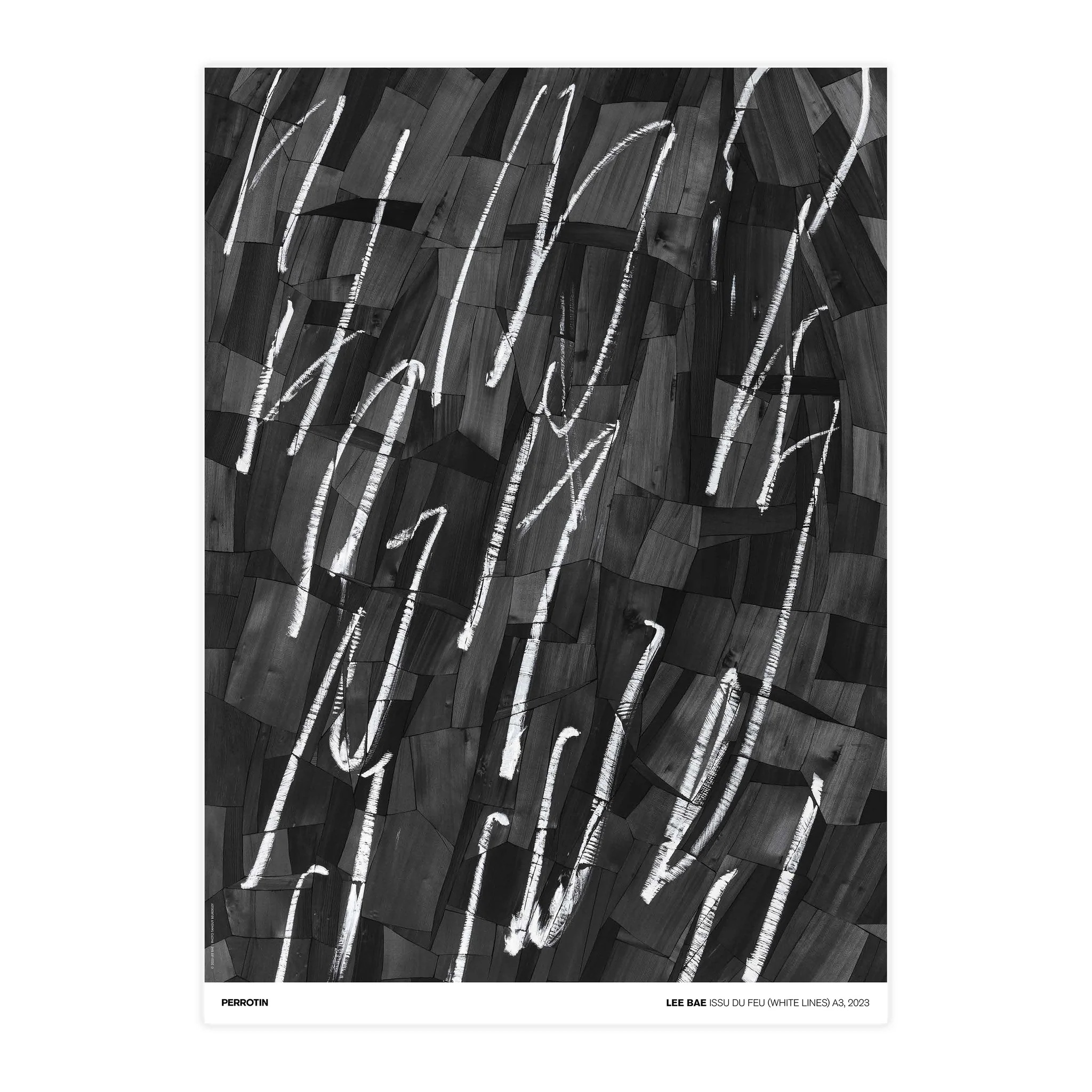
This work continues the central concerns of Lee Bae's practice: charcoal, fire, black, and traces.
The background is a composition of charcoal fragments in varying shades of black, like pieces of wood left after burning. Its surface is not simply black but richly layered: matte black, gray-black, and lustrous charcoal black form a texture reminiscent of slate, wood chips, and the remains of a fire.
Most striking are the white lines across the image. They resemble calligraphy, the paths of flames, or light cutting through cracks in the black. They suddenly give the once-still black background rhythm and speed.
How can this work be understood?
Issu du Feu is French for 'born of fire' or 'from the flames.' Lee Bae has worked with charcoal for many years. The PHI Foundation explains its significance as simultaneously material, symbolic and spiritual. For the artist, charcoal connects Korean culture, the ink of calligraphy, childhood memories and the transformative power of fire.
So this work is not depicting “black,” but expressing a deeper state:
The wood was burned by fire, but it did not disappear. It became charcoal, retaining its texture, weight, and memory. The white lines resemble flames, breath, or writing, setting the darkness in motion again.
It has something of the spirit of East Asian calligraphy without being traditional calligraphy; it has a touch of minimalist abstraction while retaining a strong sense of materiality. That is what makes Lee Bae’s work so compelling: he makes “black” feel quiet, but never dull.
Paper & medium
Original poster; size and framing options are listed above.
About the artist
Lee Bae, born in Cheongdo, South Korea, in 1956, is a contemporary Korean artist living and working between Paris and Seoul. He received bachelor's and master's degrees in fine arts from Hongik University and has become an internationally prominent representative of Korean monochrome and material-based art.
His most important material is charcoal. This is fascinating because charcoal is not simply a black pigment; it is “what remains of wood’s life after fire.” Perrotin describes his work aptly: Lee Bae’s art reveals the material and symbolic power of “wood shaped by fire.”
For Lee Bae, charcoal connects Korean cultural memory, the ink of calligraphy, fire, nature, death, and rebirth. The PHI Foundation notes that, in Korean tradition, charcoal also symbolizes purification, moisture control, protection of a space, and the welcoming of new life. His black is therefore not simply black, but a black imbued with cultural memory and spirituality.