

THE LIGHTO EDIT
A little art
changes everything.
Thoughtful works by artists near and far, chosen for the spaces we call home.
EXPLORE THE COLLECTIONMeet the artists and find the piece that feels like yours.
LIGHTO TO MEET YOUFIND YOUR POINT OF VIEW
A place to begin.
Landscapes, abstract forms, and everyday beauty.
THE COLLECTION
Art to live with
Browse the works from LIGHTO's authorized artists.
No artworks match these filters. Try another color, subject, or orientation.
THE PEOPLE BEHIND THE ART
Meet the artists
From established names to new perspectives, discover the makers in the LIGHTO collection.
Sizes & prices
| Size | Artwork only | With framing | Framing + acrylic |
|---|---|---|---|
| 70×50 cm | — | USD 190 | USD 223 |
Product details
* The mounting and framing process is time-consuming and labor-intensive. Please allow 2–3 weeks for your order and thank you for your patience.
Artwork title:
Poster size: 70cm x 50cm
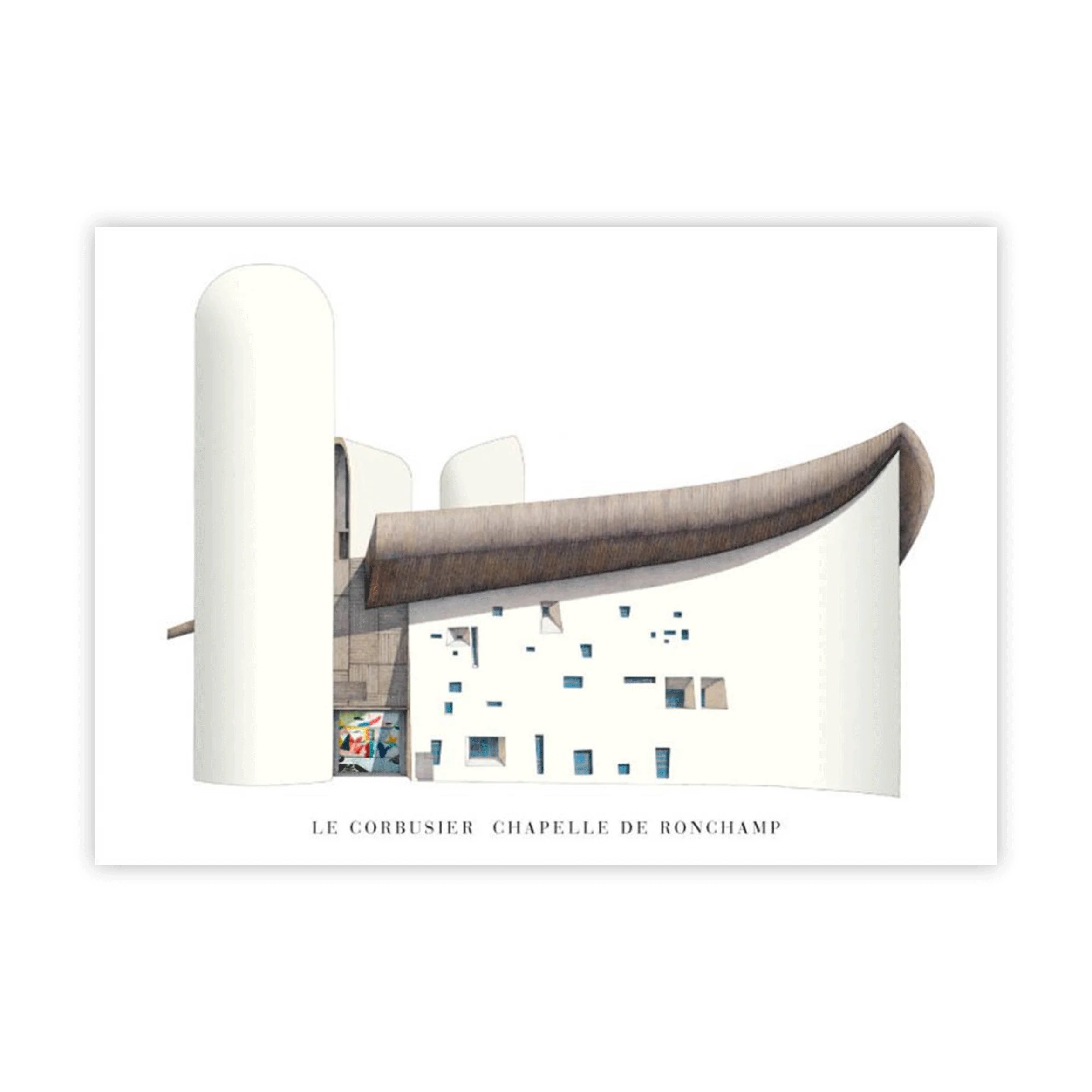
Introduction to the work/building: Notre-Dame du Haut chapel
Chapelle Notre-Dame-du-Haut stands on Bourlémont hill in Ronchamp, France. Le Corbusier paid particular attention to landscape and sightlines, making the building seem to grow from the hillside. The official World Heritage account describes its asymmetrical plan and curved walls beneath a roof resembling a crab shell. Although it lacks the side aisles and cruciform plan typical of traditional churches, it still faces east.
Its most captivating features are its thick walls, curved roof, light, and sense of stillness. From the outside, it looks like a white sculpture, while the roof resembles a heavy yet floating dark shell. Window openings of different sizes let light enter the interior in highly irregular, almost mysterious ways. The Fondation Le Corbusier also notes that the chapel uses a range of materials, including exposed concrete, painted plaster, wood, cast iron, and bronze, with stained glass and light creating a distinctive atmosphere.
Artist/architect introduction: Le Corbusier
Le Corbusier, born Charles-Édouard Jeanneret-Gris in La Chaux-de-Fonds, Switzerland, in 1887, adopted his pseudonym after 1920. Beyond architecture, he made paintings, sculptures, tapestries and furniture and wrote extensively on architecture and urban theory. The official World Heritage website notes that, despite lacking formal degrees in architecture or urban planning, he became internationally renowned in both fields.
He is one of the most important figures in 20th-century modern architecture. Early Le Corbusier is often associated with rationality, geometry, white houses, and functionalism, as exemplified by Villa Savoye. By the time of the chapel at Ronchamp, however, his architectural language had become freer, more substantial, and more sculptural. That is what makes this chapel special: rather than cold modernism, it is a work of modern architecture rich in spirituality, emotion, and spatial poetry.