

THE LIGHTO EDIT
A little art
changes everything.
Thoughtful works by artists near and far, chosen for the spaces we call home.
EXPLORE THE COLLECTIONMeet the artists and find the piece that feels like yours.
LIGHTO TO MEET YOUFIND YOUR POINT OF VIEW
A place to begin.
Landscapes, abstract forms, and everyday beauty.
THE COLLECTION
Art to live with
Browse the works from LIGHTO's authorized artists.
No artworks match these filters. Try another color, subject, or orientation.
THE PEOPLE BEHIND THE ART
Meet the artists
From established names to new perspectives, discover the makers in the LIGHTO collection.
Sizes & prices
| Size | Artwork only | With framing | Framing + acrylic |
|---|---|---|---|
| 50×70 cm | — | USD 176 | USD 210 |
Product details
* The original poster was purchased on your behalf from overseas.
* The mounting and framing process is time-consuming and labor-intensive. Please allow 3–4 weeks for your order and thank you for your patience.
Why is my artwork uneven!? The difference between mounting and framing artwork.
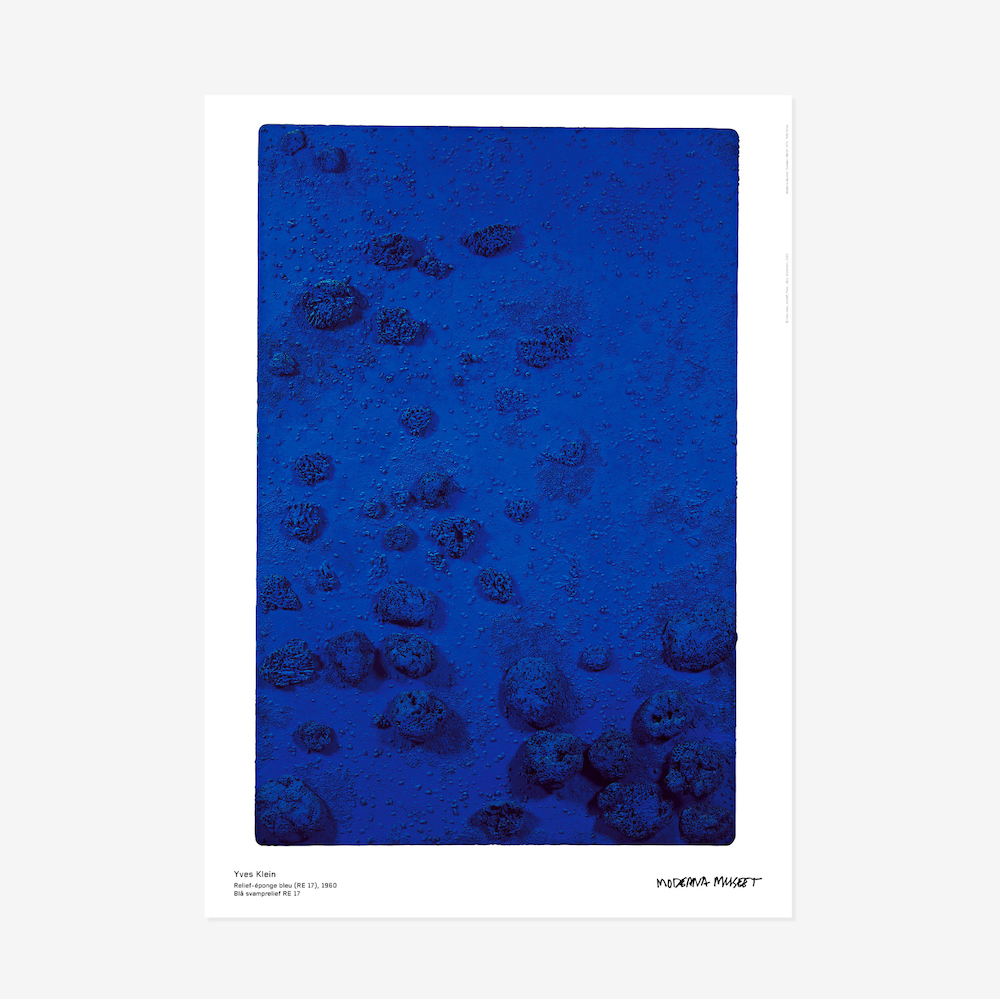
Title: Relief éponge-Blue RE 17, 1960
Artwork medium: Poster
Artwork dimensions: 50 x 70 cm
Artwork source: original museum poster
(Photograph of the actual poster. It looks even better in person; the special blue ink is difficult to capture in photographs.)
🎨 I. Artist Introduction
Born in Nice, France, Yves Klein was a major figure in the postwar European avant-garde. He is regarded as a central member of Nouveau Réalisme and a pioneer of conceptual and performance art. Although he lived only 34 years, he left a profound mark on painting, sculpture, music, architecture, and even philosophy.
🔵 II. Signature Style: The Monochrome Blue Revolution
Klein is best known for his distinctive International Klein Blue (IKB), an intensely saturated ultramarine that appears both brilliant and almost infinitely deep. He believed it could embody spiritual infinity and the dissolution of matter: a color between sky and cosmos.
In 1957, he held the celebrated exhibition Proposte monochrome: Epoca Blu (Blue Period), showing a number of monochrome blue paintings and inviting viewers to immerse themselves in an experience of pure color.
🧍♀️ III. A Pioneer of Performance and Conceptual Art
Klein worked beyond painting, often using actions to challenge art's boundaries. His most representative experiments include:
Anthropometries: He had nude female models cover themselves in IKB paint and leave marks on canvas with their bodies as brushes, surrounded by music and an audience. This is regarded as an early form of performance art in which the body becomes the brush.
Architecture of Air: Working with architects, he envisioned invisible architecture, using natural elements such as “air, fire, and water” as building materials and reflecting his pursuit of “immaterial art.”
Leap into the Void (Le Saut dans le Vide, 1960): He photographed himself leaping from a rooftop into the air, symbolizing the flight of the human spirit and faith in freedom.
✨ IV. Artistic Thought and Legacy
Klein's central idea was immaterial art, seeking to move art beyond physical matter into energy, spirit and space. In Paris, he even sold Zones of Immaterial Pictorial Sensibility in exchange for gold, later casting gold into the Seine to symbolize art's dissolution and transcendence.
His ideas deeply influenced later:
Conceptual Art
Performance art
Minimal Art and Monochrome Painting
🕊️ V. Conclusion
Yves Klein was an artist who used “blue” to explore the boundaries of the universe and the spirit. He once said, “Blue is the color of the immaterial; it transcends the visible world.” His art invites us to reconsider: What is “creation”? And what is “existence”?
Paper & medium
Original poster; size and framing options are listed above.
About the artist
Born in Nice, France, Yves Klein was a major figure in the postwar European avant-garde. He is regarded as a central member of Nouveau Réalisme and a pioneer of conceptual and performance art. Although he lived only 34 years, he left a profound mark on painting, sculpture, music, architecture, and even philosophy.
Klein is best known for his distinctive International Klein Blue (IKB), an intensely saturated ultramarine that appears both brilliant and almost infinitely deep. He believed it could embody spiritual infinity and the dissolution of matter: a color between sky and cosmos.
In 1957, he held the celebrated exhibition Proposte monochrome: Epoca Blu (Blue Period), showing a number of monochrome blue paintings and inviting viewers to immerse themselves in an experience of pure color.
Klein worked beyond painting, often using actions to challenge art's boundaries. His most representative experiments include:
Anthropometries: He had nude female models cover themselves in IKB paint and leave marks on canvas with their bodies as brushes, surrounded by music and an audience. This is regarded as an early form of performance art in which the body becomes the brush.
Architecture of Air: Working with architects, he envisioned invisible architecture, using natural elements such as “air, fire, and water” as building materials and reflecting his pursuit of “immaterial art.”
Leap into the Void (Le Saut dans le Vide, 1960): He photographed himself leaping from a rooftop into the air, symbolizing the flight of the human spirit and faith in freedom.
Klein's central idea was immaterial art, seeking to move art beyond physical matter into energy, spirit and space. In Paris, he even sold Zones of Immaterial Pictorial Sensibility in exchange for gold, later casting gold into the Seine to symbolize art's dissolution and transcendence.
Performance art
Minimal Art and Monochrome Painting
Yves Klein was an artist who used “blue” to explore the boundaries of the universe and the spirit. He once said, “Blue is the color of the immaterial; it transcends the visible world.” His art invites us to reconsider: What is “creation”? And what is “existence”?