

THE LIGHTO EDIT
A little art
changes everything.
Thoughtful works by artists near and far, chosen for the spaces we call home.
EXPLORE THE COLLECTIONMeet the artists and find the piece that feels like yours.
LIGHTO TO MEET YOUFIND YOUR POINT OF VIEW
A place to begin.
Landscapes, abstract forms, and everyday beauty.
THE COLLECTION
Art to live with
Browse the works from LIGHTO's authorized artists.
No artworks match these filters. Try another color, subject, or orientation.
THE PEOPLE BEHIND THE ART
Meet the artists
From established names to new perspectives, discover the makers in the LIGHTO collection.
Sizes & prices
| Size | Artwork only | With framing | Framing + acrylic |
|---|---|---|---|
| 30×42 cm | USD 43 | USD 96 | USD 113 |
| 50×72 cm | USD 93 | USD 173 | USD 206 |
| 60×86 cm | USD 130 | USD 243 | USD 280 |
Product details
* The original is a woodcut, which gives the marks a rougher texture.
Discover Japanese woodblock prints:
Production process and division of responsibilities
1. Artist (eshi)
Responsible for drawing the original design.
Provides the overall composition and the design of the figures and landscape.
For example: Katsushika Hokusai, Utagawa Hiroshige, and Kawase Hasui.
2. Publisher (hanmoto)
The heart of the entire team, akin to a “producer + distributor.”
Funded and planned the work, determined its theme, and collaborated with the artist.
Hire carvers and printers, and coordinate the schedule and quality.
Responsible for sales and promotion, and for deciding the size of the edition.
For example: Shozaburo Watanabe of the shin-hanga movement.
3. Block carver (horishi)
Transfer the artist’s original drawing onto a woodblock for carving.
Each color requires a dedicated woodblock.
The technical demands are extremely high: precision down to the millimeter is required, or the overprinted colors will be misaligned.
4. Printer (surishi)
Woodblocks and pigments are used to print the image layer by layer onto washi paper.
Responsible for color gradation, blending, and light-and-shadow effects.
The level of technical skill directly affects the work’s final appearance.
Paper & medium
Giclée print / fine art etching paper
About the artist
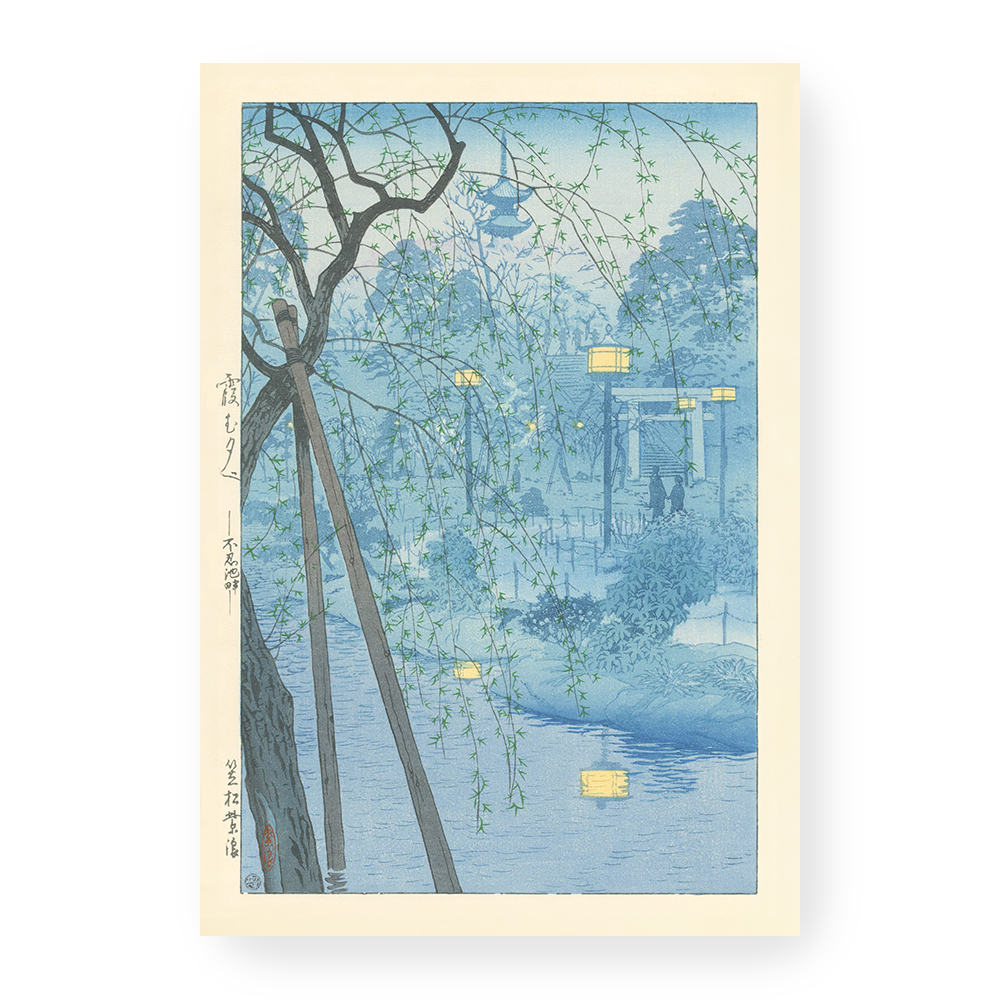
Kasamatsu Purple Wave
Kasamatsu Shirō (1898-1991) was a famous Japanese woodblock printmaker whose artistic career spanned and connected two major printmaking movements: new printmaking and creative printmaking. Kasamatsu is known for his emotional landscapes and urban landscapes, and his works are widely praised for blending traditional Japanese aesthetic consciousness with the sensibility of modern art. His artistic path, which shows both his focus on craftsmanship and his vision of continuous evolution as an artist, reflects the important characteristics of the transition period in the history of Japanese art.
Born in Asakusa, Tokyo, Kasamatsu has demonstrated artistic talent since childhood. He initially learned from Kiyokata Tsugi, a Japanese painter. Under his guidance, he deeply understood Japanese traditional aesthetics and techniques, and profoundly influenced the style of early woodblock prints. The Qing side later introduced his cooperation with Shozaburo Watanabe, an important edition of the new print. This partnership led to many classic works by Kasamatsu, such as woodblock prints depicting quiet landscapes and daily life in Japan, which impressed domestic and foreign audiences.
During the new printmaking period, Kasamatsu mainly worked as a designer, and skilled craftsmen were responsible for engraving and printing. His prints are complex and delicate, often themed on quiet pastoral scenery, the four seasons and traditional architecture, capturing the beauty and nostalgia of the Japanese countryside. His delicate grasp of color gradients and lines fully demonstrates the spirit of craftsmanship and collaboration in Japanese printmaking culture. However, in the 1950s, he began to feel that this mode of cooperation constrained creativity and pursued greater artistic autonomy.
This quest for independence led him into the printmaking movement. The movement emphasizes the personal participation of artists from design, sculpture to printing, enabling Kasamatsu to experiment with new techniques and themes to create more personal and expressive works. At this stage, although he still retains a preference for landscape and traditional themes, his style is more bold and abstract, and he is influenced by the trend of modern art, which further deepens the exploration of texture and color.
Kasamatsu straddled new prints and created prints, making him one of the few artists to successfully navigate both trends. In the field of new printmaking, his work is known for its exquisite technology and lyrical beauty; in the field of creative printmaking, his work is praised for its uniqueness and innovation. With this double achievement, Kasamatsu Shiranui established its important position in the history of Japanese printmaking in the 20th century.