

THE LIGHTO EDIT
A little art
changes everything.
Thoughtful works by artists near and far, chosen for the spaces we call home.
EXPLORE THE COLLECTIONMeet the artists and find the piece that feels like yours.
LIGHTO TO MEET YOUFIND YOUR POINT OF VIEW
A place to begin.
Landscapes, abstract forms, and everyday beauty.
THE COLLECTION
Art to live with
Browse the works from LIGHTO's authorized artists.
No artworks match these filters. Try another color, subject, or orientation.
THE PEOPLE BEHIND THE ART
Meet the artists
From established names to new perspectives, discover the makers in the LIGHTO collection.
Sizes & prices
| Size | Artwork only | With framing | Framing + acrylic |
|---|---|---|---|
| 50×70 cm | — | USD 156 | USD 186 |
Product details
* The original poster was purchased on your behalf from overseas.
* The mounting and framing process is time-consuming and labor-intensive. Please allow 3–4 weeks for your order and thank you for your patience.
* The colors of the actual poster take precedence; photographs and screens may show color differences.
_
A replaceable physical body and irreplaceable humanity.
Tetsuya Ishida used his brush to portray modern people disciplined by institutions and alienated by technology, allowing viewers to feel the fear and sorrow of “becoming a tool” within his claustrophobic images. As artificial intelligence rapidly replaces labor and creativity, his work reminds us that, in a world governed by efficiency and standardization, what may truly be irreplaceable is our vulnerable, free humanity.
.
【Tetsuya Ishida (1973–2005)】
* The illusion of human replaceability
Tetsuya Ishida was born in Yaizu, Shizuoka Prefecture, Japan, and graduated from Musashino Art University’s Department of Visual Communication Design in 1996. In his brief life of thirty-one years, he created a series of highly symbolic paintings that gave surreal visual form to the starkness of modern society and the anxieties of the individual. His protagonists are mostly expressionless young men, often fused with machines, buildings, or everyday objects—sometimes their bodies become part of a table or chair; at other times they turn into components on a factory assembly line. These images have an unsettling poetry and reflect the social climate of Japan after the “Lost Decade”: an era marked by economic stagnation, rigid institutions, and anxiety about people being consumed by systems.
At the heart of Ishida’s work is a warning about people being mechanized and made replaceable. With delicate brushwork, he depicts a claustrophobic modern world—the orderly lines of students at school, the cold order of the office, and faceless groups of people. These images belong not only to Japan in the 1990s but also to our globalized, digital present. In an era dominated by artificial intelligence and algorithms, Ishida’s metaphor of “people becoming tools” seems especially prophetic.
In 2005, he died in a railway accident, leaving just over two hundred works. His early death made him a legendary figure in contemporary Japanese art and gives each work a particular sense of rarity and significance.
* Exhibitions and international attention
Ishida’s reputation grew gradually after his death. In 2019, Spain’s Museo Reina Sofía held a major retrospective, Self-Portrait of Other, systematically introducing his work to European audiences for the first time. In 2023, New York’s Gagosian gallery presented My Anxious Self, placing him within global discussions of the “anxious generation” and the “boundary between humans and machines.” That same year, the exhibition The Irreplaceable Man at Denmark’s Louisiana Museum of Modern Art also featured his representative work Mebae (Awakening, 1998). Its image of boys arranged in neat rows with identical faces symbolizes how society molds people into “functional beings.”
* Auction market and collectible value
On the art market, Tetsuya Ishida’s works are rare and highly sought after. In recent years, auction prices have repeatedly reached new highs:
At Bonhams Hong Kong's Modern and Contemporary Art auction in 2024, The Men on a Belt Conveyor (1996, 145.7 × 103.2 cm) sold for approximately HK$10.01 million, around US$1.28 million, setting a personal auction record.
At auctions in the same series in May 2025, several works by Ishida once again sparked intense bidding, with total sales exceeding US$2 million. According to the international art platform Artsy, both his average auction prices and demand for his work have continued to rise.
Ishida’s work has attracted considerable attention from collectors not only because its subjects speak directly to the isolation and sense of weightlessness shared by modern people, but also because his output was limited and his style distinctive and highly narrative. His work has both art-historical value and a depth of insight into its era.
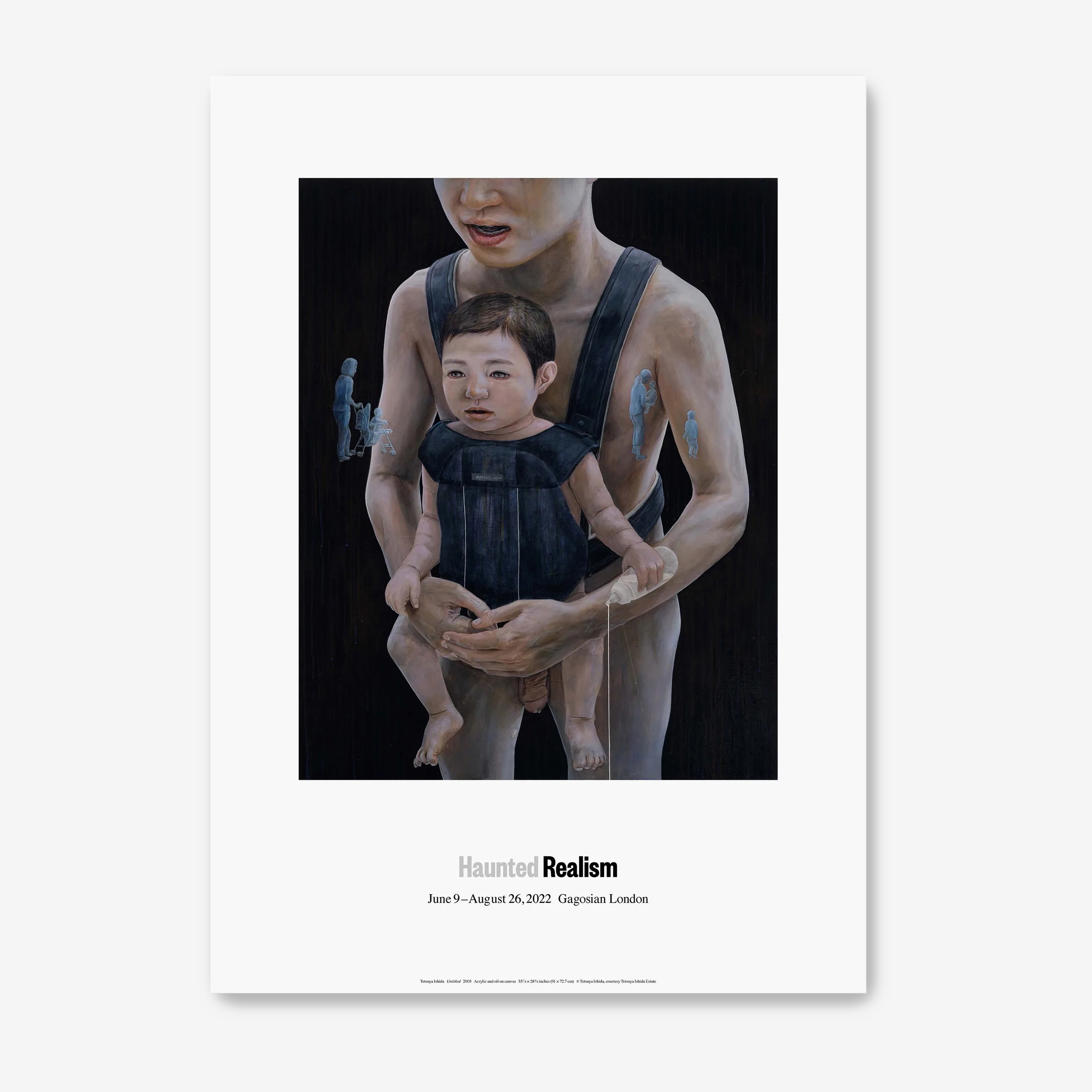
Artwork title: HAUNTED REALISM
At the heart of hauntological realism are modernity’s aspirations—“lost futures” that can now be perceived only as ghostly traces of their original expression. Confronting the accelerating flow of images in contemporary media culture and the proliferation of the “non-places” we increasingly inhabit, the exhibition examines some of the ways artists address this condition. Ishida’s painting depicts a naked man wearing a baby, while a ghostly image of a family floats before him as milk pours from the baby’s bottle.
Poster size: 50x70 cm
Original poster issued by an art museum
Paper & medium
Original poster; size and framing options are listed above.
About the artist
【Tetsuya Ishida (1973–2005)】
* The illusion of human replaceability
Tetsuya Ishida was born in Yaizu, Shizuoka Prefecture, Japan, and graduated from Musashino Art University’s Department of Visual Communication Design in 1996. In his brief life of thirty-one years, he created a series of highly symbolic paintings that gave surreal visual form to the starkness of modern society and the anxieties of the individual. His protagonists are mostly expressionless young men, often fused with machines, buildings, or everyday objects—sometimes their bodies become part of a table or chair; at other times they turn into components on a factory assembly line. These images have an unsettling poetry and reflect the social climate of Japan after the “Lost Decade”: an era marked by economic stagnation, rigid institutions, and anxiety about people being consumed by systems.
At the heart of Ishida’s work is a warning about people being mechanized and made replaceable. With delicate brushwork, he depicts a claustrophobic modern world—the orderly lines of students at school, the cold order of the office, and faceless groups of people. These images belong not only to Japan in the 1990s but also to our globalized, digital present. In an era dominated by artificial intelligence and algorithms, Ishida’s metaphor of “people becoming tools” seems especially prophetic.
In 2005, he died in a railway accident, leaving just over two hundred works. His early death made him a legendary figure in contemporary Japanese art and gives each work a particular sense of rarity and significance.
* Exhibitions and international attention
Ishida’s reputation grew gradually after his death. In 2019, Spain’s Museo Reina Sofía held a major retrospective, Self-Portrait of Other, systematically introducing his work to European audiences for the first time. In 2023, New York’s Gagosian gallery presented My Anxious Self, placing him within global discussions of the “anxious generation” and the “boundary between humans and machines.” That same year, the exhibition The Irreplaceable Man at Denmark’s Louisiana Museum of Modern Art also featured his representative work Mebae (Awakening, 1998). Its image of boys arranged in neat rows with identical faces symbolizes how society molds people into “functional beings.”
* Auction market and collectible value
On the art market, Tetsuya Ishida’s works are rare and highly sought after. In recent years, auction prices have repeatedly reached new highs:
At Bonhams Hong Kong's Modern and Contemporary Art auction in 2024, The Men on a Belt Conveyor (1996, 145.7 × 103.2 cm) sold for approximately HK$10.01 million, around US$1.28 million, setting a personal auction record.
At auctions in the same series in May 2025, several works by Ishida once again sparked intense bidding, with total sales exceeding US$2 million. According to the international art platform Artsy, both his average auction prices and demand for his work have continued to rise.
Ishida’s work has attracted considerable attention from collectors not only because its subjects speak directly to the isolation and sense of weightlessness shared by modern people, but also because his output was limited and his style distinctive and highly narrative. His work has both art-historical value and a depth of insight into its era.