

THE LIGHTO EDIT
A little art
changes everything.
Thoughtful works by artists near and far, chosen for the spaces we call home.
EXPLORE THE COLLECTIONMeet the artists and find the piece that feels like yours.
LIGHTO TO MEET YOUFIND YOUR POINT OF VIEW
A place to begin.
Landscapes, abstract forms, and everyday beauty.
THE COLLECTION
Art to live with
Browse the works from LIGHTO's authorized artists.
No artworks match these filters. Try another color, subject, or orientation.
THE PEOPLE BEHIND THE ART
Meet the artists
From established names to new perspectives, discover the makers in the LIGHTO collection.
Sizes & prices
| Size | Artwork only | With framing | Framing + acrylic |
|---|---|---|---|
| 40×40 cm | USD 43 | USD 96 | USD 110 |
| 60×60 cm | USD 90 | USD 176 | USD 203 |
Product details
Printing paper: giclée print on etching fine art paper.
* Photographic paper only: ships in 3–5 business days.
* The mounting and framing process is time-consuming and labor-intensive. Please allow 2–3 weeks for your order and thank you for your patience.
Artwork dimensions: Medium 40x40 cm / Large 60x60 cm
* Please message us to discuss other sizes.
Artist: Josef Albers
Josef Albers: Master of Color and Form
Early Life and the Bauhaus Legacy
Josef Albers (1888–1976) was a German-American artist and educator. His artistic career began at Germany’s renowned **Bauhaus** school, where he progressed from student to “Master,” profoundly influenced by the Bauhaus emphasis on experimental craft and functional design.
In 1933, after the Bauhaus closed under Nazi pressure, Albers emigrated to the United States. He became an important bridge between European modernism and American art, heading the art department at Black Mountain College and later the design department at Yale University.
The philosophy of color: Homage to the Square
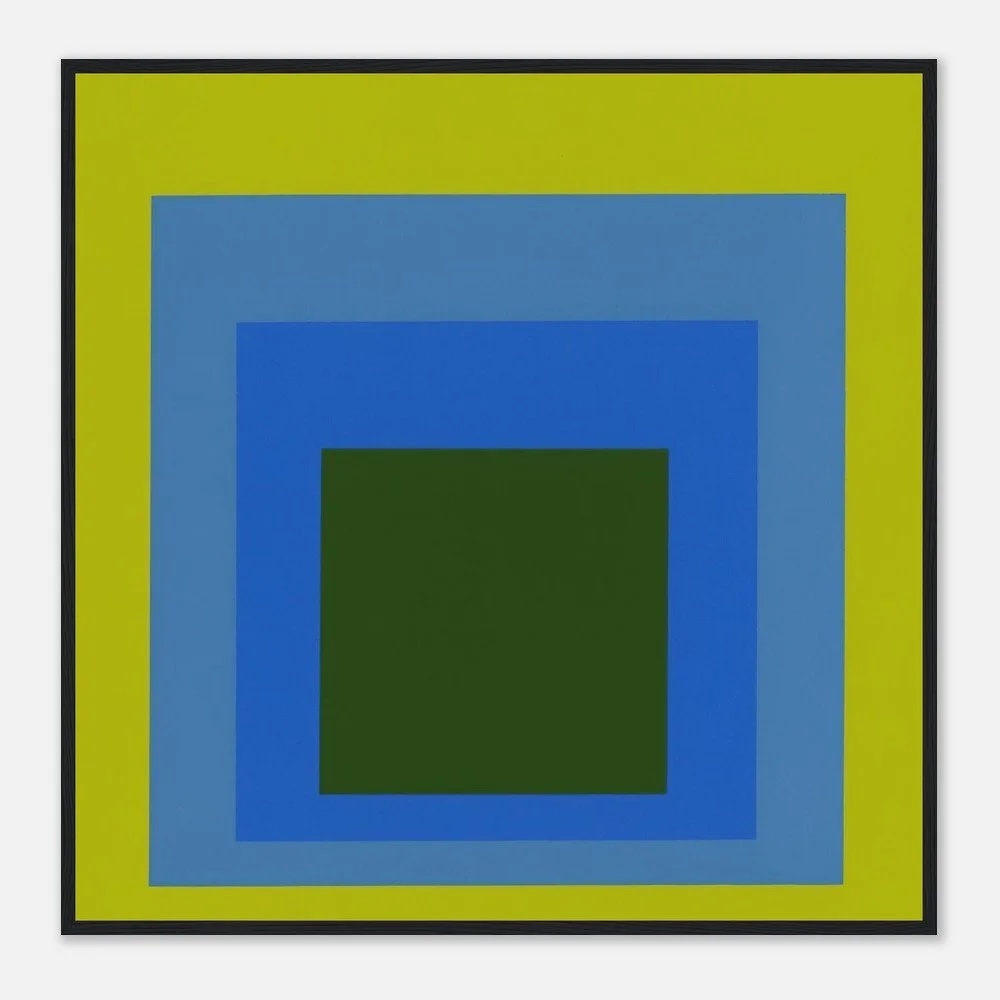
Albers’s best-known achievement is Homage to the Square, a rigorous, in-depth series he sustained over several decades.
Form: He used standardized “nested squares” as an experimental framework.
Core theory: He devoted himself to exploring the relativity of color. Albers argued that color is the most relative medium in art: a single hue can produce entirely different visual impressions depending on the colors around it.
Purpose: By abandoning representational subjects, he compels viewers to focus on how colors interact and vibrate, creating illusions of depth or movement on a flat surface.
Educational Legacy and Interaction of Color
Beyond his work on canvas, Albers revolutionized art education through his educational philosophy. He firmly believed that **“doing comes before expression.”**
A classic work: His 1963 book Interaction of Color remains a foundational text for artists, designers, and scientists worldwide.
Perspective: He taught students not to view art as a static object, but as a dynamic physiological experience.
Influence: As a pioneer of Geometric Abstraction, he mentored countless influential artists, including Robert Rauschenberg and Cy Twombly, establishing his place as a foundational figure in modern visual culture.
Paper & medium
Fine art print on etching paper.
About the artist
Josef Albers: Master of Color and Form
Josef Albers (1888–1976) was a German-American artist and educator. His artistic career began at Germany’s renowned **Bauhaus** school, where he progressed from student to “Master,” profoundly influenced by the Bauhaus emphasis on experimental craft and functional design.
In 1933, after the Bauhaus closed under Nazi pressure, Albers emigrated to the United States. He became an important bridge between European modernism and American art, heading the art department at Black Mountain College and later the design department at Yale University.
Albers’s best-known achievement is Homage to the Square, a rigorous, in-depth series he sustained over several decades.
Form: He used standardized “nested squares” as an experimental framework.
Core theory: He devoted himself to exploring the relativity of color. Albers argued that color is the most relative medium in art: a single hue can produce entirely different visual impressions depending on the colors around it.
Purpose: By abandoning representational subjects, he compels viewers to focus on how colors interact and vibrate, creating illusions of depth or movement on a flat surface.
Beyond his work on canvas, Albers revolutionized art education through his educational philosophy. He firmly believed that **“doing comes before expression.”**
A classic work: His 1963 book Interaction of Color remains a foundational text for artists, designers, and scientists worldwide.
Perspective: He taught students not to view art as a static object, but as a dynamic physiological experience.
Influence: As a pioneer of Geometric Abstraction, he mentored countless influential artists, including Robert Rauschenberg and Cy Twombly, establishing his place as a foundational figure in modern visual culture.