

THE LIGHTO EDIT
A little art
changes everything.
Thoughtful works by artists near and far, chosen for the spaces we call home.
EXPLORE THE COLLECTIONMeet the artists and find the piece that feels like yours.
LIGHTO TO MEET YOUFIND YOUR POINT OF VIEW
A place to begin.
Landscapes, abstract forms, and everyday beauty.
THE COLLECTION
Art to live with
Browse the works from LIGHTO's authorized artists.
No artworks match these filters. Try another color, subject, or orientation.
THE PEOPLE BEHIND THE ART
Meet the artists
From established names to new perspectives, discover the makers in the LIGHTO collection.
Sizes & prices
| Size | Artwork only | With framing | Framing + acrylic |
|---|---|---|---|
| 30×42 cm | USD 43 | USD 96 | USD 113 |
| 50×72 cm | USD 93 | USD 173 | USD 206 |
| 60×86 cm | USD 130 | USD 243 | USD 280 |
Product details
* Photographic paper only (without framing): ships in 3–5 business days.
*If you choose mounting and framing: the process is time-consuming and labor-intensive, so please allow 2–3 weeks for your order and be patient.
Artwork dimensions: Small size: 30 x 42 cm Medium: 50 x 72 cm
Large size: 60 x 86 cm * Please message us about other sizes.
Giclée on etching art paper Hanging method:
Every aluminum frame has a hanging wire on the back. To hang it, you can attach a 3M damage-free hook to the wall (please purchase a version rated for at least 5 kg for safety).
* The original is a woodcut, which gives the marks a rougher texture.
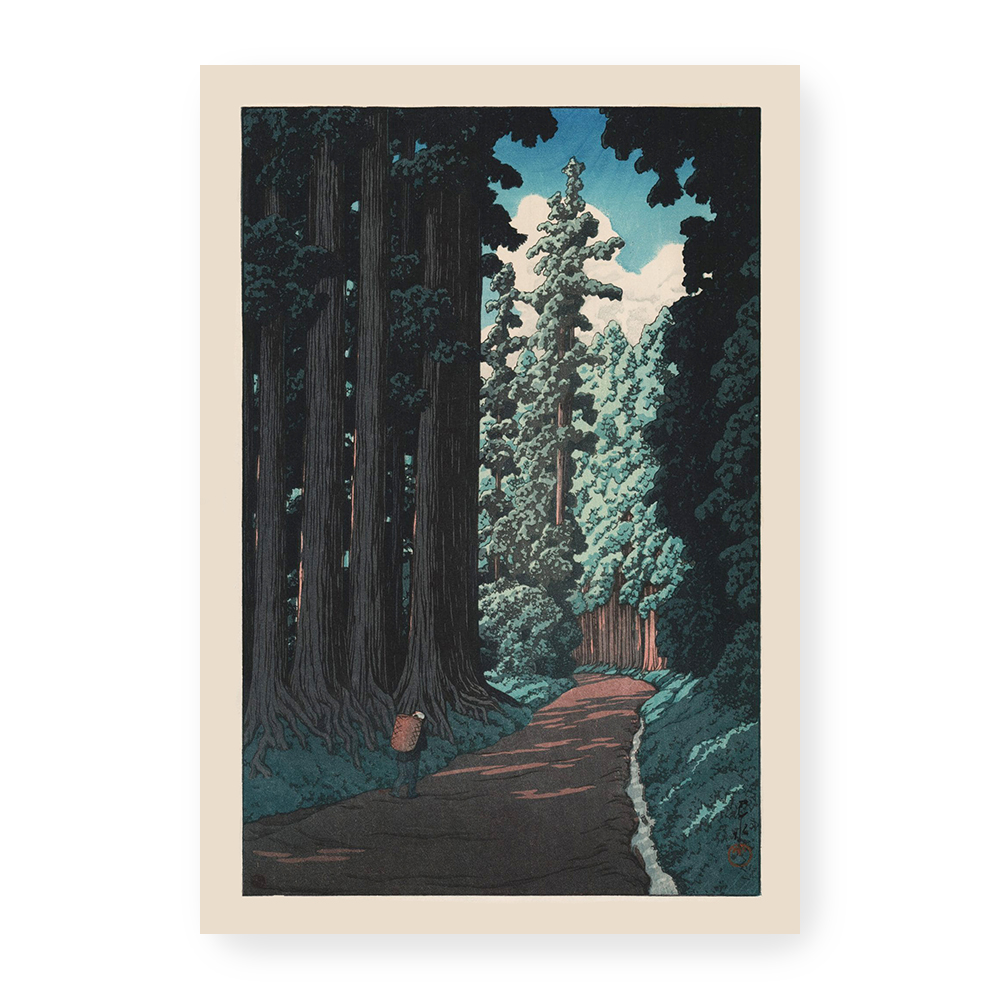
Kawase Hasui (1883–1957) was one of the most important modern Japanese shin-hanga artists and was known as the “Hiroshige of the Showa era.” Born in Tokyo’s Shiba district, he studied Western-style painting in his early years before turning to traditional Japanese painting under Kaburaki Kiyokata. In 1918, inspired by the work of fellow student Ito Shinsui, Hasui joined the shin-hanga movement and began collaborating with the noted publisher Watanabe Shozaburo, embarking on a creative career that spanned decades.
Hasui’s work consists primarily of landscape prints. He was adept at capturing subtle changes in light and shadow through the four seasons, transforming natural scenery and cityscapes across Japan into poetic images. His compositions often have a tranquil atmosphere, frequently depicting dusk, night, rain, or snow. Figures are scarce or entirely absent, allowing viewers to immerse themselves in the scenery and experience a sense of solitude and romance. This distinctive aesthetic made his work popular with audiences in Japan and abroad at the time, earning him the epithet “the travel poet.”
In his technique, Hasui Kawase combined the traditions of ukiyo-e with Western Impressionist treatments of light and shadow. He carried forward the fine carving and layered colors of woodblock printing while skillfully employing gradation to create a soft, watercolor-like effect. Achieving this required highly coordinated skills from the block carvers and printers. Compared with the flat colors of Edo-period ukiyo-e, Hasui’s works have a more painterly quality, demonstrating the innovative spirit of shin-hanga.
Kawase Hasui created approximately 620 woodblock prints during his lifetime, including major series such as Twelve Scenes of Tokyo, Selected Views of Japan, and Twenty Views of Tokyo. His works not only document the urban and rural landscapes of Japan’s Taisho and Showa periods but also garnered widespread international attention. In 1956, he was designated a “Living National Treasure” for his outstanding contributions to Japanese art. He died the following year at the age of 74.
Today, Kawase Hasui’s prints are held by major museums around the world, including the British Museum, the Museum of Fine Arts, Boston, and the Los Angeles County Museum of Art. His artistic achievements embody the fusion of Japanese tradition and modernity: they not only preserve romantic images of Japan’s landscapes but also reveal to the world the boundless appeal of woodblock prints in the modern era.
Discover Japanese woodblock prints:
Production process and division of responsibilities
1. Artist (eshi) Responsible for drawing the original design.
Provides the overall composition and the design of the figures and landscape.
For example: Katsushika Hokusai, Utagawa Hiroshige, and Kawase Hasui.
2. Publisher (hanmoto)
The heart of the entire team, akin to a “producer + distributor.”
Funded and planned the work, determined its theme, and collaborated with the artist.
Hire carvers and printers, and coordinate the schedule and quality.
Responsible for sales and promotion, and for deciding the size of the edition.
For example: Shozaburo Watanabe of the shin-hanga movement. 3. Block carver (horishi)
Transfer the artist’s original drawing onto a woodblock for carving.
Each color requires a dedicated woodblock.
The technical demands are extremely high: precision down to the millimeter is required, or the overprinted colors will be misaligned.
4. Printer (surishi)
Woodblocks and pigments are used to print the image layer by layer onto washi paper.
Responsible for color gradation, blending, and light-and-shadow effects.
The level of technical skill directly affects the work’s final appearance.