

THE LIGHTO EDIT
A little art
changes everything.
Thoughtful works by artists near and far, chosen for the spaces we call home.
EXPLORE THE COLLECTIONMeet the artists and find the piece that feels like yours.
LIGHTO TO MEET YOUFIND YOUR POINT OF VIEW
A place to begin.
Landscapes, abstract forms, and everyday beauty.
THE COLLECTION
Art to live with
Browse the works from LIGHTO's authorized artists.
No artworks match these filters. Try another color, subject, or orientation.
THE PEOPLE BEHIND THE ART
Meet the artists
From established names to new perspectives, discover the makers in the LIGHTO collection.
Sizes & prices
| Size | Artwork only | With framing | Framing + acrylic |
|---|---|---|---|
| 50×78.5 cm | — | USD 183 | USD 216 |
Product details
“As I grow older, I realize more and more how lonely I am.”
Artist: Alberto Giacometti
Swiss artist Alberto Giacometti was one of the most important artists of the twentieth century, renowned worldwide for his tall, slender, elegant human figures. Born into an artistic family in 1901, Giacometti had two younger brothers, Diego and Bruno, who were also involved in the arts.
Giacometti studied at the Geneva School of Fine Arts and moved to Paris in 1922, where he met the artists Max Ernst and Joan Miró. The influence of Surrealism can be seen in his early sculptures. He later turned to making a series of small heads, each no more than 3 inches high. After World War II, Giacometti completed his best-known sculptures: a series of slender, elongated figures, some standing and others walking, such as Three Men Walking II in the collection of the Metropolitan Museum of Art in New York. The series defies any simple stylistic classification; the gaunt, haggard figures embody a reflection on the desolation left by the two world wars.
In 2015, a major Giacometti solo exhibition opened to acclaim at the National Portrait Gallery in London. His work is also held by leading museums, including the Hirshhorn Museum and Sculpture Garden in Washington, D.C., and the J. Paul Getty Museum in Los Angeles.
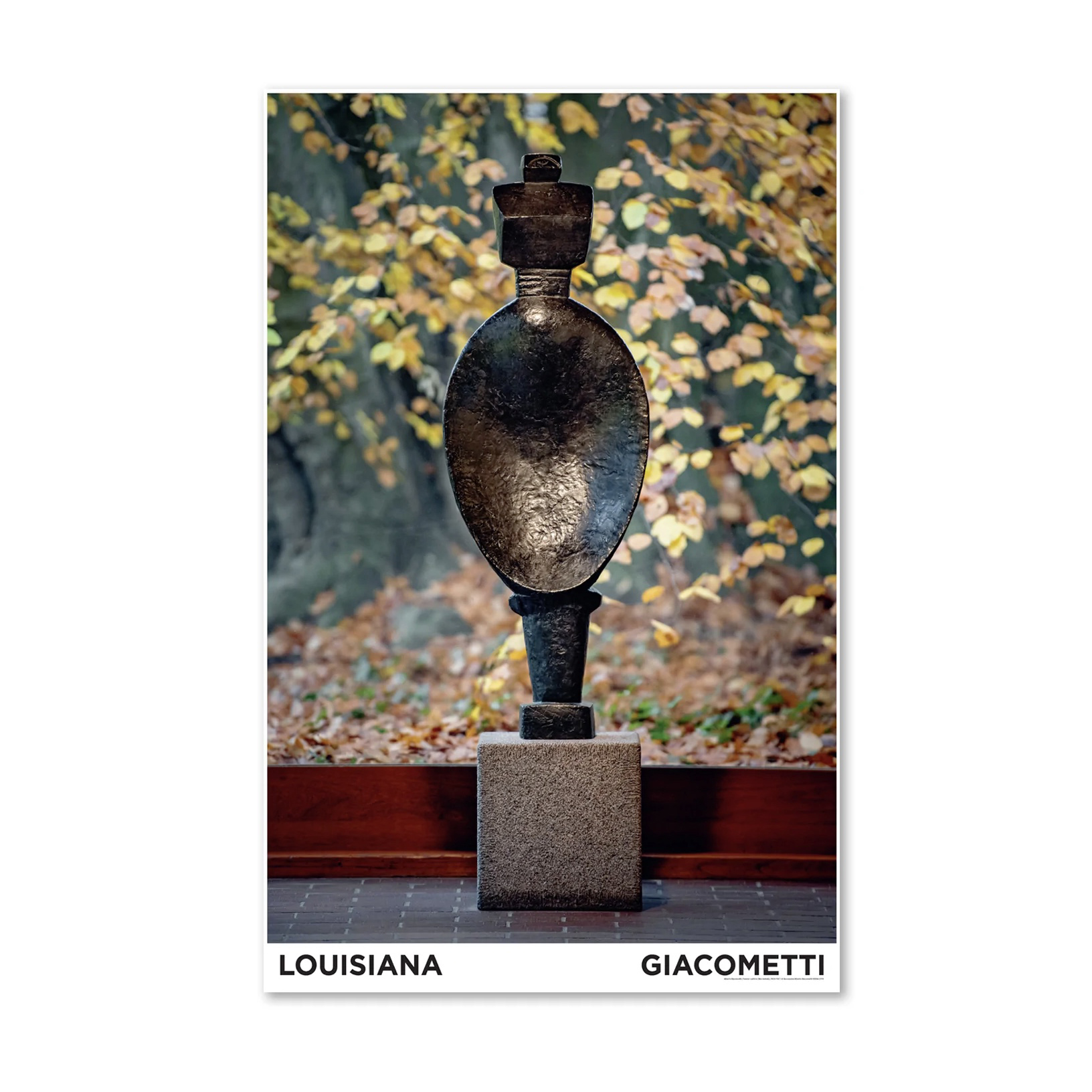
Femme Cullière (1927), a work by Swiss artist Alberto Giacometti (1901–1966). Giacometti is a central figure in the Louisiana story, and this woman stands at its heart, among the artist’s many other iconic works in the museum.
After making naturalistic portrait busts and paintings, Giacometti worked in a Cubist style early in his career, from which Woman emerged. You can see that Giacometti, like many artists in Paris at the time—for example, Picasso—was also influenced by African culture and visual traditions.
Artwork title:
Femme Cuillère (1927), Woman
Poster size: 50x78.5 cm
Original exhibition poster
Paper & medium
Original poster; size and framing options are listed above.
About the artist
Swiss artist Alberto Giacometti was one of the most important artists of the twentieth century, renowned worldwide for his tall, slender, elegant human figures. Born into an artistic family in 1901, Giacometti had two younger brothers, Diego and Bruno, who were also involved in the arts.
Giacometti studied at the Geneva School of Fine Arts and moved to Paris in 1922, where he met the artists Max Ernst and Joan Miró. The influence of Surrealism can be seen in his early sculptures. He later turned to making a series of small heads, each no more than 3 inches high. After World War II, Giacometti completed his best-known sculptures: a series of slender, elongated figures, some standing and others walking, such as Three Men Walking II in the collection of the Metropolitan Museum of Art in New York. The series defies any simple stylistic classification; the gaunt, haggard figures embody a reflection on the desolation left by the two world wars.
In 2015, a major Giacometti solo exhibition opened to acclaim at the National Portrait Gallery in London. His work is also held by leading museums, including the Hirshhorn Museum and Sculpture Garden in Washington, D.C., and the J. Paul Getty Museum in Los Angeles.
Femme Cullière (1927), a work by Swiss artist Alberto Giacometti (1901–1966). Giacometti is a central figure in the Louisiana story, and this woman stands at its heart, among the artist’s many other iconic works in the museum.
After making naturalistic portrait busts and paintings, Giacometti worked in a Cubist style early in his career, from which Woman emerged. You can see that Giacometti, like many artists in Paris at the time—for example, Picasso—was also influenced by African culture and visual traditions.