

THE LIGHTO EDIT
A little art
changes everything.
Thoughtful works by artists near and far, chosen for the spaces we call home.
EXPLORE THE COLLECTIONMeet the artists and find the piece that feels like yours.
LIGHTO TO MEET YOUFIND YOUR POINT OF VIEW
A place to begin.
Landscapes, abstract forms, and everyday beauty.
THE COLLECTION
Art to live with
Browse the works from LIGHTO's authorized artists.
No artworks match these filters. Try another color, subject, or orientation.
THE PEOPLE BEHIND THE ART
Meet the artists
From established names to new perspectives, discover the makers in the LIGHTO collection.
Sizes & prices
| Size | Artwork only | With framing | Framing + acrylic |
|---|---|---|---|
| 40×60 cm | — | USD 427 | USD 447 |
Product details
* The mounting and framing process is time-consuming and labor-intensive. Please allow 2–3 weeks for your order and thank you for your patience.
Poster size: 40*60 cm
Year of release: 2020
Original exhibition poster
Title:
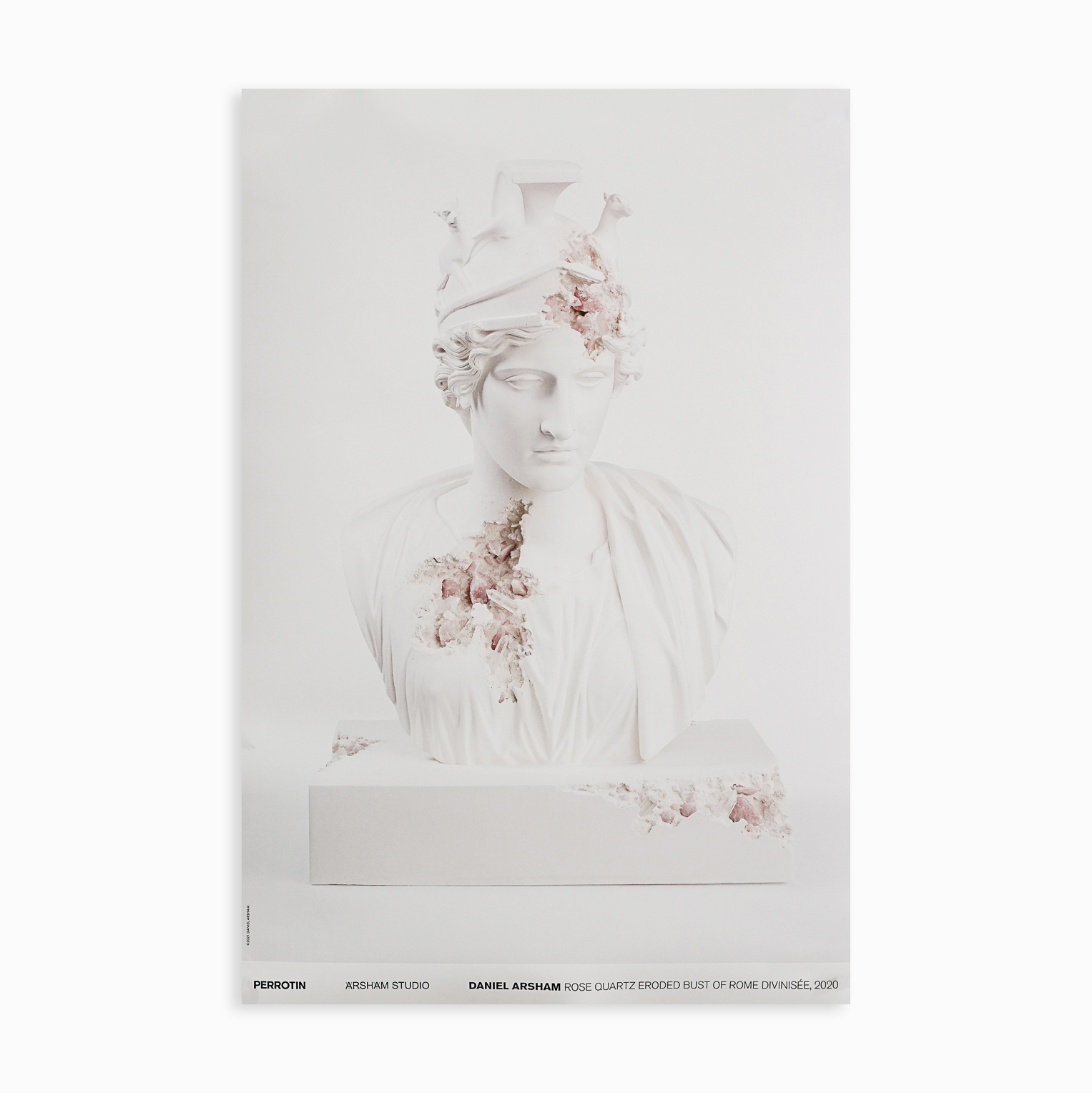
Daniel Arsham: Rose Quartz Eroded Bust of Rome Divinisée
This work is Rose Quartz Eroded Bust of Rome Divinisée by contemporary artist Daniel Arsham. He transforms an ancient Roman bust into a future relic eroded by rose quartz, bringing classical beauty, the erosion of time, and mineral rebirth together in a single work. It perfectly embodies his signature style of “fictional archaeology.”
The meaning of “Rose Quartz”
Rose quartz is a softly pink mineral. In Arsham's visual language, quartz, crystals and selenite often replace portions that appear damaged or missing.
So the image is not simply made to look old; it asks a very interesting question:
Has this classical statue been eroded by time? Or, after so long, is it growing new forms of life?
This sense of “decay and creation existing simultaneously” is the most captivating aspect of his work.
What does “Divinisée” mean?
Divinisée is French for 'deified' or 'made divine.' The title can therefore be understood as a classical Roman bust invested with sacred meaning. Rather than a flawless museum sculpture, it is an image reshaped by time, minerals and imagined futures.
How does this relate to the core of Daniel Arsham’s work?
Daniel Arsham's practice is often described as fictional archaeology.
He likes to make classical sculptures, contemporary objects, and architectural fragments look like archaeological finds from the future. In its coverage of his exhibition, Vogue also noted that he combines classical forms with minerals such as quartz, rose quartz, and selenite, so that his works resemble both ancient relics and fragments of a future civilization.
**Actual photograph of the poster**
About the artist / Daniel Arsham(,1980–
An American contemporary artist born in Cleveland who now works primarily in New York. Perrotin’s gallery information also states that he was born in Cleveland, Ohio, in 1980 and now lives in New York.
Artist introduction: Daniel Arsham
Daniel Arsham's best-known concept is fictional archaeology, also associated with his Future Relics. He makes contemporary objects, classical statues and architectural spaces appear eroded, crystallized and weathered by time, creating a dislocation: are these ancient ruins, or traces of modern civilization unearthed by people in the future?
He is particularly skilled at combining several elements:
A sense of classical civilization: Greco-Roman statues, temples, and archaeological fragments. A post-apocalyptic, futuristic feel: weathering, breakage, erosion, crystallization, and gray-white or icy-blue tones. A pop-culture sensibility: he has also collaborated across disciplines with Pokémon, Dior, Tiffany, Porsche, and others. A sense of displaced time: the works appear to come from the past, present, and future at once.
Ocula likewise identifies future history and fictional archaeology as central to his practice. He transforms contemporary objects and architecture into fossil-like forms, exploring time, erosion and cultural memory.
Paper & medium
Original poster; size and framing options are listed above.
About the artist
An American contemporary artist born in Cleveland who now works primarily in New York. Perrotin’s gallery information also states that he was born in Cleveland, Ohio, in 1980 and now lives in New York.
Daniel Arsham's best-known concept is fictional archaeology, also associated with his Future Relics. He makes contemporary objects, classical statues and architectural spaces appear eroded, crystallized and weathered by time, creating a dislocation: are these ancient ruins, or traces of modern civilization unearthed by people in the future?
A sense of classical civilization: Greco-Roman statues, temples, and archaeological fragments. A post-apocalyptic, futuristic feel: weathering, breakage, erosion, crystallization, and gray-white or icy-blue tones. A pop-culture sensibility: he has also collaborated across disciplines with Pokémon, Dior, Tiffany, Porsche, and others. A sense of displaced time: the works appear to come from the past, present, and future at once.
Ocula likewise identifies future history and fictional archaeology as central to his practice. He transforms contemporary objects and architecture into fossil-like forms, exploring time, erosion and cultural memory.