

THE LIGHTO EDIT
A little art
changes everything.
Thoughtful works by artists near and far, chosen for the spaces we call home.
EXPLORE THE COLLECTIONMeet the artists and find the piece that feels like yours.
LIGHTO TO MEET YOUFIND YOUR POINT OF VIEW
A place to begin.
Landscapes, abstract forms, and everyday beauty.
THE COLLECTION
Art to live with
Browse the works from LIGHTO's authorized artists.
No artworks match these filters. Try another color, subject, or orientation.
THE PEOPLE BEHIND THE ART
Meet the artists
From established names to new perspectives, discover the makers in the LIGHTO collection.
Sizes & prices
| Size | Artwork only | With framing | Framing + acrylic |
|---|---|---|---|
| 50×40 cm | USD 70 | USD 143 | USD 160 |
| 60×48 cm | USD 86 | USD 170 | USD 200 |
| 75×60 cm | USD 103 | USD 203 | USD 246 |
Product details
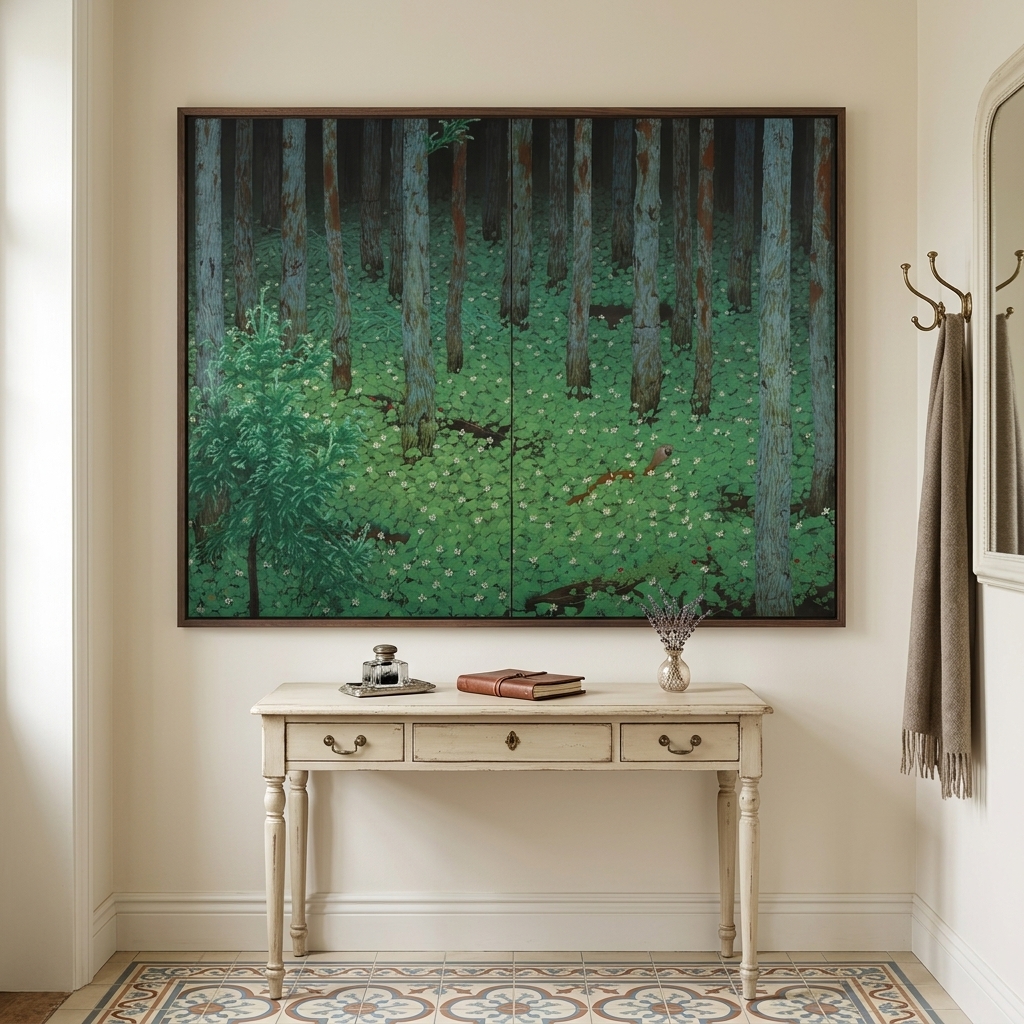
The Forest
The Forest, completed in 1928, is a two-panel screen measuring approximately 189.2 × 237.4 cm, painted in ink and mineral pigments on silk. It is now held by the Minneapolis Institute of Art in the United States. Towering tree trunks that seem almost to extend beyond the edges dominate the image; the woodland recedes diagonally into the scene, and a tiny weasel rests among wild strawberries and low-growing plants. The animal’s minute scale makes the forest seem especially vast and quiet.
Noteworthy aspects of this work include:
The tree trunks create a strong vertical rhythm, while the seam between the two screens blends naturally into the forest’s structure.
Mineral pigments are used to depict bark, moss, and ground-level plants in fine detail, with the decorative quality characteristic of Japanese painting.
The woodland recedes into the distance as its colors gradually fade, creating a spatial depth akin to Western linear and atmospheric perspective.
There is no dramatic event in the picture; the true subjects are the forest’s silence, the damp air, and the instant a small animal stops, alert.
Forest is therefore neither simply a realistic natural landscape nor merely a decorative screen. It transforms “observable nature” into a deep, spiritually charged space: viewers seem to stand at the forest’s edge and unexpectedly glimpse a world that was never meant for humans.
Paper & medium
Fine art print on etching paper.
About the artist
Bokuyō Katayama (1900–1937), born Kenzō Katayama in Onomichi, Hiroshima Prefecture, Japan, was a prominent Japanese painter in the early Shōwa period. He studied Nanga painting, calligraphy, and Japanese painting in his early years before moving to Tokyo for further study. He worked with traditional materials such as ink, silk, gofun, and mineral pigments, while incorporating a Western sense of space and realistic observation.
Bokuyō Katayama pursued “yūgen” as an artistic ideal and excelled at depicting forests, animals, fishing villages, and tranquil night scenes. The natural world he painted was not merely scenery, but a deep, quiet spiritual space imbued with life. In 1927, his work “Oboro” received a Special Selection at the eighth Teiten exhibition; the following year, he exhibited his representative work “Forest” and gained “exemption from jury review” status. Other important works include “A Fishing Village in the Languor of Spring,” “Breaking the Silence,” “Heat Haze,” “A Cat Reclining on a Spring Night,” and “Wild Foxes.”
Although Bokuyo Katayama died young of illness and had a very brief creative career, his keen observation of nature, tranquil colors, and distinctive sense of subtle, mysterious depth secured him a vivid and irreplaceable place in modern Japanese painting.