

THE LIGHTO EDIT
A little art
changes everything.
Thoughtful works by artists near and far, chosen for the spaces we call home.
EXPLORE THE COLLECTIONMeet the artists and find the piece that feels like yours.
LIGHTO TO MEET YOUFIND YOUR POINT OF VIEW
A place to begin.
Landscapes, abstract forms, and everyday beauty.
THE COLLECTION
Art to live with
Browse the works from LIGHTO's authorized artists.
No artworks match these filters. Try another color, subject, or orientation.
THE PEOPLE BEHIND THE ART
Meet the artists
From established names to new perspectives, discover the makers in the LIGHTO collection.
Sizes & prices
| Size | Artwork only | With framing | Framing + acrylic |
|---|---|---|---|
| 50×70 cm | — | USD 176 | USD 203 |
Product details
Artist:
Atsuko Tanaka
Atsuko Tanaka (1932–2005), born in Osaka, was a leading figure in Japan's postwar avant-garde. According to Moderna Museet's chronology, she entered the Osaka Municipal Museum of Art's art research institute in 1950 and later also studied art in Kyoto. In 1955, she joined the recently founded Gutai Art Association.
Gutai was one of Japan's most important postwar avant-garde groups. Rather than extending traditional painting's rules, its artists sought to begin from zero, redefining art through the body, sound, light, fabric, everyday objects, industrial materials and actions. Moderna Museet's account of Tanaka's exhibition likewise explains that, against the background of postwar Japan and the shadow of nuclear warfare, Gutai artists wanted to escape academic art and create art for a new era through everyday materials and radical experimentation.
Atsuko Tanaka’s best-known work is Electric Dress, created in 1956. Made from numerous colored light bulbs and electrical wires, the work was worn by the artist, as though turning her body into a glowing city, a circuit board, or a futuristic machine. Whitestone Gallery also notes that Tanaka joined Gutai in 1955 and that Electric Dress is one of her best-known works.
What makes her remarkable is that she freed “painting” from the canvas very early on. Rather than simply painting a picture, she made sound, electricity, light, the body, and time part of the work. Her practice thus connects painting, installation, performance, and technological art. It remains strikingly avant-garde today, almost as though she anticipated electronic art, wearable devices, and interactive art back in the 1950s.
Artwork title: untitled
Poster size: 50*70cm
Original poster from an art museum
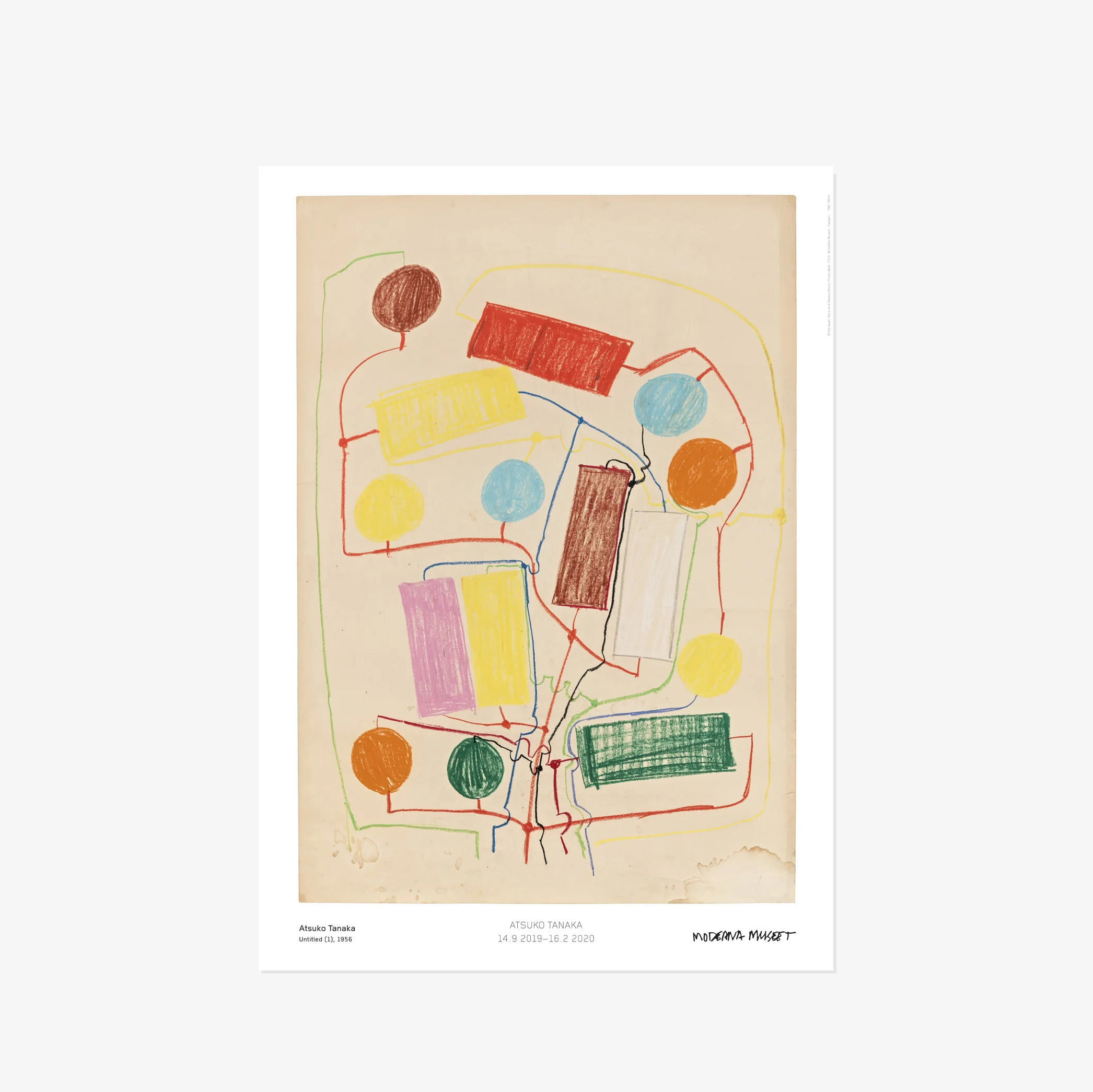
This poster features Atsuko Tanaka's 1956 work Untitled (1). The Moderna Museet exhibition page lists works from the same group made in 1956, including Untitled (1), Untitled (3), Untitled (6), and Untitled (9), and identifies the Nakanoshima Museum of Art, Osaka, as the provider of the works.
Untitled (1) can be seen as an important clue to Tanaka’s move from installation and performance toward the language of painting. Her signature circles, lines, connections, and sense of circuitry often appear in the image, readily calling to mind light bulbs, electrical wires, neural networks, or urban transport systems. These forms are closely related to Electric Dress, which she created in the same year: the bulbs and wires are actual materials in the installation, while in her two-dimensional work they become dots, lines, and colorful structures.
This work is not an abstract painting in the traditional sense; it is more like a “diagram of energy.” It looks somewhat playful, but it is not merely cute; it resembles a hand-drawn circuit diagram, yet also has a physical, improvisational quality. You might understand it this way: Atsuko Tanaka transforms the electricity, speed, technology, and bodily sensations of modern society into a visual language that is light yet powerful.
Its appeal lies in how a composition so simple can be full of movement. The circles resemble lightbulbs as well as cells; the lines evoke electrical wires as well as relationships between people. That is why Tanaka’s work is often discussed in contexts as varied as “postwar avant-garde,” “women artists,” “technology and art,” and “performance art.”
Space and collecting considerations
This poster is especially well suited to modern, minimalist, Scandinavian, or design-conscious spaces. It is not as visually heavy as a typical abstract painting; it is lighter and more clever, while also carrying a sense of the history of Japan's postwar avant-garde. Its 50 × 70 cm size also works well on a wall at home: it makes an eye-catching statement on its own and looks beautiful alongside other modern art posters in a gallery wall.
Paper & medium
Original poster; size and framing options are listed above.
About the artist
Atsuko Tanaka (1932–2005), born in Osaka, was a leading figure in Japan's postwar avant-garde. According to Moderna Museet's chronology, she entered the Osaka Municipal Museum of Art's art research institute in 1950 and later also studied art in Kyoto. In 1955, she joined the recently founded Gutai Art Association.
Gutai was one of Japan's most important postwar avant-garde groups. Rather than extending traditional painting's rules, its artists sought to begin from zero, redefining art through the body, sound, light, fabric, everyday objects, industrial materials and actions. Moderna Museet's account of Tanaka's exhibition likewise explains that, against the background of postwar Japan and the shadow of nuclear warfare, Gutai artists wanted to escape academic art and create art for a new era through everyday materials and radical experimentation.
Atsuko Tanaka’s best-known work is Electric Dress, created in 1956. Made from numerous colored light bulbs and electrical wires, the work was worn by the artist, as though turning her body into a glowing city, a circuit board, or a futuristic machine. Whitestone Gallery also notes that Tanaka joined Gutai in 1955 and that Electric Dress is one of her best-known works.
What makes her remarkable is that she freed “painting” from the canvas very early on. Rather than simply painting a picture, she made sound, electricity, light, the body, and time part of the work. Her practice thus connects painting, installation, performance, and technological art. It remains strikingly avant-garde today, almost as though she anticipated electronic art, wearable devices, and interactive art back in the 1950s.