

THE LIGHTO EDIT
A little art
changes everything.
Thoughtful works by artists near and far, chosen for the spaces we call home.
EXPLORE THE COLLECTIONMeet the artists and find the piece that feels like yours.
LIGHTO TO MEET YOUFIND YOUR POINT OF VIEW
A place to begin.
Landscapes, abstract forms, and everyday beauty.
THE COLLECTION
Art to live with
Browse the works from LIGHTO's authorized artists.
No artworks match these filters. Try another color, subject, or orientation.
THE PEOPLE BEHIND THE ART
Meet the artists
From established names to new perspectives, discover the makers in the LIGHTO collection.
Sizes & prices
| Size | Artwork only | With framing | Framing + acrylic |
|---|---|---|---|
| 59.4×84.1 cm | — | USD 223 | USD 263 |
Product details
Artist:
Asger Jorn (1914–1973) was one of Denmark's most important twentieth-century artists and a central figure in postwar European avant-garde art. Beyond painting, he worked in ceramics, prints, sculpture, artist's books and theoretical writing, resisting any single category. Louisiana Museum likewise describes him as a central figure in twentieth-century Danish art and emphasizes the special place his work holds in its collection.
Jorn's most important place in art history is as a co-founder of the avant-garde CoBrA movement. Its name combines Copenhagen, Brussels and Amsterdam. CoBrA sought a postwar European expression grounded in freedom, intuition, childlike vision, primal energy and spontaneity, explaining the wild, humorous, grotesque and intensely vital qualities of Jorn's work. The Art Story likewise identifies him as a co-founder of CoBrA in 1948.
In addition to CoBrA, Jorn was involved in Situationist International and worked closely with Guy Debord and others. Museum Jorn’s introduction specifically notes that he was a key driving force behind artistic and intellectual groups including Helhesten, CoBrA, MIBI, and Situationist International. This makes him more than an artist who “painted wildly”: he was someone who thought about art, politics, society, and ways of living together.
His art often moves between abstraction and figuration: an image may resemble a monster, mythical creature, or face, or it may simply be a clash of colors and lines. Britannica describes his style as influenced by Expressionists and modern artists such as James Ensor and Paul Klee, often using intense colors and distorted forms to create an emotional impact.
Simply put, Asger Jorn is the kind of artist who was “against refinement and authority, yet deeply versed in art.” He deliberately challenged the decorum of high art, bringing humor, roughness, absurdity, childlike playfulness, and a rebellious spirit into painting. Louisiana’s product page also notes that he criticized the elevation of art to an exalted status and challenged refined culture through the ordinary, satire, humor, and anti-aesthetics.
Artwork title: “Etudes et surprises” (1971)
Poster size: W: 59.4 x H: 84.1 cm (A1)
Original poster from an art museum
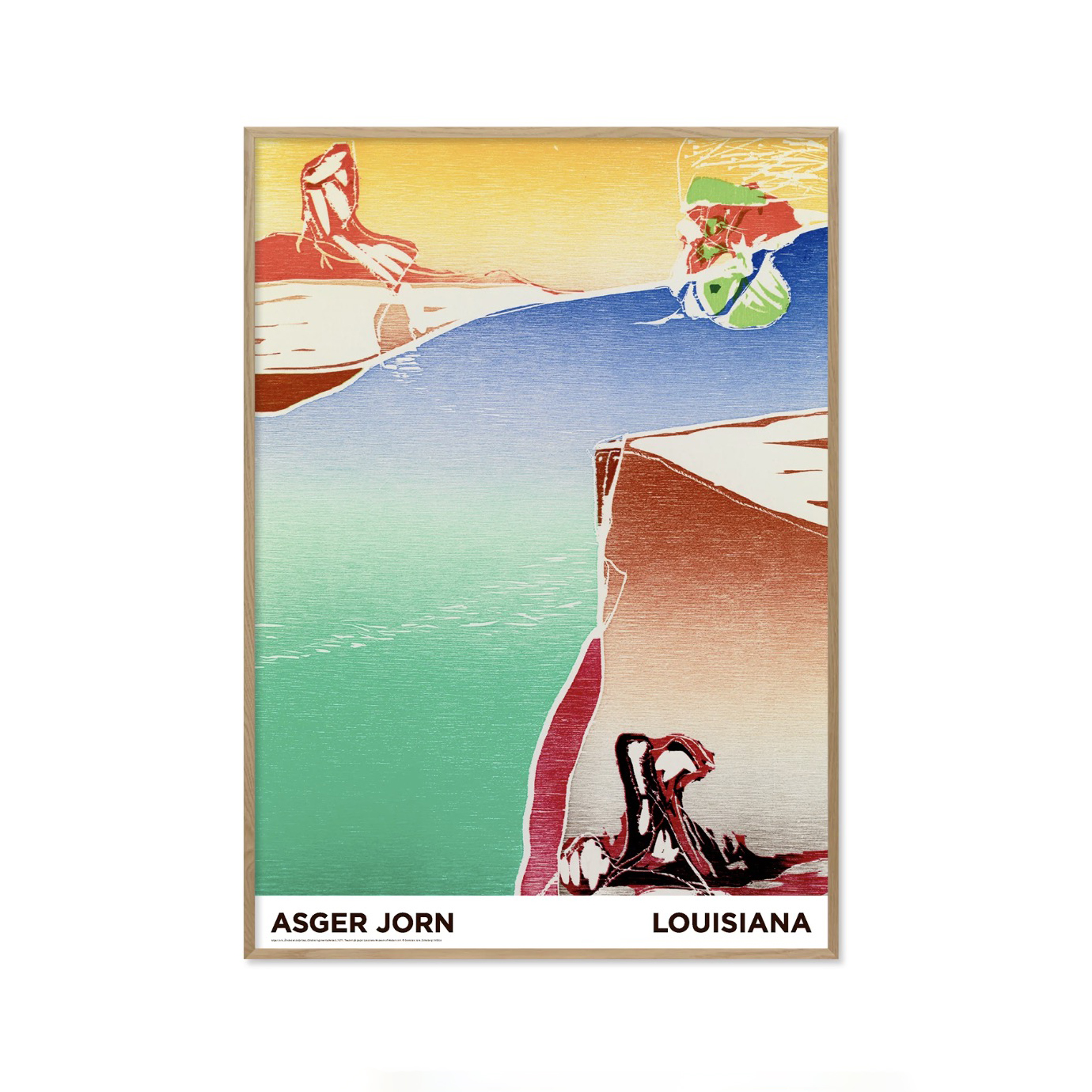
This Louisiana poster features Asger Jorn's 1971 series Etudes et surprises. The French title can be understood as “Studies and Surprises” or “Exercises and Surprises.” Louisiana's product page says the series reveals a less frequently seen, “more delicate and more sensitive” side of Jorn.
This is important because the Jorn most people know is associated with rough, uninhibited images full of strange vitality. Etudes et surprises, by contrast, is relatively gentle: its lines and fields of color seem to arise naturally on the paper. Rather than seeking only explosive expression, as typical Abstract Expressionism might, it has the quality of improvised notes, dream sketches, physical sensation, and poetry.
The forms in the picture appear abstract, yet they still suggest some kind of organic life: faces, bodies, plants, or imaginary creatures not yet fully formed. This echoes Louisiana’s description of Jorn: his images are about life, death, love, and happiness, and his works are often inhabited by imaginary beings that, like people, are born, die, love, cry, and laugh.
From the perspectives of collecting and interior display, this work’s appeal lies in how it retains Jorn’s avant-garde spirit while being easier to incorporate into a home than many of his more intense, rugged works. It has the intellectual depth of abstract art, along with gentle lines and a rhythm of color, making it suitable for modern, Scandinavian, and more art-focused spaces.
Paper & medium
Original poster; size and framing options are listed above.
About the artist
Asger Jorn (1914–1973) was one of Denmark's most important twentieth-century artists and a central figure in postwar European avant-garde art. Beyond painting, he worked in ceramics, prints, sculpture, artist's books and theoretical writing, resisting any single category. Louisiana Museum likewise describes him as a central figure in twentieth-century Danish art and emphasizes the special place his work holds in its collection.
Jorn's most important place in art history is as a co-founder of the avant-garde CoBrA movement. Its name combines Copenhagen, Brussels and Amsterdam. CoBrA sought a postwar European expression grounded in freedom, intuition, childlike vision, primal energy and spontaneity, explaining the wild, humorous, grotesque and intensely vital qualities of Jorn's work. The Art Story likewise identifies him as a co-founder of CoBrA in 1948.
In addition to CoBrA, Jorn was involved in Situationist International and worked closely with Guy Debord and others. Museum Jorn’s introduction specifically notes that he was a key driving force behind artistic and intellectual groups including Helhesten, CoBrA, MIBI, and Situationist International. This makes him more than an artist who “painted wildly”: he was someone who thought about art, politics, society, and ways of living together.
His art often moves between abstraction and figuration: an image may resemble a monster, mythical creature, or face, or it may simply be a clash of colors and lines. Britannica describes his style as influenced by Expressionists and modern artists such as James Ensor and Paul Klee, often using intense colors and distorted forms to create an emotional impact.
Simply put, Asger Jorn is the kind of artist who was “against refinement and authority, yet deeply versed in art.” He deliberately challenged the decorum of high art, bringing humor, roughness, absurdity, childlike playfulness, and a rebellious spirit into painting. Louisiana’s product page also notes that he criticized the elevation of art to an exalted status and challenged refined culture through the ordinary, satire, humor, and anti-aesthetics.