

THE LIGHTO EDIT
A little art
changes everything.
Thoughtful works by artists near and far, chosen for the spaces we call home.
EXPLORE THE COLLECTIONMeet the artists and find the piece that feels like yours.
LIGHTO TO MEET YOUFIND YOUR POINT OF VIEW
A place to begin.
Landscapes, abstract forms, and everyday beauty.
THE COLLECTION
Art to live with
Browse the works from LIGHTO's authorized artists.
No artworks match these filters. Try another color, subject, or orientation.
THE PEOPLE BEHIND THE ART
Meet the artists
From established names to new perspectives, discover the makers in the LIGHTO collection.
Sizes & prices
| Size | Artwork only | With framing | Framing + acrylic |
|---|---|---|---|
| 60×80 cm | — | USD 230 | USD 260 |
Product details
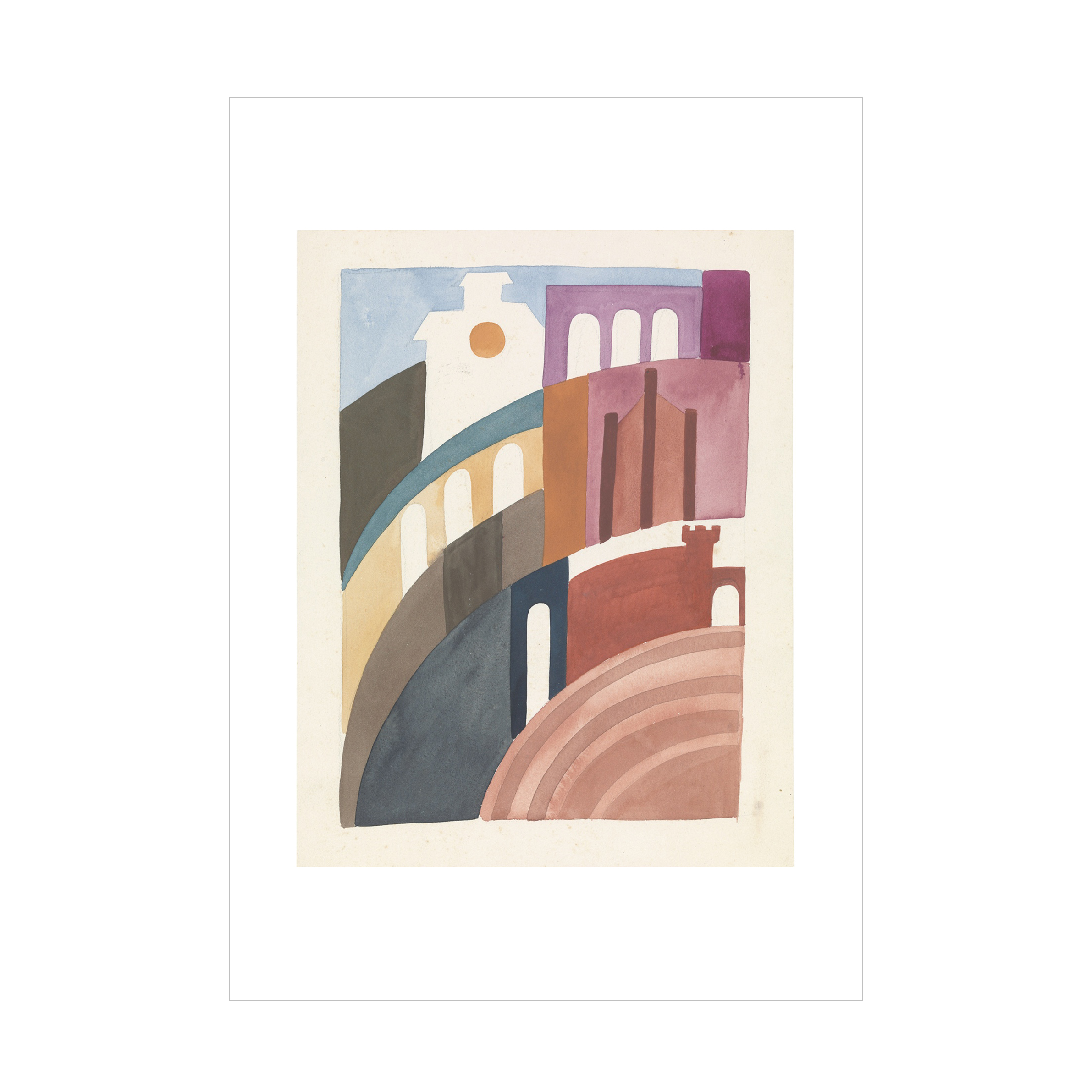
Artwork title: Siena, Architecture
Poster size: 60*80 cm
Original poster from an art museum
Artist: Sophie Taeuber-Arp
Swiss artist Sophie Taeuber-Arp was a central figure in many of the most important avant-garde movements of the last century. Her work has inspired artists and designers around the world.
Born in Switzerland, Taeuber-Arp left home at 18 to continue studying textile design in Germany. After returning to Zurich in 1914, she taught in the applied arts department of a trade school and began making nonrepresentational works on paper, often used as designs for her textiles, embroidery, and even clothing. Influenced by her training in textile design, these works marked the beginning of an extraordinarily varied career.
Throughout her life, Taeuber-Arp worked as a designer, teacher, puppet maker, architect, painter, interior designer, sculptor, performer, jewelry maker, illustrator, and magazine editor. Through her precise yet playful work, she fulfilled her wish to “make the things we own more beautiful.”
She has a distinctive style.
Taeuber-Arp worked first in Switzerland and then in France, developing her distinctive visual style during World War I. While other artists arrived at abstraction through a gradual process of breaking down and simplifying figurative forms, she drew directly on the grid structure of textiles. This approach distinguished her from other modernist artists working at the time.
First, she developed a group of vertical-horizontal compositions. Created between 1916 and 1925, they all feature grid structures and carefully considered color schemes. This modular concept, inspired by textile structures, reveals the artist’s creative process. The approach paved the way for further inventions, as she later experimented with textiles, jewelry, architecture, furniture, stained glass, and painting.
In the 1930s, Taeuber-Arp began creating a series of works known as “multi-space compositions” and “schematic compositions,” made up of aligned circles, squares, rectangles, and crosses against white or black backgrounds. These elements retain a sense of movement and have been likened to movable pieces in a game. Art critic and writer Gabrielle Buffet-Picabia recalled that Taeuber-Arp compared her works to the popular game of boules.
She was one of the key figures of the Dada movement.
Switzerland remained neutral during the First World War. Artists, writers, and thinkers from across Europe seeking to escape the conflict settled in Zurich. The city became a center of avant-garde art. Among them was fellow artist Hans (Jean) Arp, who would become Sophie Taeuber’s lifelong partner. They married in 1922.
One of the most radical movements to emerge from the war was Dada. This group of artists, poets, and performers challenged the rationalism and social conventions they believed had led to the war. Taeuber-Arp was an important member of the group and one of its few women artists. She embraced Dada’s absurd, playful, and radical practices. A photograph from the time shows her performing at the opening of the Dada Gallery in 1917, dancing in avant-garde costume and a mask with Dada founder Hugo Ball. From collages and watercolors to stage sets and abstract head sculptures, Taeuber-Arp’s works from this period are considered emblematic of Dada.
In the late 1920s and early 1930s, Taeuber-Arp shifted her focus to architecture and interior design. In 1926, she and Arp were invited to redesign a wing of the Aubette building in Strasbourg as a modernist entertainment complex. Given the scale of the project, they invited Dutch artist Theo van Doesburg to join them. Taeuber-Arp was solely responsible for the design concepts of the Five O’Clock Tea Room, the Aubette Bar, and the Foyer Bar, while collaborating with Arp and van Doesburg on other elements. The dynamic abstract environments she created immersed visitors in geometric forms and vivid colors. Taeuber-Arp’s exploration of applied art and design expanded from objects to living environments.
The café commission brought her international acclaim. She joined several artists’ organizations, including the abstract artists’ group Cercle et Carré, edited and wrote for radical publications, and exhibited her work across Europe alongside artists Sonia Delaunay, Wassily Kandinsky, Le Corbusier, and Piet Mondrian.
In 1943, Taeuber-Arp died tragically from accidental carbon monoxide poisoning. She was 53 and one of the most successful and innovative artists of her time. After her death, her husband Hans Arp worked to promote her legacy, in part by recreating works posthumously. Her influence on design and art continues to this day.
Paper & medium
Original poster; size and framing options are listed above.
About the artist
Sophie Taeuber-Arp's 1927 statement beautifully summarizes her philosophy of art and creativity. She believed the desire to enrich and beautify things came not from materialism but from an instinct for perfection and the act of creation itself. Throughout her career, her diverse artistic pursuits embodied this philosophy, displaying a distinctive attention to detail that became her hallmark.
Taeuber-Arp’s versatility as an artist is astonishing. From designing textiles, beadwork, clothing, furniture, and interiors to teaching applied arts, making puppets, and even working in architecture, she explored many different media and fields with equal passion and skill. She broke down the boundaries between fine art, craft, and design, challenging traditional notions of artistic hierarchy.
Her involvement in the Zurich Dada movement was an important period in her career. The movement was initiated by her future husband, Jean (Hans) Arp, and others. A key figure in the movement, she made puppets for avant-garde theater and created the abstract head sculptures considered emblematic of the Dada period.
In the late 1920s and early 1930s, Taeuber-Arp took part in several architectural and interior design projects, most notably a large-scale collaboration with Arp and Dutch artist Theo van Doesburg on the decoration of the Aubette entertainment complex in Strasbourg, France. In 1929, Taeuber-Arp left Zurich for Paris and began to focus on abstract painting and carved wooden reliefs, works that reveal the tension between precision and playfulness characteristic of her artistic career.
In the 1930s, Taeuber-Arp was associated with abstract art groups such as Cercle et Carré and Abstraction-Création, further cementing her reputation as a pioneer of abstract art. She also contributed to the international journal Plastique/Plastic, demonstrating her commitment to promoting abstract art.
Despite facing exile during the Nazi occupation of France, Taeuber-Arp continued to create innovative artworks, contributed to print portfolios, and produced a series of lively line drawings. She tragically died of carbon monoxide poisoning in 1943, a loss to the art world, but her husband, Jean (Hans) Arp, worked tirelessly to ensure that her contributions to modern art would not be forgotten.