

THE LIGHTO EDIT
A little art
changes everything.
Thoughtful works by artists near and far, chosen for the spaces we call home.
EXPLORE THE COLLECTIONMeet the artists and find the piece that feels like yours.
LIGHTO TO MEET YOUFIND YOUR POINT OF VIEW
A place to begin.
Landscapes, abstract forms, and everyday beauty.
THE COLLECTION
Art to live with
Browse the works from LIGHTO's authorized artists.
No artworks match these filters. Try another color, subject, or orientation.
THE PEOPLE BEHIND THE ART
Meet the artists
From established names to new perspectives, discover the makers in the LIGHTO collection.
Sizes & prices
| Size | Artwork only | With framing | Framing + acrylic |
|---|---|---|---|
| 44×99 cm | — | USD 536 | USD 570 |
Product details
* The mounting and framing process is time-consuming and labor-intensive. Please allow 2–3 weeks for your order and thank you for your patience.
Artist: Andreas Gursky
Andreas Gursky was born in Leipzig, Germany. He specializes in using a large-format view camera to photograph expansive scenes, then combining multiple negatives with computer technology to create large-scale images of constructed landscapes rich in color and detail. His 1999 photograph Rhine II sold for more than US$4.3 million in 2011, becoming the world’s most expensive photograph to date.
Born in Leipzig, Germany, in 1955, he grew up in a family of photographers. In 1981, he entered the Kunstakademie Düsseldorf to study photography under the conceptual artists Hilla and Bernd Becher. His innovative approach opened a new path in photography and established him as a leading contemporary photographer. Since the 1990s, he has used digital post-production to break images of everyday life into fragments and reassemble them into monumental, bird's-eye views of space. Their grandeur unsettles viewers, making familiar impressions seem strange and revealing patterns of mutual destruction and renewal between humanity and nature. These images invite reflection on globalization, standardization and capitalism within the wider social environment.
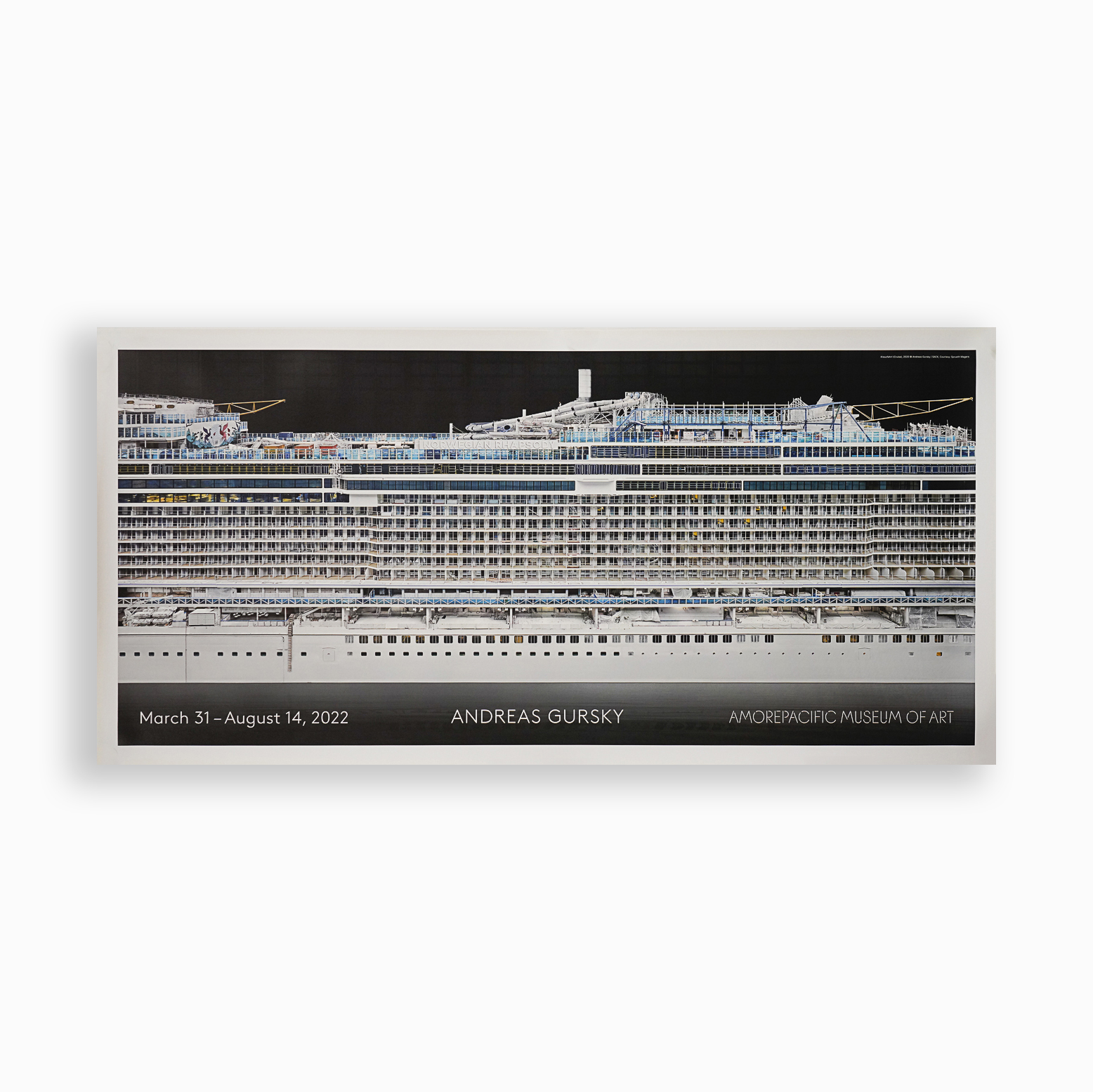
Artwork title: CRUISE
Poster size: 44*99 cm
Original poster from an American museum.
This work is Andreas Gursky's Kreuzfahrt (Cruise), 2020.
It photographs a giant cruise ship still under construction. At first glance it looks like a ship, but the longer you look, the more it resembles a flattened city: rows of windows, rooms, decks, and steel frames, all organized into a coolly ordered, enormous “grid of modern civilization.” Gursky excels at using immense scale and frontal compositions to photograph the order, consumption, capital, and collective life of human society as though they were one vast system. Cruise is a quintessential example.
Interestingly, this is not a romantic vacation photograph of a cruise ship; instead, it turns the ship into an “artificial world.” A cruise ship ordinarily symbolizes vacation, pleasure, and consumption, but here it looks more like an industrial monster, so immense that it seems a little unreal. Viewers may feel a sense of grandeur, order, and oppression all at once, even a touch of absurdity.
This image also recalls Gursky's early masterpiece Paris, Montparnasse: both feature a frontal view and densely packed windows, with architecture abstracted into a grid. But Cruise replaces the apartment building with a cruise ship, turning a “city of residence” into a “mobile city of consumption.”
According to the gallery’s artwork information, it is an inkjet print, Diasec, with framed dimensions of approximately 228 × 468 × 6.7 cm—an exceptionally large horizontal work;
What you see in your photo is the poster version for the 2022 Andreas Gursky exhibition at the Amorepacific Museum of Art in Seoul.
Paper & medium
Original poster; size and framing options are listed above.
About the artist
Andreas Gursky was born in Leipzig, Germany. He specializes in using a large-format view camera to photograph expansive scenes, then combining multiple negatives with computer technology to create large-scale images of constructed landscapes rich in color and detail. His 1999 photograph Rhine II sold for more than US$4.3 million in 2011, becoming the world’s most expensive photograph to date.
Born in Leipzig, Germany, in 1955, he grew up in a family of photographers. In 1981, he entered the Kunstakademie Düsseldorf to study photography under the conceptual artists Hilla and Bernd Becher. His innovative approach opened a new path in photography and established him as a leading contemporary photographer. Since the 1990s, he has used digital post-production to break images of everyday life into fragments and reassemble them into monumental, bird's-eye views of space. Their grandeur unsettles viewers, making familiar impressions seem strange and revealing patterns of mutual destruction and renewal between humanity and nature. These images invite reflection on globalization, standardization and capitalism within the wider social environment.